
Introduction
You find the right corrugated box size, configure your order — then discover the supplier requires 2,000 units when you only need 400. That's MOQ in action, and it catches B2B buyers off guard more often than it should.
Minimum Order Quantity affects nearly every purchasing decision in B2B supply chains, from corrugated packaging to raw materials. Understanding it reshapes how you negotiate with suppliers, manage inventory levels, and protect working capital.
This guide covers what MOQ means, why suppliers set it, how to calculate it, and most usefully, how to negotiate or work around requirements that don't align with your operational needs.
Key Takeaways
- MOQ is the smallest quantity a supplier will accept per transaction — set by the seller, not the buyer
- High MOQs increase carrying costs; low MOQs drive up ordering frequency and admin overhead
- The break-even formula (Fixed Costs ÷ Contribution Margin per Unit) is the most practical starting point for evaluating any MOQ
- Both sides benefit from well-structured MOQs: suppliers protect margins, buyers often gain better per-unit pricing
- MOQs are frequently negotiable — volume commitments, consolidated orders, and staggered deliveries create leverage
What Is Minimum Order Quantity (MOQ)?
MOQ is the fewest units — or minimum dollar value — a supplier will sell in a single transaction. Critically, it's set by the seller, not the buyer. Depending on the product and industry, MOQ can be expressed in units, cases, pallets, or total order value.
Two distinctions trip up buyers regularly:
- MOQ ≠ Minimum Purchase Value. A dollar-based floor (e.g., "minimum order of $500") is technically a "minimum order value," not an MOQ. SAP's documentation treats these as separate commercial controls — one governs quantity, the other governs currency thresholds.
- MOQ ≠ EOQ. Economic Order Quantity is a buyer-side calculation for the ideal order size that minimizes holding and ordering costs. MOQ is a supplier mandate. They solve different problems and should never be treated as interchangeable.
Simple vs. Complex MOQs
Simple MOQs have one constraint — for example, a minimum of 200 corrugated boxes per order. Straightforward.
Complex MOQs stack multiple conditions simultaneously:
- Minimum per SKU
- Minimum per product configuration (box style, flute type, print setup)
- Minimum total order value
For corrugated packaging buyers, this distinction matters. Standard box sizes carry lower MOQs because no custom tooling is required. Specialty configurations — government-spec corrugated, custom-printed cartons, non-standard dimensions — carry higher minimums because setup costs must be recovered across the run.
For buyers looking to avoid those higher thresholds, inventory depth is the practical solution. Cardboard Boxes 4 U stocks over 1,300 corrugated box sizes in standard configurations, with MOQs starting at 100 pieces — meaning most buyers can find a ready-to-ship size that fits their needs without the higher minimums and 7–14 day lead times that come with custom runs.
Why Do Suppliers Set Minimum Order Quantities?
Every production run carries fixed costs: machine setup, labor scheduling, raw material batches, administrative processing. These costs exist whether the order is for 10 units or 10,000. When orders are too small, those fixed costs consume the profit margin entirely.
A 2022 study at a corrugated box plant found that average machine setup time ran 55 minutes per run. That time cost applies whether the run produces 50 boxes or 5,000. Spread across 5,000 units, setup is negligible in per-unit cost. Spread across 50 units, it's devastating to margin.
The math is direct: a production run with $2,000 in fixed costs and a $4 contribution margin per unit requires at least 500 units sold just to break even. Sell in lots of 10, and that same run loses money on every order.
MOQs exist to prevent exactly that outcome. The four business outcomes they protect:
- Profit margin — fixed costs are distributed across enough units to remain profitable
- Economies of scale — longer production runs lower per-unit variable costs
- Production scheduling — predictable order volumes enable efficient planning
- Cash flow stability — filtering out unprofitable micro-orders creates more consistent revenue
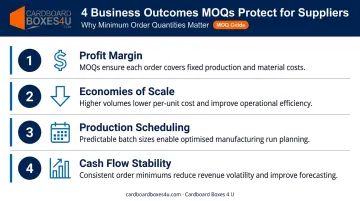
MOQ sets a financial floor — the minimum order size at which a production run actually covers its costs and stays viable for the supplier.
How Does MOQ Impact Your Inventory?
MOQ directly shapes how much inventory a buyer must hold at any given time. Order too much and you tie up working capital; order too little and you risk stockouts or ineligibility with your supplier.
The Impact of High MOQs
When supplier MOQs are high relative to your demand, expect:
- More stock on hand than near-term demand requires, raising average inventory levels
- Higher carrying costs — ISM benchmarks most companies at 20–30% of inventory value annually
- More working capital locked in physical stock
- Lower stockout risk, since large volumes provide a long supply runway
- Fewer purchase orders per year, reducing administrative overhead
The hidden risk specific to packaging: obsolescence. If your business rebrands, changes product dimensions, or shifts volume to a new SKU, corrugated inventory ordered under a high MOQ may become unusable — representing a direct capital loss with no recovery path.
The Impact of Low MOQs
Low MOQs keep inventory lean but shift costs elsewhere:
- Smaller stock on hand, less capital at risk
- Greater flexibility to adapt to demand changes or SKU shifts
- Higher ordering frequency and more administrative overhead
- Greater stockout exposure when demand spikes or lead times extend
| Dimension | High MOQ | Low MOQ |
|---|---|---|
| Inventory Required | High | Low |
| Lead Time Flexibility | Low | High |
| Holding Cost | High | Low |
| Stockout Risk | Low | High |
The right configuration depends on your demand volume, storage capacity, and how often your product mix shifts. For packaging buyers specifically, factoring in obsolescence risk — not just carrying cost — is what separates a smart MOQ decision from an expensive one.
How to Calculate Minimum Order Quantity
There's no single universal MOQ formula. The calculation depends on the supplier's cost structure. For buyers evaluating whether a supplier's MOQ makes sense — or for suppliers setting their own — a break-even approach is the most practical starting point:
MOQ = Fixed Costs per Production Run ÷ (Unit Selling Price − Unit Variable Cost)
The denominator — contribution margin per unit — is what remains after variable costs are covered. Per break-even analysis principles from the U.S. Small Business Administration, this identifies the floor below which a production run generates no profit.
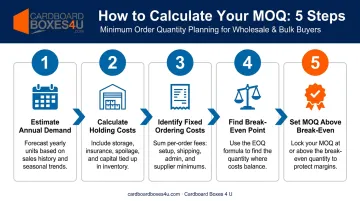
Step-by-Step MOQ Calculation
Step 1 — Estimate annual demand. A 90-day rolling average beats a full-year estimate for volatile SKUs — seasonality skews annual numbers.
Step 2 — Calculate holding/carrying costs. Express as a percentage of inventory value. ISM's 2022 benchmark puts this at 20–30% annually, covering capital cost, storage, handling, insurance, and obsolescence risk.
Step 3 — Identify fixed ordering costs. Include setup charges, freight, and administrative processing per order — everything that doesn't change based on how many units are in the run.
Step 4 — Find the break-even point. Divide total fixed costs by the contribution margin per unit. This is the floor — the minimum quantity at which revenue covers all associated costs.
Step 5 — Set or evaluate MOQ above break-even. Add a profit buffer and factor in minimum material batch sizes from upstream suppliers. A supplier's MOQ should sit well above break-even, not right at it.
Worked Example: Corrugated Box Order
A small e-commerce business ships roughly 150 orders per month and needs corrugated shipping boxes. Their supplier's MOQ is 500 units.
- At 150 boxes/month, 500 units represents a 3–4 month supply
- If carrying cost is 25% annually and boxes cost $1.50 each, holding 500 units costs roughly $47 per year in carrying cost — manageable
- Storage footprint: 500 flat-packed boxes occupy modest space
- Conclusion: the 500-unit MOQ aligns reasonably with this buyer's demand and cost structure
Scale that down to 30 orders per month, and 500 units becomes 16+ months of supply. The carrying costs and cash tied up in slow-moving inventory make the same MOQ very difficult to justify.
Common Mistakes Buyers Make
- Defaulting to "1" in ordering systems when no MOQ is specified — this causes planning errors and unexpected below-minimum orders
- Unit-of-measure mismatches — ordering in "units" when the supplier thinks in "cases" or bundles. Cardboard Boxes 4 U, for example, sells many products in bundle quantities where the listed price is per piece but the minimum purchase is the full bundle
- Failing to update MOQ parameters when supplier terms change — stale data in ERP systems generates consistently incorrect purchase orders
Benefits of Minimum Order Quantity (MOQ)
Benefits for Suppliers
MOQs aren't just a sales policy — they're a financial lever that makes production more efficient and revenue more predictable.
- Improved cash flow predictability — filtering out unprofitable small orders creates more stable, forecastable revenue
- Longer production runs spread fixed setup costs across more output, lowering per-unit cost and improving margin
- Predictable order volumes simplify scheduling and reduce the risk of costly overproduction
Benefits for Buyers
Meeting MOQ thresholds shifts the economics in the buyer's favor, too.
- Bulk pricing advantages — buyers ordering 2,500 to 100,000 boxes from Cardboard Boxes 4 U can negotiate purchase price variance (PPV) pricing well below the entry-level rate
- Suppliers prioritize customers with consistent, MOQ-compliant orders; sporadic small-quantity buyers often get slower service and less pricing flexibility
- Reduced reorder frequency — fewer purchase orders per year means lower administrative burden for procurement teams managing high-SKU catalogs
6 Tips for Negotiating and Optimizing Your MOQ
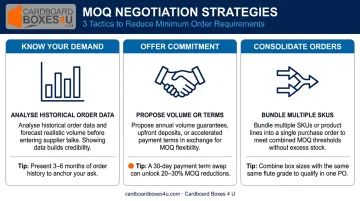
Before sitting down with a supplier, three fundamentals will carry most of your negotiating weight:
- Know your actual demand. Bring 90-day or seasonal sales data to the conversation. Suppliers respond better to buyers who can show consistent ordering patterns and credible volume forecasts — not just a request for a lower number.
- Offer commitment in exchange for flexibility. Annual volume guarantees, advance deposits, or faster payment terms give suppliers the certainty they need. A committed buyer is often worth more than a single large transactional order.
- Consolidate orders across SKUs. If a supplier carries multiple products you need, combine them into one purchase order to hit a total MOQ threshold rather than fighting individual SKU minimums.
For corrugated packaging buyers, consolidation is especially practical. Cardboard Boxes 4 U's fanfold corrugated ships with nearly twice the transportation cube efficiency of finished boxes, so adding it to an order builds volume without overwhelming your storage capacity.
On the Inventory and Operations Side
Request staggered deliveries. Negotiate to pay for the full MOQ upfront but receive inventory across two or more shipments. This satisfies the supplier's production minimum while keeping your warehouse from absorbing more stock than it can handle. Cardboard Boxes 4 U offers JIT delivery for fanfold orders, which solves this directly for manufacturing environments.
Eliminate slow-moving SKUs. Audit inventory regularly to spot products where MOQ requirements consistently generate six or more months of excess stock. If an SKU can't turn within a reasonable window, cut it from the active catalog or swap it for a faster-moving alternative.
Automate MOQ compliance with your ERP. SAP's replenishment documentation confirms that ERP systems can read MOQ parameters from supplier data and automatically adjust proposed order quantities to meet minimums. Configure this correctly and you eliminate the manual tracking errors behind most MOQ-related ordering mistakes.
Frequently Asked Questions
How do you calculate minimum order quantity?
Divide total fixed production costs by the contribution margin per unit (selling price minus variable costs). That gives you the break-even quantity — the point below which the supplier loses money. Buyers can then compare that figure against their own demand volume and carrying costs to determine whether the required stock level is workable.
What is the difference between MOQ and EOQ?
MOQ is supplier-imposed: the minimum quantity they will accept. EOQ (Economic Order Quantity) is buyer-calculated: the order size that minimizes total holding and ordering costs. The two figures serve different functions and rarely align, so when MOQ exceeds EOQ, buyers must either negotiate or absorb higher inventory levels.
What does MOQ mean in the context of OEM and SKU management?
MOQ is the smallest quantity a supplier will sell per transaction. In OEM contexts, MOQs are typically higher because products are custom-produced to buyer specifications. At the SKU level, MOQs often apply per variant, so five different box sizes may each carry their own minimum unless the supplier allows combined-SKU thresholds.
Can you negotiate a lower MOQ with a supplier?
Yes, MOQs are often negotiable — especially for established buyers or those offering volume commitments. Annual volume guarantees, faster payment terms, and staggered delivery arrangements are the most common levers. Suppliers value certainty; buyers who provide it gain flexibility in return.
What is the difference between a high MOQ and a low MOQ?
High MOQs reduce per-unit cost and ordering frequency but raise inventory levels and holding costs. Low MOQs keep stock lean but increase ordering frequency and administrative overhead. The right balance depends on your demand volume, storage capacity, and how stable your product mix is.
Why do suppliers set minimum order quantities?
Suppliers use MOQs to ensure each order covers fixed production costs (setup, labor, materials, and shipping) and generates a profit. Without MOQs, small orders would erode margins or produce outright losses. MOQ is the financial floor that makes the supplier's production model viable.