
So how long is cardboard storage actually safe? The honest answer: it depends on what you're storing, where you're storing it, and what's inside that box. According to Store Space, standard cardboard should be treated as a short-term solution — under 3 months for most everyday clothing. Push past that window without the right precautions, and you're gambling with your wardrobe.
This guide covers the full picture: how long cardboard storage is reasonably safe, what makes it risky, which garments should never touch a cardboard box, and how to do it right if cardboard is your only option.
Key Takeaways
- Standard cardboard is safe for most everyday clothes for up to 3 months in a dry, climate-controlled indoor space
- Moisture, pests, and cardboard's natural acidity are the three real threats
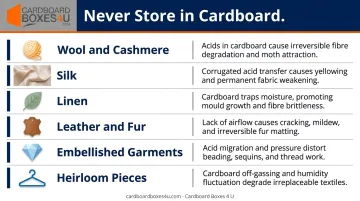
- Never store wool, silk, cashmere, leather, or heirloom garments in standard cardboard
- Clean, dry clothes packed in a quality corrugated box with silica gel packets can push storage safely past 6 months
- For storage beyond 3–6 months, upgrade to weatherized corrugated or airtight plastic bins
How Long Can You Store Clothes in Cardboard Boxes?
Under good indoor conditions — climate-controlled, dry, away from pests — most everyday clothing stays safe in cardboard for up to 3 months. That's the practical threshold cited by storage professionals, and it maps neatly onto seasonal transitions: winter-to-spring, summer-to-fall.
The 3-month mark matters for a few concrete reasons. Seasonal humidity shifts can affect even well-insulated indoor spaces. The EPA recommends keeping indoor relative humidity between 30% and 50%, but homes routinely drift outside that range as temperatures swing — and cardboard absorbs that ambient moisture rather than blocking it.
Everyday Clothes: Short-Term Storage (Up to 3 Months)
For basic cotton, denim, polyester blends, and synthetic activewear, standard cardboard is workable in the short term — provided three conditions are met:
- Clothing is clean and completely dry before it goes in the box
- The box is in good condition — no prior water damage, no previous use for food or chemicals
- The storage location is cool, dark, and dry — an interior closet or climate-controlled room, not a garage or basement
Meet those conditions, and most non-delicate garments tolerate a few months of cardboard storage without issue.
Medium-Term Storage: 3 to 6 Months
Push past that threshold, and the variables start working against you. With the right preparation steps (covered later in this article), everyday items can stretch into the 3–6 month range — but risk increases during this window because:
- Seasonal humidity fluctuations affect indoor environments even when air conditioning or heat is running
- Cardboard begins to compress and weaken under stacking weight over time
- Any moisture that entered the box early has longer to cause damage
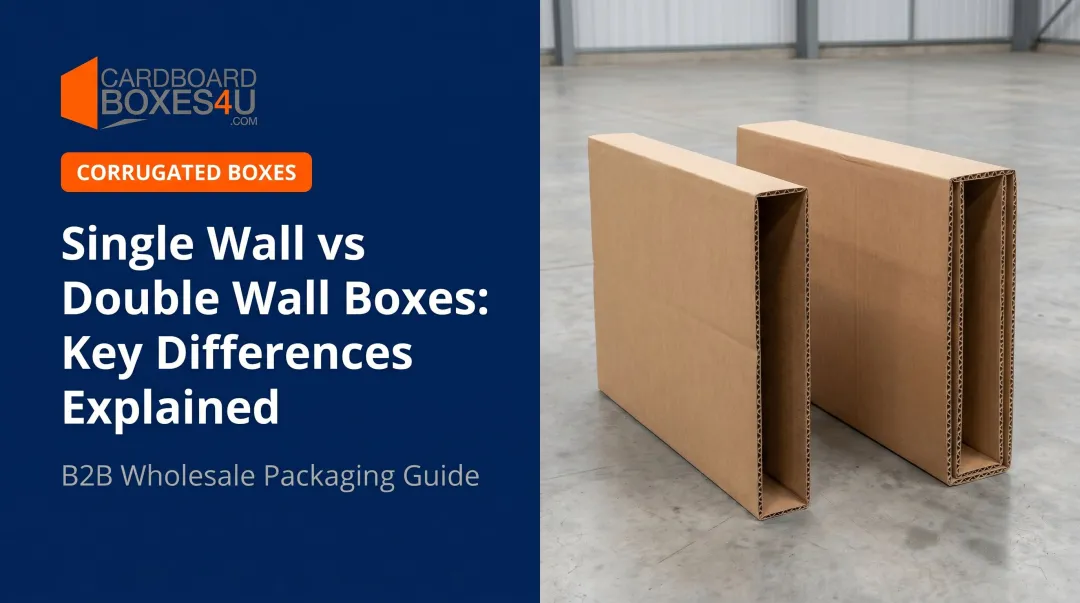
This is the range where box quality starts to matter significantly. A flimsy single-wall moving box behaves very differently from a sturdy double-wall corrugated box — and that structural difference affects how well the box maintains its integrity and protects the contents from external moisture.
Long-Term Storage (6+ Months): Where Cardboard Falls Short
Standard cardboard is not designed for long-term textile storage. Full stop.
Cardboard is porous, moisture-absorbing, and becomes increasingly acidic as it ages. The Smithsonian Institution confirms that boxing textiles can create a microclimate that's damper inside the box than outside, particularly in warm or humid climates.
For anything stored beyond six months, weatherized corrugated boxes or airtight plastic bins are the practical minimum. Standard cardboard in that timeframe risks yellowing, mildew, and permanent odor transfer — damage that no amount of laundering fully reverses.
What Makes Cardboard Risky for Clothes Storage?
Cardboard's risks trace directly to its physical properties — and they compound the longer clothes sit inside a sealed box.
Moisture and Humidity
Corrugated board is cellulose-based and hygroscopic — it pulls moisture from surrounding air. Research testing corrugated boxes across humidity levels from 30% to 90% found that moisture content rose nonlinearly while compression strength fell as relative humidity increased.
When moisture builds up inside a sealed box, it creates conditions where mold and mildew can form on fabric. Location matters for exactly this reason. Garages, unfinished basements, and attics with temperature swings are particularly damaging, even for short-term cardboard storage.
Pests and Insects
Cardboard provides no barrier against fabric-eating insects. The three you need to know about:
| Pest | Target Fibers | Attractants |
|---|---|---|
| Webbing clothes moth (Tineola bisselliella) | Wool, silk, fur, felt, leather | Dark, undisturbed boxes; food and perspiration stains |
| Carpet beetles (Anthrenus verbasci) | Wool, silk, leather, feathers | Food stains, body oils |
| Silverfish (Lepisma saccharina) | Starch-sized cotton and linen | Starchy paper, cardboard corrugations |
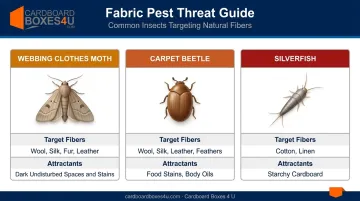
Clothing with food residue or body oils is particularly vulnerable to all three. Rodents present a separate problem: they chew through corrugated walls to access nesting material, regardless of what's stored inside.
Acidity and Fabric Degradation
Standard cardboard becomes acidic as it ages. The Smithsonian notes that papers and boards can transfer acidity to adjacent objects, weakening or discoloring them over time. The Library of Congress explains the mechanism: acids cleave cellulose chains through hydrolysis, generating additional acids that accelerate the breakdown — a self-reinforcing cycle.
Textile conservators specify acid-free archival boxes (pH 8.0–10.0 per NARA standards) for any garment meant to be preserved. Standard kraft cardboard doesn't meet that threshold.
Which Clothes Should (and Shouldn't) Go in Cardboard Boxes?
Clothes That Can Tolerate Cardboard Short-Term
These garment types are lower-risk for brief cardboard storage when kept clean, dry, and in a good indoor location:
- Sturdy cotton (t-shirts, jeans, casual pants)
- Polyester and nylon activewear
- Synthetic blends
- Basic knitwear in non-animal fibers
Even these garments should be freshly washed and completely dry before boxing. No exceptions.
Clothes That Should Never Go in Cardboard
If the items above sit at one end of the risk spectrum, these sit firmly at the other. Keep them out of standard cardboard regardless of how short the storage period is:
- Wool and cashmere — absorbs up to a third of its weight in moisture without feeling wet; primary target for clothes moths and carpet beetles
- Silk — weakens when wet; buffered cardboard can actually harm silk fibers
- Linen — plant-based fiber and mold-prone; starch sizing attracts silverfish
- Leather and fur — moisture causes deformation, staining, and mold
- Heavily beaded or embellished garments — weight distorts fabric; high humidity corrodes metal threads
- Heirloom pieces (wedding dresses, christening gowns, vintage garments) — the V&A and Smithsonian both specify pH-neutral archival board for these, not standard moving cardboard
How to Store Clothes in Cardboard Boxes Safely
If cardboard is what you're working with, these steps keep garments protected within the reasonable storage window.
Clean and Completely Dry All Clothing First
Wash every item before storage. Body oils, perfume residue, and invisible food traces are primary food sources for fabric pests — and they cause stains to permanently set during storage. Clothing must be 100% dry before it goes in. Even slight dampness inside a sealed box is enough to trigger mold growth.
Choose a Quality, Intact Corrugated Box
Not all cardboard is the same. A flimsy single-wall moving box offers far less protection than a sturdy double-wall corrugated box. Look for:
- No visible water damage or soft spots
- Intact, undamaged flaps
- No prior use with food, chemicals, or raw materials
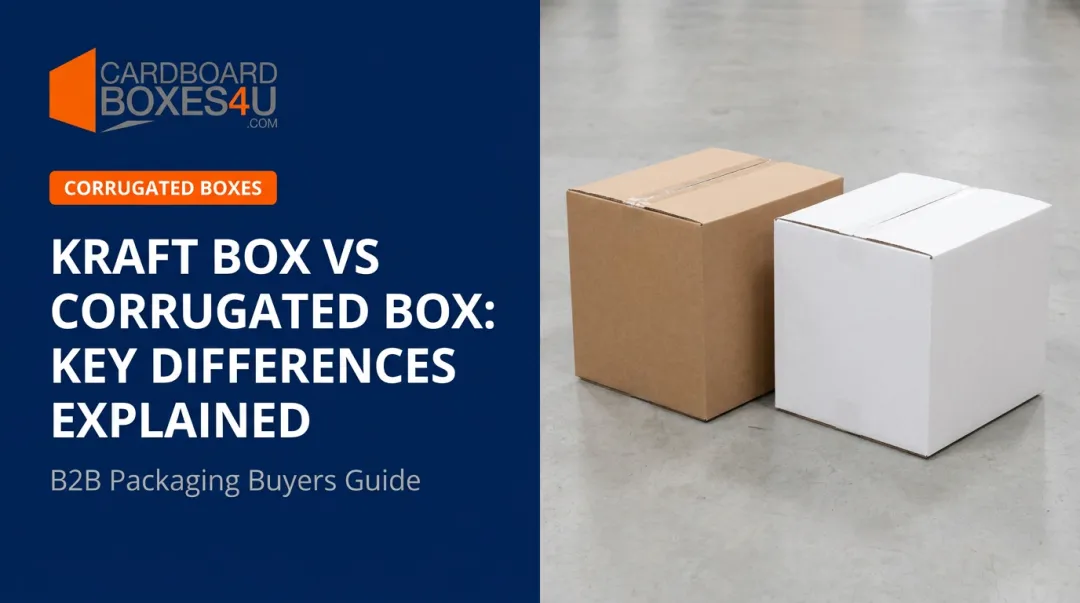
For storage in spaces with any humidity variability, Cardboard Boxes 4 U's double-wall corrugated and weather-resistant W5C and V3C boxes are a practical step up from standard kraft boxes.
Line the Box and Pack Wisely
- Line the interior with clean white cotton fabric or acid-free tissue paper to buffer clothes from direct cardboard contact
- Place heavier items at the bottom, lighter or more delicate items on top
- Don't overfill — clothes need some airspace to prevent compression damage and moisture buildup
Add Moisture and Pest Protection
- Silica gel desiccant packets absorb residual moisture inside the box
- Cedar blocks offer some deterrence against fabric pests, though research from Oregon State and Clemson Extension notes that cedar's effectiveness declines over time and it won't eliminate an active infestation
- Avoid chemical mothballs — naphthalene and paradichlorobenzene require an airtight enclosure to work, leave a persistent odor, and pose inhalation hazards
Store in the Right Location and Label Clearly
- Cool, dark, dry indoor space only — interior closets or climate-controlled rooms
- Never garages, unfinished basements, or attics
- Label boxes on multiple sides with contents and the date packed, so you can track how long items have been stored
When to Choose a Better Box Than Standard Cardboard
Weatherized and Coated Corrugated Boxes
For anyone storing clothes in a storage unit, a basement with some climate control, or any space where temperature and humidity aren't perfectly stable, weatherized corrugated boxes offer a practical upgrade over standard cardboard.
Cardboard Boxes 4 U's V3C and W5C government-specification corrugated boxes meet ASTM D4727 and ASTM D5118 standards, with WRA and MPA water-resistance compliance. The V3C single-wall grade carries a 400 PSI burst strength; the W5C comes in at 275 PSI. Both are available in a range of sizes and sold in bulk quantities suited to commercial and institutional buyers.
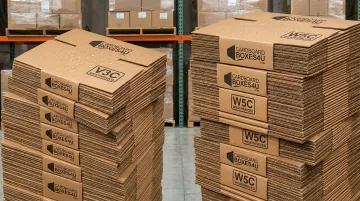
For hanging garments specifically, Cardboard Boxes 4 U also carries wardrobe boxes with integrated 20-inch and 24-inch hanger bars — a purpose-built option that keeps garments wrinkle-free and upright during storage or transit.
Airtight Plastic Bins and Archival Boxes
When storage extends beyond 6 months, or when garments have any sentimental or monetary value, the right container changes:
- Airtight plastic bins with clip-on lids — best for everyday long-term clothing storage; block moisture and pests completely
- Acid-free archival boxes (polypropylene corrugated or pH-neutral paperboard) — required for heirloom garments, vintage pieces, and any textile you genuinely cannot replace
Cardboard Boxes 4 U does not carry acid-free archival boxes as a standard product line. For heirloom or irreplaceable textiles, specialist archival suppliers — such as Gaylord Archival or University Products — stock the pH-neutral materials those garments require.
Frequently Asked Questions
How long can you store clothes in cardboard boxes?
The general safe window is up to 3 months for clean, non-delicate clothes in a dry indoor environment. With proper prep — fully dry clothes, a quality corrugated box, silica gel packets, and a climate-controlled location — everyday items can reasonably stretch to 3–6 months.
Is it safe to store clothes in cardboard boxes?
Short-term indoor storage of non-delicate garments is generally fine under good conditions — but humid environments, long-term timelines, and natural-fiber, leather, or heirloom items all carry real risks from moisture absorption, acidity, and pest access.
What types of clothes should never be stored in cardboard?
Wool, cashmere, silk, linen, leather, fur, heavily embellished garments, and heirloom pieces. These fabrics are especially vulnerable to moisture damage, acid migration from aging cardboard, and pest activity — making standard cardboard a poor choice regardless of storage duration.
Can cardboard boxes attract bugs and pests?
Cardboard offers no barrier against silverfish, carpet beetles, or clothing moths. Clean garments, cedar deterrents, and sealed storage all help reduce — but don't eliminate — the risk.
How can I protect clothes in cardboard from moisture?
Start with a high-quality corrugated box — ideally double-wall or weather-resistant — and ensure clothes are completely dry before packing. Add silica gel desiccant packets inside, then store in a cool, dry indoor location away from garages, basements, and attics.
What is the best long-term alternative to cardboard for storing clothes?
Airtight plastic bins with clip-on lids work well for most everyday garments stored long-term. Weatherized corrugated boxes (such as V3C or W5C grade) are a practical upgrade for less controlled environments. Acid-free archival boxes are the right choice for heirloom or irreplaceable textiles.