
The decision goes well beyond whether a box "feels sturdy." Thickness selection affects structural protection, stacking performance, freight weight, print quality, and compliance with standards like ASTM D4727 and ASTM D5118 — particularly in demanding sectors like electronics, aerospace, and government logistics.
This guide covers how corrugated thickness is actually measured, what the standard flute profiles mean in practice, and which factors should drive your board selection based on product type, shipping route, and industry requirements.
Key Takeaways
- Corrugated thickness is determined by flute profile, wall construction, and liner weight — not one number
- ECT rating predicts stacking and compression performance better than raw thickness alone
- Choosing the lightest board that still meets your protection needs reduces both material and freight costs
- Government, military, and electronics buyers often require specialty configurations beyond standard commercial grades
- Always validate board selection through samples and pilot shipments before committing at volume
What Is Cardboard Thickness?
In corrugated packaging, "thickness" is not a single dimension you look up on a spec sheet. It results from three combined variables: the height of the fluted medium, the number of corrugated wall layers, and the weight of the liner paper. Change any one of those, and the structural behavior of the board changes with it.
Corrugated board is structurally distinct from flat chipboard or solid paperboard. Its strength comes from the wave-shaped (fluted) interior layer — that geometry is what delivers cushioning, compression resistance, and rigidity. Remove it, and the board loses most of its load-bearing capability.
How Corrugated Thickness Is Measured
Three measurement systems appear across spec sheets and supplier documentation:
- GSM (Grams per Square Meter): Measures paper density per unit area (TAPPI/ANSI T 410). Per FEFCO, linerboard runs 90–200 gsm, fluting medium 90–150 gsm, and finished board ranges from under 300 gsm to over 900 gsm. GSM indicates liner quality — not box strength on its own.
- Caliper/Thickness: Physical board thickness measurement, covered under TAPPI/ANSI T 411 for single-sheet paper, paperboard, and combined corrugated board.
- ECT (Edge Crush Test): Measures resistance to edge-compression force along the flute axis (ISO 3037, TAPPI T 811). Common commercial grades are 23, 32, and 44 ECT — the most operationally relevant metric for stacking performance.
The Mullen/Burst Test (TAPPI T 810) measures puncture resistance at roughly 100–700 psi; some procurement contracts still call for it, but ECT has become the dominant predictor of real-world performance.
Corrugated Flute Types and Thickness Profiles
The flute profile determines cushioning depth, surface smoothness, and compression characteristics:
| Flute | Approx. Thickness | Flutes per Foot | Best For |
|---|---|---|---|
| A | ~4.8 mm | ~33 | Maximum cushioning, fragile goods |
| C | ~3.6 mm | ~38 | General-purpose shipping (most common) |
| B | ~2.4 mm | ~45–53 | Rigidity, printing, self-supporting goods |
| E | ~1.2 mm | ~70–98 | Retail packaging, enhanced graphics |
| F | ~0.5–0.8 mm | ~125 | Premium print surfaces, small cartons |
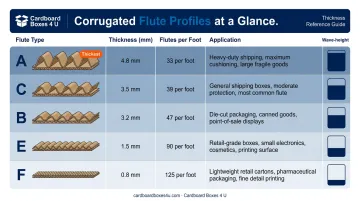
Source: FEFCO corrugated board production data and Fibre Box Association flute descriptions
The practical tradeoff is direct: larger flute = more cushioning and compression strength; smaller flute = smoother print surface. Flute selection, however, only tells part of the story — wall count determines how much protection any given flute actually delivers.
Board Construction Styles
Wall count multiplies the protection provided by any given flute:
| Construction | Layers | Load Application |
|---|---|---|
| Single face | 2 | Wrapping, padding, surface protection |
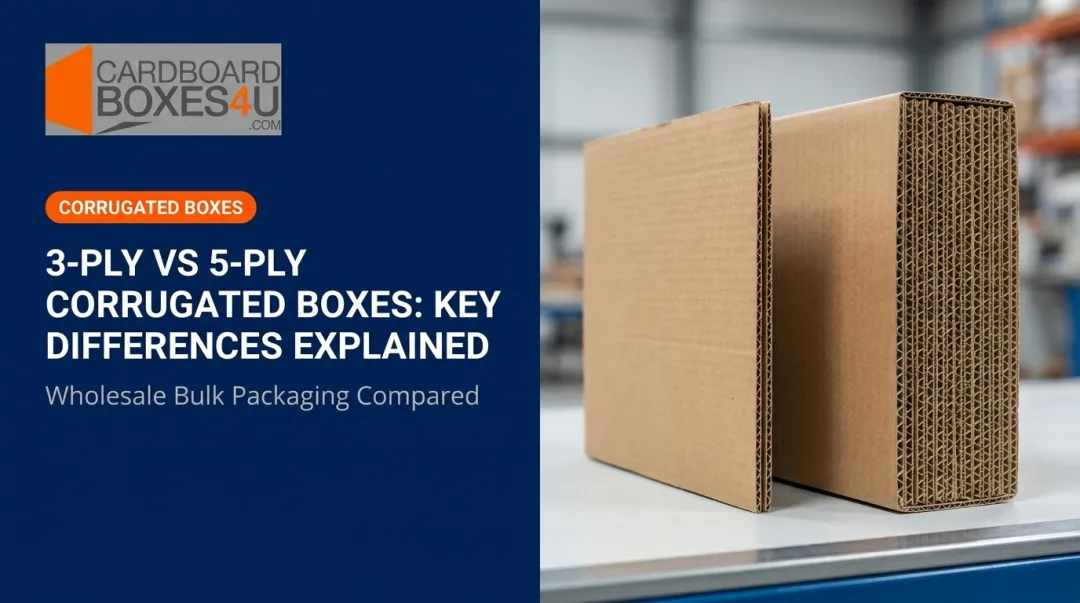
| Single wall (3-ply) | 3 | Most e-commerce and consumer goods shipments |
| Double wall (5-ply) | 5 | Heavy, fragile, or high-value goods |
| Triple wall (7-ply) | 7 | Industrial shipping, crate replacement |
For regulated applications, board construction goes beyond these commercial grades. ASTM D4727 covers corrugated and solid fiberboard sheet stock across multiple classes — including weather-resistant and water-and-vapor-resistant grades. ASTM D5118 covers fabrication requirements for corrugated fiberboard shipping boxes and supersedes the older federal PPP-B-636 specification for government use.
Why Cardboard Thickness Matters for Packaging Performance
Product Protection
Flute profile and wall count determine three distinct protective functions: cushioning (air gap and flute height), puncture resistance (liner weight and density), and compression load handling (ECT-to-BCT performance under stacking).
Thicker boards maintain box geometry under sustained stacking pressure, which is critical for fragile or high-value items. High ECT alone doesn't protect against impact shock. A fragile item in a thin-flute, high-ECT box may survive the pallet stack but break from a drop if there's no internal cushioning layer or suspension design separating the product from the box wall.
Freight Cost Balance
Heavier board configurations increase both material cost and outbound shipping weight. Carriers like UPS and DHL base billable weight on whichever is greater — actual weight or dimensional weight — using divisors of 139–166 (UPS) or 6,000 cm³ (DHL). Upgrading from single-wall to double-wall adds weight, and that weight has a freight cost.
Underspecifying board weight leads to compression failures, returns, and replacement shipments that cost far more than the weight differential. The goal is the lightest board that reliably performs across the full shipping route.
Print Quality and Branding
Coarser flutes (A, C) have more surface variation, which causes a "fluting" defect in direct printing: higher ink gain on flute tops than in valleys, producing a corduroy stripe effect. Finer flutes (E, F) provide a near-flat surface that supports high-resolution flexographic printing. That makes flute selection a print quality decision as much as a structural one.
A common approach for premium brands: use an E-flute inner carton for the unboxing presentation, with a separate, structurally robust outer shipping box. This separates print quality from load-bearing requirements and avoids the cost of revising artwork after a flute decision is locked in.
Key Factors When Choosing Cardboard Thickness
The right board specification comes from evaluating several interdependent variables.
Product Weight, Density, and Fragility
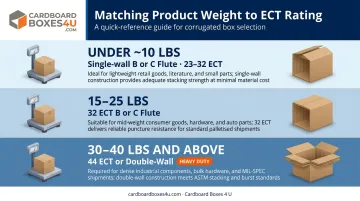
Weight is the strongest predictor of required ECT rating:
- Under ~10 lbs: Single-wall B or C flute at 23–32 ECT typically sufficient
- 15–25 lbs: 32 ECT B or C flute is the standard working range
- 30–40 lbs and above: 44 ECT or double-wall construction required
Dense items concentrate stress differently than lightweight, bulky goods — a 30-lb metal component in a small box stresses the board very differently than a 30-lb foam cushion in a large one.
Fragility adds a separate dimension. High ECT with a thin flute and no internal cushioning won't prevent shock damage. Fragile products need flute height (air gap) or a suspension system — not just better compression ratings.
Shipping Route and Handling Environment
Local, short-distance deliveries tolerate lighter boards. Multi-hub national distribution, freight carriers, and long-distance routes accumulate significantly more compressive, vibration, and drop stress.
Stacking height in the warehouse is the other key variable. Research confirms that most distribution center case damage is compression-based, concentrated on the bottom tier of the unit load. Boxes that will be palletized and stacked several units high need ECT ratings high enough to translate into adequate Box Compression Test (BCT) values — not just adequate edge crush on a test bench.
Box Dimensions and Panel Size
A board that performs well in a small box can fail in a large-format box with the same ECT rating. Larger panels flex more under vertical compression — the geometry works against the material's compression resistance.
Oversized or tall boxes often require a flute upgrade (B to C, for example) or a move to double-wall, even when the product itself is relatively light. Box style matters too: die-cut mailer formats require flutes that fold cleanly without cracking at scored edges — B and E flute are common choices for this reason, while thicker A-flute can delaminate at heavy score lines.
Environmental and Weather Exposure
Humidity is a significant corrugated performance variable. Clemson University research found that above 30% relative humidity, paper fibers are affected and box compression strength decreases. Standard kraft-lined boards are not designed for sustained moisture exposure.
For outdoor storage, cold-chain logistics, or government field use, weatherized coated boards meeting ASTM D4727 (weather-resistant classes) are required — not recommended. These are procurement mandates in government and military contracting, not optional upgrades.
Industry Compliance and Specialty Requirements
Some industries have packaging specifications that override general commercial selection entirely:
- Government/Military: Grades V3C, W5C, and V11C are specified under ASTM D5118 and ASTM D4727 — covering single-wall (400 PSI burst), weather-resistant single-wall (275 PSI burst), and double-wall (600 PSI burst) respectively.
- Electronics: ANSI/ESD S541-2019 requires packaging for electrostatic discharge susceptible (ESDS) items to meet defined protective properties. Standard corrugated is not ESD-protective; conductive or static-dissipative board is required.
Request ASTM D4727, ASTM D5118, WRA, and MPA documentation from suppliers before finalizing orders — particularly for government contracts or defense work.
How Cardboard Boxes 4 U Helps You Choose the Right Thickness
Cardboard Boxes 4 U is a B2B wholesale corrugated supplier with over 1,300 box sizes and direct experience supplying government, military, electronics, aerospace, and industrial customers across the United States. Their catalog addresses the selection factors covered in this guide directly — not as edge cases but as standard product lines.
Specialty configurations available:
- Weatherized V3C and W5C government spec corrugated — ASTM D4727 and ASTM D5118 compliant, with V3C at 400 PSI burst (single wall) and V11C at 600 PSI burst (double wall). Over 191 V3C products in stock. WRA and MPA compliance documentation available upon request.
- Conductive Black Corrugated Boxes — Purpose-built for electronic assemblies requiring static protection throughout manufacturing, shipping, and distribution.
- Korrvu retention and suspension packaging — Uses resilient film to suspend fragile or high-value products in the airspace of the container, delivering consistent shock protection across repeated drops without foam or loose fill.
- Fanfold corrugated in V3C, W5C, and V11C grades — transportation cube efficiency is nearly twice that of finished boxes (two bales fit side-by-side in a standard trailer). Widths run from 6" to 86".
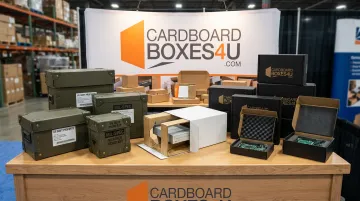
All boxes ship flat, reducing inbound freight costs and warehouse storage footprint. ECT ratings span 32 ECT (standard), 44 ECT (heavy-duty single wall), 48 ECT (double wall), and up to 1,100 lb burst for triple-wall configurations, giving procurement teams a clear tier structure to match protection requirements to budget. Custom lead times for MIL-SPEC orders run 10–14 business days.
Conclusion
Choosing the right cardboard thickness means matching your board to the actual demands of the shipment: product weight and fragility, shipping route conditions, box dimensions, compliance requirements, and branding goals. A 32 ECT single-wall C-flute box is the right answer for millions of shipments. A double-wall V11C at 600 PSI is the right answer for others.
Packaging decisions aren't permanent either. Changes in carrier, storage environment, product line, or regulatory requirements can shift which specification is correct. Re-evaluate your board selection when those variables change, and test new configurations through samples and pilot shipments before committing at volume.
Frequently Asked Questions
How thick does cardboard need to be for shipping?
The required thickness depends on product weight, box dimensions, and shipping route. Most consumer goods ship reliably in single-wall B or C flute at 32 ECT; heavy or fragile items typically require 44 ECT or double-wall construction. ECT rating matters more than raw millimeter thickness for predicting stacking performance.
What are the different thicknesses of cardboard?
Corrugated thickness ranges from F-flute (~0.5–0.8mm) for small premium cartons up to triple-wall constructions (approximately 14–16mm) for industrial freight. Single-wall C-flute (~3.6mm) is the most commonly used configuration for standard shipping applications.
What is ECT rating and why does it matter?
ECT (Edge Crush Test) measures how much compressive force a corrugated board can withstand along its edge, directly predicting stacking strength under palletized loads. Common ratings are 23, 32, and 44 ECT. Higher values indicate greater resistance to column compression during warehousing and distribution.
What is the difference between single wall and double wall corrugated?
Single wall (3-ply) has one fluted layer between two liners and handles most standard shipments. Double wall (5-ply) adds a second fluted layer, increasing compression strength, puncture resistance, and overall load capacity. It's the better choice for heavy, fragile, or high-value goods.
What flute type is best for electronics or fragile components?
Fragile electronics often benefit from C or BC flute for cushioning depth. For sensitive electronic assemblies, standard flute selection isn't enough — conductive or anti-static corrugated board is required to prevent ESD damage, as required by ANSI/ESD S541-2019.
Do corrugated boxes need to meet specific standards for government or military shipments?
Yes. Government and military contracts frequently specify grades such as V3C, W5C, or V11C, with compliance required under ASTM D4727 and ASTM D5118. Buyers should request certification documentation from their supplier before placing an order, not after.