Introduction
Every warehouse manager, e-commerce operator, and procurement buyer eventually faces the same question: plastic bins or corrugated cardboard boxes? It sounds simple, but the wrong choice can affect cost per unit, protection performance, regulatory compliance, and what happens to the container at end of life.
The stakes are real. A 2019 Clemson University study found that raising relative humidity from 50% to 90% can cut corrugated box compression strength by more than 50% — a failure mode that pushes many buyers toward plastic.
Plastic bins carry their own tradeoffs, though. Condensation can trap organic materials inside sealed containers, and polypropylene recycling rates sit at just 8%, according to the 2024 Polypropylene Recycling Coalition annual report.
This article delivers a direct comparison across cost, durability, moisture resistance, environmental impact, and real-world use cases to help you choose the right container for your specific operation.
Key Takeaways
- Corrugated cardboard dominates on cost, size variety, recyclability, and shipping logistics at scale.
- Plastic bins have a genuine edge for long-term personal storage in damp, uncontrolled environments.
- Specialty corrugated options (double-wall, weatherized-coated, conductive) close the performance gap in demanding applications.
- Your best choice depends on storage duration, humidity, item type, volume, and whether the container ships or stays put.
- For commercial and government buyers, certified corrugated options (ASTM D5118, ASTM D4727) eliminate the need for plastic bins even in challenging conditions.
Plastic Bins vs. Cardboard Boxes: Quick Comparison
Here's how the two options compare across the attributes that matter most to commercial and industrial buyers.
| Attribute | Plastic Bins (PP/PE) | Corrugated Cardboard Boxes |
|---|---|---|
| Unit Cost | Typically $3–$15+ per unit depending on size and material | From ~$2.93 (single-wall 20×20×20) to ~$10.95–$11.40 (double-wall 30×17×17 at 500–1,000+ units) |
| Durability | Hard-shell; SKU-specific load ratings | Rule 41 ECT: 23–55 lb/in (single-wall), 42–82 lb/in (double-wall), 67–112 lb/in (triple-wall) |
| Moisture Resistance | Resists external water; can trap internal humidity | Standard corrugated vulnerable to humidity; weatherized/WRA-rated variants designed for wet environments |
| Environmental Impact | ~8% PP recycling rate; reusable but hard to recycle at end of life | 69%–74% U.S. cardboard recycling rate in 2024; biodegradable; accepted in virtually all curbside programs |
| Stackability / Space | Stacks when full; does not fold flat when empty | Ships and stores flat; fanfold corrugated offers nearly 2x the transportation cube efficiency of finished boxes |
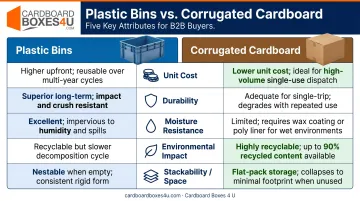
The table above covers the core trade-offs, but the right choice depends on your specific use case — covered in the sections below.
What Are Plastic Storage Bins?
Plastic storage bins — for this comparison, rigid polypropylene or polyethylene containers with snap or locking lids — are designed for repeated use over many years. They're not food containers or industrial IBCs. They're the kind of bin you find in home improvement stores and commercial storage catalogs.
Where plastic bins genuinely perform:
- Long-term household storage in damp basements, garages, or outdoor sheds
- Seasonal items that stay put for months without being moved
- Closed-loop logistics where containers return to the same facility
- Situations where clear bins and visual organization matter
Where plastic bins fall short:
- Don't fold flat, which creates warehouse overhead between uses
- Available in far fewer standardized sizes than corrugated
- Can trap internal condensation — sealed bins containing paper, textiles, or wood can develop mold when ambient humidity is high
- Significantly more expensive per unit at commercial scale
- Only about 8% of polypropylene is actually recycled at end of life
The National Archives recommends keeping paper and photographs below 65% relative humidity to prevent mold — and a sealed plastic bin does nothing to control the humidity inside the container. For organic materials, the container type matters far less than the environment it sits in.
What Are Corrugated Cardboard Boxes?
Corrugated cardboard is two flat liner sheets bonded to a fluted (wave-shaped) inner medium. That geometry distributes compressive load across the flutes, which is why corrugated dominates global supply chains despite weighing almost nothing.
Wall Types and Strength Ratings
Wall count isn't just trivia. It directly determines what a box can handle:
| Wall Type | Burst Strength | ECT Range | Typical Use |
|---|---|---|---|
| Single-wall | 125–350 psi | 23–55 lb/in | Light retail, short-term storage, e-commerce |
| Double-wall | 200–600 psi | 42–82 lb/in | Heavy industrial parts, commercial shipping |
| Triple-wall | 700–1,300 in-oz/in puncture | 67–112 lb/in | Bulk cargo, pallet shipping, extreme-duty applications |
ECT measures edgewise compression of the board. Box Compression Test (BCT), measured per TAPPI T 804 or ISO 12048, gives the finished-container stacking load — and that varies by size, flute, and closure. When stacking capacity matters, always specify BCT for the exact SKU, not just wall count.
Beyond the Brown Box
The most common objection to corrugated is water vulnerability — and it's fair for standard corrugated. But modern specialty variants address this directly.
Cardboard Boxes 4 U offers V3C and W5C government-spec weatherized corrugated that meets both ASTM D5118 (container fabrication) and ASTM D4727 (board material) standards:
- V3C — Single-wall, 400 PSI bursting strength, WRA and MPA rated. 191 stock sizes available.
- W5C — Single-wall, 275 PSI, weather-resistant (WR) designation for outdoor and humid environments.
- V11C — Double-wall, 600 PSI bursting strength, for maximum structural and moisture performance.
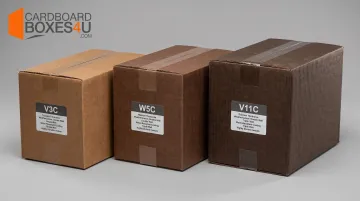
WRA (Water Resistant Adhesive) and MPA (Moisture-Proof Adhesive) are material-level certifications embedded in both ASTM standards, ensuring adhesives and liners maintain integrity under wet conditions: a threshold standard ECT-32 kraft corrugated doesn't meet.
For electronics manufacturers, conductive black corrugated boxes protect against electrostatic discharge from personnel, equipment, and work surfaces — critical protection for PCB assemblies and sensitive components throughout the supply chain.
Logistics Efficiency at Scale
Corrugated has a structural logistics advantage that plastic bins can't replicate:
- Ships and stores flat, consuming minimal warehouse space before use
- Fanfold corrugated offers nearly twice the transportation cube efficiency of finished boxes — two bale units fit side-by-side in a standard trailer
- Over 1,000 stock sizes available from Cardboard Boxes 4 U, from 4"×4"×4" up to 48"×48"×48" and beyond
- Custom sizes produced in 7–10 business days
For high-volume operations managing dozens of SKUs, that size flexibility alone justifies corrugated over plastic bins.
Environmental Credentials
The American Forest & Paper Association reported a 69%–74% U.S. cardboard recycling rate in 2024, totaling more than 33 million tons recovered. Corrugated is biodegradable and accepted in virtually every curbside recycling program in the country. Contrast that with plastic bins, where polypropylene recovery sits at roughly 8% — a gap that matters directly for any operation where packaging leaves the facility.
Which Is Better for Storage? A Decision Framework
The comparison isn't binary. Five factors drive the right answer:
- Storage duration — days/weeks vs. months/years
- Environmental conditions — climate-controlled vs. damp, uncontrolled
- Item type — fragile, organic, static-sensitive, or heavy industrial
- Scale and budget — 50 units/month vs. 5,000+
- End-use logistics — shipped, palletized, or shelved in place
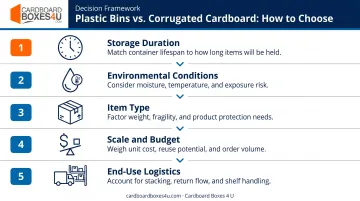
The sections below work through each factor to help you identify where corrugated or plastic wins for your operation.
Duration and Environment
Plastic bins hold a genuine edge in one scenario: very long-term personal storage in uncontrolled environments like damp basements or outdoor sheds. For everything else, corrugated often wins on cost and practicality.
In commercial facilities with climate control or pallet racking, double-wall or weatherized corrugated performs comparably — at significantly lower per-unit cost. The humidity threat is real for standard corrugated, but controlled storage environments and specialty coated variants eliminate it.
Cost at Scale
A double-wall 18"×12"×10" box from Cardboard Boxes 4 U runs $4.57 per unit. At 500 units per month, that's $2,285/month in boxes — and those boxes don't need to come back. A comparable plastic bin might cost 3–5x more per unit upfront, requires a return logistics system to realize its reuse value, and demands tracking, cleaning, and damage management.
For one-way shipping or high-throughput operations, the math heavily favors corrugated.
Situational Recommendation
| Choose plastic bins if... | Choose corrugated cardboard if... |
|---|---|
| Storing personal belongings long-term in a genuinely damp, uncontrolled space | Shipping products — any volume, any distance |
| Running a closed-loop reuse system with controlled return logistics | Operating at commercial scale with high monthly throughput |
| Contents require a near-watertight external seal | Storing items requiring size-specific containers (1,000+ sizes available) |
| Item count is small and reuse cycles are high | Needing certification compliance (ASTM D5118, MIL-SPEC, ASTM D4727) |
| Long-term archival storage in uncontrolled outdoor or shed environments | Prioritizing recyclability and straightforward end-of-life disposal |
Electronics and Government Applications
Two sectors where plastic bins are traditionally assumed to be necessary actually illustrate corrugated's reach. Electronics manufacturers handling ESD-sensitive assemblies can use conductive black corrugated boxes — which resist static from personnel and equipment throughout the supply chain — rather than relying on rigid plastic containers.
Government and defense buyers can spec V3C or W5C boxes to ASTM D5118, complete with WRA and MPA certification documentation. That meets the same moisture performance standards they'd expect from plastic, without the disposal complexity.
Conclusion
Plastic bins serve a specific and legitimate role: long-term, small-scale personal storage in harsh, uncontrolled conditions where moisture resistance and permanence matter more than cost or logistics efficiency.
For shipping, commercial storage, government procurement, electronics handling, and high-volume fulfillment, corrugated cardboard is the more practical choice. It matches or exceeds plastic bin performance in most commercial applications, with several concrete advantages:
- Lower cost per unit at scale
- Over 1,300 size configurations available
- Flat shipping and storage cuts freight and warehouse overhead
- ASTM-certified specialty variants for regulated industries
- 69%–74% recycling rate supports sustainability requirements
Businesses forcing products into a limited range of plastic bin sizes when 1,300+ corrugated configurations are available are accepting unnecessary constraints. Specialty corrugated — from double-wall ECT-48 to weatherized V3C and conductive black shippers — closes the performance gaps that standard cardboard leaves open.
Frequently Asked Questions
Are heavy-duty plastic storage bins better than cardboard boxes for storage?
In genuinely damp, uncontrolled environments, heavy-duty plastic bins outperform standard corrugated. However, double-wall and triple-wall corrugated — particularly weatherized-coated variants like V3C (400 PSI, WRA/MPA rated) or W5C (weather-resistant designation) — close this gap significantly for most commercial and industrial applications.
Do movers prefer boxes or bins?
For most commercial and industrial operations, corrugated boxes are the practical default — they stack edge-to-edge, come in standardized sizes that maximize trailer and warehouse space, and distribute weight more predictably than plastic totes, which can crack or shift during transit.
Can cardboard boxes be used for long-term storage?
Standard corrugated degrades in humid conditions over time, but double-wall boxes stored in a cool, dry environment can last for years without meaningful structural loss. Weatherized-coated corrugated (W5C or V3C grade) extends performance further for damp or outdoor-adjacent conditions.
Which is more environmentally friendly — plastic bins or cardboard boxes?
Corrugated cardboard is both recyclable and biodegradable, with a 69%–74% U.S. recycling rate in 2024. Plastic bins are reusable but carry only ~8% actual recycling recovery at end of life. For most commercial operations, corrugated is the cleaner end-of-life option unless plastic bins are running a tightly managed reuse loop.
Are corrugated cardboard boxes stronger than regular cardboard?
Yes. Corrugated boxes use a fluted medium bonded between two liner facings, providing significantly greater compression strength, stacking capacity, and impact resistance than flat (non-corrugated) cardboard. ECT ratings range from 23–55 lb/in for single-wall up to 67–112 lb/in for triple-wall construction.
What type of cardboard box is best for heavy items?
Double-wall corrugated rated at ECT-48 (275# DW) handles most heavy industrial applications, while triple-wall construction (1,100 PSI burst strength) suits bulk cargo and extreme-duty pallet shipping. For electronics, conductive black corrugated adds ESD protection on top of structural strength.