
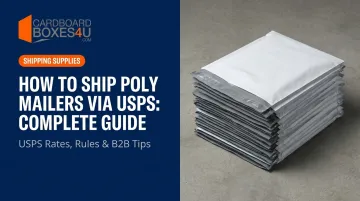
This guide covers exactly what you need to know: USPS's requirements for poly mailers, a step-by-step shipping walkthrough, which mail service to choose, and the most common mistakes that cost sellers time and money.
Key Takeaways
- USPS classifies poly mailers as flats, parcels, or nonmachinable letters depending on size and contents
- Use 2 mil thickness for loads up to 5 lbs; step up to 4 mil for loads up to 10 lbs
- The three most cost-effective USPS services: First Class Mail, Priority Mail, and Ground Advantage
- Sealed flat overhang must stay within 0.5 inches with uniform thickness throughout
- Poly mailers suit non-fragile, soft, or pre-packaged goods only—fragile items require rigid packaging
How to Ship a Poly Mailer via USPS: Step-by-Step
Step 1: Choose the Right Poly Mailer
Start by confirming the item is appropriate. Poly mailers work for clothing, soft goods, and items already in sturdy inner packaging. They don't work for anything fragile, liquid, or with sharp edges that could puncture the bag.
Match the size to what you're shipping:
- 6×9" — socks, small accessories
- 10×13" — t-shirts, lightweight apparel
- 14.5×19" — jeans, folded hoodies
A poor fit creates either a loose item that shifts during transit or an oversized package that costs more to ship.
Also verify mil thickness before ordering in bulk—USPS requires 2 mil minimum for loads up to 5 lbs and 4 mil for loads up to 10 lbs.
Step 2: Pack and Seal the Item Correctly
Place the item flat and centered inside the mailer. If the item doesn't fill the bag snugly, add lightweight padding—tissue paper or a small bubble wrap sheet—to prevent shifting. An irregular shape from a loose item can trigger a nonmachinable classification.
Press out excess air, then use the self-adhesive strip to seal the top flap. Skip cellophane or masking tape; they're not recognized as valid reinforcement for USPS purposes.
Once sealed, confirm the mailer:
- Lies flat with no more than 0.5 inches of overhang at the top
- Has uniform thickness with no more than 1/4-inch variance caused by the contents
- Does not exceed 3/4 inch thick (anything thicker is classified as a parcel)
Step 3: Weigh the Package and Select Your Mail Service
Use a postal scale—not a kitchen scale—to get an accurate weight. Mail class eligibility depends on exact weight, and even a half-ounce difference can change your rate or service eligibility.
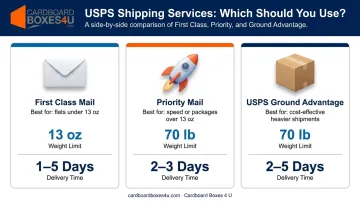
Use the USPS Retail Postage Price Calculator to compare rates based on weight, destination, and delivery speed. Your options:
| Mail Service | Best For | Weight Limit | Delivery |
|---|---|---|---|
| First Class Mail | Lightweight flats under 13 oz | 13 oz | 1–5 days |
| Priority Mail | Speed or packages over 13 oz | 70 lbs | 2–3 days |
| USPS Ground Advantage | Cost-effective heavier shipments | 70 lbs | 2–5 days |
Step 4: Apply the Label and Drop Off
Print or write the shipping label clearly and affix it directly to the flat surface of the poly mailer. Per DMM 601.5.2, labels must be firmly affixed to the mailing container with no more than 1/8-inch separation between the label ends and the container surface.
Drop-off options:
- Any USPS Post Office location
- Blue collection boxes (lightweight First Class flats only)
- Free Package Pickup at USPS.com for Priority Mail and Ground Advantage shipments
USPS Poly Mailer Requirements: Thickness, Size, and Weight Rules
USPS classifies poly mailers as a flat, parcel, or nonmachinable letter — and that classification determines your postage rate. Misclassification typically results in surcharges or returned packages, so knowing the thresholds before you ship matters.
Classification Basics
USPS assigns one of three classifications to poly mailers:
- Nonmachinable letter: Fits within letter dimensions; carries a $0.49 surcharge
- Flat (large envelope): Exceeds letter dimensions AND meets flexibility and uniformity standards
- Parcel: Fails flat standards; billed at the higher parcel rate
Thickness Requirements
- 2 mil minimum — easy loads up to 5 lbs
- 4 mil minimum — easy loads up to 10 lbs
- USPS plastic-bag standards only cover loads through 10 lbs; anything heavier requires a corrugated box
Flat Size Requirements
To qualify as a large envelope/flat, the piece must exceed at least one letter maximum AND stay within flat maximums:
| Standard | Minimum | Maximum |
|---|---|---|
| Length | More than 11½ inches | 15 inches |
| Height | More than 6⅛ inches | 12 inches |
| Thickness | More than ¼ inch | ¾ inch |
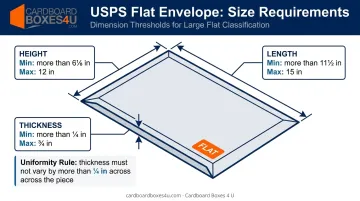
The piece must also be rectangular, flexible, and uniformly thick. Bumps or protrusions that create more than 1/4-inch variance in thickness will fail the flat standard.
Parcel Standards (When Applicable)
If your poly mailer doesn't qualify as a flat, parcel standards apply:
- Machinable parcel minimum: at least 3 inches high × 6 inches long × ¼ inch thick
- Maximum size: 108 inches in combined length and girth (130 inches for USPS Ground Advantage at oversized pricing)
- Maximum weight: 70 lbs
Which USPS Shipping Service Should You Use for Poly Mailers?
First Class Mail
The most affordable option for lightweight poly mailers. Applies to large envelopes/flats weighing 13 oz or less and includes forwarding and return services.
As of July 9, 2023, First-Class Package Service was consolidated into USPS Ground Advantage. First Class Mail now covers postcards, letters, and large envelopes/flats only. If your poly mailer qualifies as a flat under 13 oz, First Class Mail still applies. If it's a parcel, route it through Ground Advantage.
Priority Mail
Best for any poly mailer over 13 oz or when faster delivery is the priority. According to USPS Priority Mail, delivery is 2–3 days (not guaranteed), pricing is zone-based, and the service includes USPS Tracking, up to $100 of insurance, and free Package Pickup. Maximum weight is 70 lbs.
USPS Ground Advantage
The most cost-effective option for heavier poly mailer shipments. USPS Ground Advantage launched July 9, 2023, consolidating First-Class Package Service, USPS Retail Ground, and Parcel Select Ground into one service. It delivers in 2–5 business days, includes $100 of insurance, and accepts packages up to 70 lbs. Prices increased approximately 3.9% overall effective January 19, 2025.
Here's a quick comparison to help you decide:
| Service | Best For | Delivery | Max Weight | Insurance |
|---|---|---|---|---|
| First Class Mail | Flats ≤ 13 oz | 1–5 days | 13 oz | None included |
| Priority Mail | Parcels > 13 oz, speed-sensitive | 2–3 days | 70 lbs | $100 included |
| USPS Ground Advantage | Heavier parcels, cost-sensitive | 2–5 business days | 70 lbs | $100 included |
Once you've identified the right service, use the USPS Price Calculator to get current rates for your shipment's weight and destination zone.
What to Ship (and Avoid) in a Poly Mailer
Good Candidates for Poly Mailers
- Shirts, jeans, socks, footwear, and hats
- Fabric, bedding, yarn, and towels
- Phone cases in retail boxes, boxed supplements, playing cards
- Books, catalogs, and flat art prints (use bubble-lined mailers for these)
What these items share: none will be damaged if a heavier package ends up on top during transit.
Items That Should Never Go in a Poly Mailer
- Glass or ceramic objects
- Loose liquids or anything that could leak
- Fragile electronics without rigid outer packaging
- Items with protruding parts that could puncture the bag
- Perishable food items
- Anything over 10 lbs
Bubble-lined poly mailers do expand your options — jewelry in boxes and cosmetics often ship fine in them. That said, genuinely fragile or high-value items still need corrugated packaging for adequate protection.
Common Mistakes When Shipping Poly Mailers via USPS
A few common errors can cost you money, delay shipments, or get packages rejected at the counter. Here's what to watch for:
Wrong thickness. Many sellers buy 1.5 mil mailers to cut costs, not realizing USPS requires a minimum of 2 mil for loads up to 5 lbs. A substandard mailer may be refused or fail in transit. Confirm mil thickness before ordering in bulk.
Overfilling or underfilling. An overfilled mailer exceeding 3/4-inch thickness gets reclassified as a parcel at a higher rate. An underfilled mailer with a shifting item creates an irregular shape that can trigger a nonmachinable surcharge. The item should fit snugly — not jammed in, not floating around.
Wrong postage class. First Class postage on a mailer over 13 oz — or one too thick to qualify as a flat — will get returned or held for postage due. Weigh and measure before printing the label, every time.
When to Use a Corrugated Box Instead of a Poly Mailer
Poly mailers have real limits. When items are fragile, heavier than what plastic bag standards cover, irregularly shaped with sharp edges, or need internal cushioning to stay in place, a corrugated box is the right call. Corrugated packaging provides structural rigidity that no poly mailer—padded or otherwise—can replicate.
For e-commerce sellers shipping mixed product types, keeping corrugated boxes alongside poly mailers isn't optional—it's standard practice. Cardboard Boxes 4 U carries over 1,300 corrugated box sizes to cover most scenarios:
- Small RSC stock boxes starting at 4"×4"×4"
- Multi-depth boxes adjustable without tools (from $0.85/unit)
- Double wall boxes for heavier or high-value shipments
- Korrvu® suspension packaging for fragile electronics
- Conductive black corrugated boxes for static-sensitive components
- All boxes ship flat to reduce storage footprint
Not sure which box fits your product? Cardboard Boxes 4 U's Custom Box Calculator and sales team (888-333-9513 or Sales@cardboardboxes4u.com) can help identify the right size and configuration. Minimum orders start at 100 pieces.
Frequently Asked Questions
Will the USPS ship poly mailers?
Yes. USPS accepts poly mailers as large envelopes/flats or parcels, provided they meet thickness requirements (2 mil for loads up to 5 lbs, 4 mil for loads up to 10 lbs) and maintain uniform thickness. Note that a letter-size poly-wrapped piece is classified as a nonmachinable letter and carries a $0.49 surcharge.
How much does it cost to ship a poly mailer?
Cost depends on weight, dimensions, mail class, and shipping zone. First Class Mail flats are priced by weight up to 13 oz; Priority Mail and Ground Advantage rates are zone-based. Use the USPS Price Calculator for an exact quote based on your specific package.
How much do poly bags cost at USPS?
USPS sells bubble mailers through its ReadyPost line, but plain poly mailers are not in the ReadyPost catalog. Buying poly mailers in bulk from a third-party packaging supplier is typically more cost-effective.
What thickness does a poly mailer need to be for USPS?
USPS requires at least 2 mil thickness for loads up to 5 lbs and at least 4 mil for loads up to 10 lbs. Poly mailers thinner than 2 mil do not meet USPS requirements.
Can I use USPS First Class Mail for poly mailers?
Yes, as long as the poly mailer qualifies as a large envelope/flat and weighs 13 oz or less. First Class Package Service no longer exists as a separate category; packages now go through USPS Ground Advantage, while First Class Mail covers qualifying flats.
What items cannot be shipped in a poly mailer via USPS?
Fragile glass or ceramic objects, loose liquids, items with protruding parts that could puncture the bag, perishables, and anything exceeding what plastic-bag standards cover all require rigid or corrugated packaging. Poly mailers offer no structural protection against compression or impact.