Introduction
Choosing the wrong bulk packaging container can trigger compliance failures, customs delays, and shipping cost overruns that erode margins across an entire operation. The problem often starts with a basic mix-up: many shippers conflate "bulk cargo" at the vessel level — entire ships carrying raw commodities — with bulk cargo packaging at the shipper level, where the actual decisions happen.
At the shipper level, bulk cargo packaging refers to the containers, enclosures, and corrugated systems used to safely contain and transport large quantities of goods before they ever reach a vessel, rail car, or distribution point. Getting this right requires matching container type to cargo form, weight, regulatory classification, and transport mode.
This guide covers the main bulk cargo packaging container types, the differences between dry, liquid, and break bulk cargo, best handling practices, and a practical framework for selecting the right packaging solution for your operation and industry.
Key Takeaways
- Bulk cargo packaging refers to containers designed for loose, granular, or large-volume goods — not individual retail units
- Main container types: FIBCs (bulk bags), corrugated bulk containers (gaylords), rigid IBCs, and drums
- Dry, liquid, and break bulk cargo each require different packaging approaches based on material form, hazard level, and handling method
- DOT, ASTM, and UN ratings must drive container selection, not cost or convenience alone
- TT Club data shows two thirds of cargo-damage claims stem from poor packing practices
What Is Bulk Cargo Packaging?
"Bulk" means different things depending on context — cargo form or regulatory classification — and the distinction has real procurement consequences.
Cargo Form vs. Regulatory Definition
UPS and the broader logistics industry define bulk cargo as loose, unpackaged goods "typically dropped or poured directly into a railway car, tanker truck, or the hold of a ship." That's a cargo-form definition — it describes how goods move, not how they're packaged.
DOT's definition under 49 CFR 171.8 is strictly capacity-based: bulk packaging means any receptacle (other than a vessel or barge) with a liquid capacity greater than 450 L (119 gal), or for solids, a net mass greater than 400 kg (882 lb) and capacity exceeding 450 L. Containers below those thresholds are legally non-bulk — even if a supplier markets them as "bulk packaging."
This distinction matters for procurement. A large gaylord box or drum may be used for bulk shipping in the operational sense, but it may not meet DOT's bulk packaging threshold. Compliance documentation must reflect both the commercial container type and its regulatory status.
Why the Packaging Decision Matters
Bulk packaging applies across sea, rail, and truck transport — and across every industry that moves goods in volume. The packaging decision made at the shipper level determines:
- Cargo handling procedures at every point in the supply chain
- Compliance with ASTM, DOT, UN, or government spec requirements
- Load efficiency through storage, freight, and customs clearance
Types of Bulk Cargo Packaging Containers
Container selection depends on material state (solid, granular, liquid), weight, hazard classification, and transport mode. Here are the main categories.
Flexible Intermediate Bulk Containers (FIBCs / Bulk Bags)
FIBCs are large woven polypropylene bags designed for dry, flowable materials — grains, fertilizers, sand, and powders. They're widely used in agriculture, mining, and chemical industries.
Key specifications to know before procuring FIBCs:
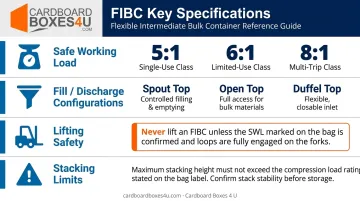
- Safe Working Load (SWL): Maximum rated load per ISO 21898:2024, with safety factors of 5:1, 6:1, or 8:1 depending on reuse class
- Choose fill/discharge configurations — spout top, open top, or duffel top — based on filling speed and dust control requirements
- Lift with all loops engaged, never exceeding SWL, and keep personnel clear of suspended bags
- Stack only bags rated for compression loads; overloading a compromised lower bag has caused fatal incidents per OSHA records
The global FIBC market was valued at USD 5.64B in 2024, with a projected 6.2% CAGR through 2033 — driven by food, chemical, and pharmaceutical demand.
Corrugated Bulk Containers (CBCs / Gaylords)
Where FIBCs handle flowable solids, corrugated bulk containers — often called gaylords — handle loose, granular, or mixed goods in a rigid, stackable format. These large-format boxes hold hundreds of pounds and drop directly onto standard pallets.
Cardboard Boxes 4 U carries gaylord-style containers in multiple formats:
- Gaylord Bottom and Lid, Octagon Bin, Telescoping Top & Bottom, HSC with Lid, Sleeve with Flange, and Tote Bins
- Wall configurations from double wall to triple wall and 5- or 6-ply
- Standard pallet-compatible size: 48" × 40" × 36"; additional sizes from 20" × 20" × 10" to 48" × 40" × 48"
- Octagon Bin Double Wall carries a 71 ECT rating for high stacking and compression strength
Specialty corrugated configurations for demanding applications:
| Format | Construction | Burst Strength | Key Property |
|---|---|---|---|
| V3C | Single Wall | 400 PSI | Water resistant (WRA/MPA), high strength |
| W5C | Single Wall | 275 PSI | Weather resistant (WR), government board |
| V11C | Double Wall | 600 PSI | Heavy-duty, weather resistant |
These formats meet ASTM D4727 (fiberboard material) and ASTM D5118 (box fabrication) — the same standards required for government and military procurement.
Cardboard Boxes 4 U stocks 191 V3C products across multiple standard sizes, plus conductive black corrugated boxes for static-sensitive electronics shipments. The full catalog runs over 1,300 corrugated sizes, covering both standard bulk applications and hard-to-find specialty configurations.
Rigid Intermediate Bulk Containers (IBCs / Tote Tanks)
Rigid IBCs are reusable, pallet-mounted containers for liquid and semi-liquid bulk goods — chemicals, oils, food-grade liquids. Under 49 CFR 178.706, rigid plastic IBC capacity ranges from 450–3,000 L (119–793 gal).
Key points:
- UN liquid IBC codes use the 31-series (31A steel, 31H1/31H2 rigid plastic, 31HA1 composite)
- UN marking on an IBC confirms it passed design qualification testing — but doesn't authorize it for every hazardous material; verify compatibility under 49 CFR 173.24 and the applicable packing section
- The IBC market was valued at USD 11.48B in 2025, with rigid IBCs representing 58% of the market
Drums, Barrels, and Fiberboard Containers
Steel (1A1/1A2), plastic (1H1/1H2), and fiberboard (1G) drums are used for liquids, semi-solids, and powders — particularly hazmat applications. DOT drum standards generally cap these at 450 L (119 gal), placing them below the DOT bulk packaging threshold under 49 CFR 171.8. They're bulk in the operational sense but non-bulk in the regulatory sense — a distinction that affects required testing and documentation under Part 178 Subpart M.
Standard Intermodal Containers
ISO-standard 20' and 40' steel containers function as the outer shipping unit that houses bulk packaging during container shipping. Commodities unsuitable for loose bulk transport — fragile goods, mixed components, specialty materials — are bagged, boxed, or containerized before being placed in an intermodal container.
Dry Bulk, Liquid Bulk, and Break Bulk: Key Differences
Each cargo category has distinct packaging requirements.
Dry bulk cargo — grain, coal, cement, ore, fertilizers — is loaded loose into holds or bulk bags. Packaging priorities include containment integrity, moisture resistance, and proper weight distribution across the load.
Liquid bulk cargo — oils, chemicals, gases — moves in tanks or tankers at the vessel level. At the shipper level, packaging involves drums, IBCs, and jerricans with sealed closure systems. Contamination prevention and spill containment are the primary concerns; 49 CFR 173.24 requires containers to prevent release under normal transport conditions and maintain chemical compatibility.
Unlike the first two categories, break bulk cargo relies on packaging at the unit level — boxes, crates, pallets, and drums — loaded onto a vessel without a standardized intermodal container. The goods aren't loose; packaging is always present. Break bulk is preferable in these situations:
- Oversized or project cargo that exceeds container dimensions
- Ports with limited container-handling infrastructure
- Shipments where standard ISO container formats don't apply
Industries That Rely on Bulk Cargo Packaging
The primary industries and their typical corrugated packaging needs:
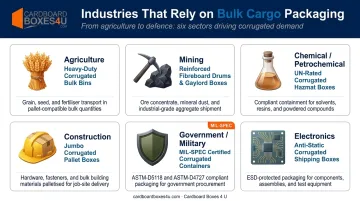
- Agriculture and food: Grain, sugar, and animal feed shipped in gaylord-style corrugated containers and bulk bins for palletized loads
- Mining and metals: Processed minerals and metal components packed in heavy-duty corrugated gaylords or double-wall bulk containers for warehouse staging and outbound freight
- Chemical and petrochemical: Dry fertilizers and granular chemicals in corrugated bulk containers; liquid products typically require IBC or drum configurations outside corrugated scope
- Construction: Bagged cement, hardware, and aggregate samples consolidated in corrugated bulk bins or gaylords for distribution and job-site delivery
- Government and military: Ammunition, supplies, and hazardous materials requiring spec-compliant packaging — V3C/W5C corrugated meeting ASTM D5118, fast packs with NSN numbers for government procurement
- Electronics manufacturers: Static-sensitive components requiring conductive black corrugated or ESD-protective packaging — not loose-load containers, but specialty configurations that protect assemblies through the full logistics cycle
Across all these segments, the packaging decision carries real financial consequences. TT Club attributes two thirds of cargo-damage claims to poor packing — specifically poor weight distribution, inadequate securing, incorrect goods description, and documentation errors. Choosing spec-appropriate containers reduces that exposure directly.
Best Practices for Handling and Shipping Bulk Cargo
Classify and Document Before Selecting Packaging
Identify material state (dry/liquid/granular), hazard classification, weight, and regulatory requirements (DOT, IMDG, ASTM) before touching a container spec sheet. Misclassification leads to compliance violations and cargo loss — not just fines.
Match Container to Cargo Characteristics
Each container type is designed for a specific material profile:
- FIBCs for free-flowing dry materials — powders, granules, and grain
- Corrugated gaylords for palletized secondary packaging of mixed or granular goods
- Rigid IBCs for liquids and semi-liquids
- UN-certified drums for hazardous materials requiring non-bulk compliance testing
Over-specifying wastes money. Under-specifying risks cargo failure and regulatory penalties.
Manage Fill Levels and Weight Distribution
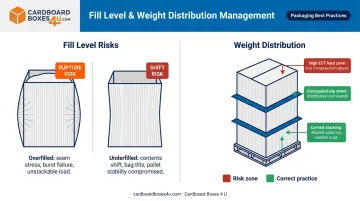
- Overfilling bulk bags increases rupture risk
- Underfilling causes load shifting during transit
- Corrugated bulk containers have stacking limits governed by ECT ratings — a 71 ECT Octagon Bin handles significantly more compression than a standard double-wall box
- Corrugated sheets placed between pallet layers disperse weight and reduce strapping damage
Cardboard Boxes 4 U carries 46+ sheet sizes from 18" × 18" to 72" × 72" to cover most pallet configurations.
Secure Documentation
Required documentation varies by cargo type but typically includes:
- Bills of lading and weight certificates
- Safety data sheets (SDS) for hazmat shipments
- ASTM compliance documentation for corrugated packaging (D4727, D5118)
- UN certification markings for drums and IBCs
- Government spec documentation (V3C, W5C) for military and institutional procurement
Request certification documentation directly from your packaging supplier at the time of order. It should ship with the goods, not arrive as an afterthought.
Match Handling Equipment to Container Type
Getting documentation right sets the stage for the last link in the chain: putting the right equipment on the right container.
- FIBCs require forklifts with spreader bars and smooth, rounded tines
- Corrugated gaylords move via standard pallet jacks
- Rigid IBCs require cage-handling equipment
- Break bulk items may need cranes or specialized lifts
Using the wrong lift equipment on the wrong container can shred a bag, collapse a gaylord, or breach an IBC seal — damage that typically isn't discovered until the cargo is already in transit.
How to Choose the Right Bulk Cargo Packaging
Start With Cargo Form and Volume
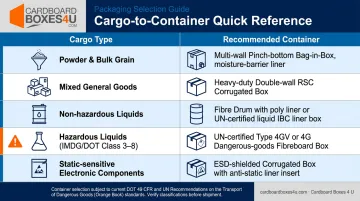
| Cargo Type | Best Container Match |
|---|---|
| Free-flowing dry goods (powder, grain) | FIBCs |
| Palletized mixed or granular goods | Corrugated gaylords |
| Liquids and semi-liquids | Drums or rigid IBCs |
| Hazardous liquids | UN-rated IBCs (31-series) |
| Static-sensitive components | Conductive corrugated containers |
Factor in Regulatory Requirements
- Government and military shipments: Require spec-compliant corrugated (ASTM D4727, D5118; V3C or W5C formats)
- Hazmat shipments: Require UN-rated containers with verified packing-group authorization under 49 CFR Part 173
- Electronics: Require static-dissipative or conductive packaging to prevent ESD damage
Working with a supplier who provides compliance documentation reduces procurement risk and simplifies customs clearance.
Consider Total Cost of Ownership
Packaging format affects more than unit price:
- Corrugated gaylords ship flat, reducing storage footprint and inbound freight cost
- Fanfold corrugated offers nearly twice the transport cube efficiency of finished boxes, cutting inbound freight frequency and warehouse storage requirements for high-volume operations
- FIBCs collapse when empty, reducing return logistics costs
- Rigid IBCs can be returned and reused, lowering per-cycle cost for liquid bulk operations
Sourcing the right format becomes easier when your supplier stocks more than standard sizes. Cardboard Boxes 4 U carries over 1,300 corrugated configurations — including government-spec V3C and W5C, flame retardant gaylords, conductive black corrugated, fanfold material, and custom-printed cartons. Custom sizes start at 100-piece minimums with a 7–14 business day lead time, and volume pricing applies to larger runs.
Frequently Asked Questions
What is bulk packaging?
Bulk packaging refers to containers or enclosures designed to hold large quantities of loose, granular, or unpackaged goods for transport and storage. Under DOT's definition, it applies to receptacles exceeding 450 L capacity for liquids or 400 kg net mass for solids — distinct from individual consumer or retail packaging.
What are the different types of cargo packaging?
The primary types are FIBCs (flexible bulk bags), corrugated bulk containers (gaylords), rigid IBCs (tote tanks), drums and barrels, and intermodal containers. The right choice depends on your cargo's physical form, required volume, and applicable transport regulations.
What is the difference between bulk cargo and break bulk cargo?
Bulk cargo is transported loose — poured or pumped directly into a vessel, tank, or hold without intermediate packaging. Break bulk cargo consists of individually packaged items (boxes, crates, pallets, drums) loaded onto a ship without being placed in a standardized intermodal container.
What containers are used for bulk cargo packaging?
FIBCs for dry flowable materials, corrugated gaylord containers for granular or mixed goods, rigid IBCs and drums for liquids, and standard intermodal containers for containerized bulk shipments. Hazmat cargo requires UN-rated containers verified against the applicable packing instruction.
What industries use bulk cargo packaging the most?
Agriculture, mining, chemicals, construction, and government/military are the heaviest users — each moving high volumes of commodity goods where per-unit packaging costs must stay minimal. Electronics and aerospace also rely on bulk packaging, though their focus is on protective and spec-compliant containers rather than loose-load capacity.
How do I know if my bulk cargo packaging meets regulatory standards?
Packaging must match the cargo's hazard classification and transport mode requirements — ASTM D4727/D5118 for corrugated, UN ratings for hazmat containers, and government spec for military applications. Request written certification and compliance documentation from your supplier before shipping.