Introduction
Most warehouses carry the same story: a wall of 8-10 box sizes that never quite fit the products going into them. Oversized boxes inflate shipping bills through dimensional weight charges, consume floor space with pre-assembled inventory, and still leave pickers scrambling when an unusual SKU ships. On-demand corrugated packaging solves this by putting the right box—in the right size, specification, and configuration—exactly where it's needed.
This guide covers what on-demand corrugated packaging is, the configurations available, which industries benefit most, how to source it effectively, and what compliance considerations matter for regulated sectors.
Worth noting on sourcing: on-demand doesn't require an in-house box-making machine. A specialist supplier like Cardboard Boxes 4 U offers over 1,300 sizes and specialty configurations—including fanfold, government-spec, conductive, and suspension packaging—delivering the same flexibility without capital equipment costs.
Key Takeaways:
- Oversized boxes trigger DIM weight charges that can inflate shipping costs by up to 20%
- Flat-shipped corrugated reduces warehouse storage overhead versus pre-assembled inventory
- Specialty configurations (conductive, government-spec, suspension) serve regulated industries that standard boxes can't accommodate
- Minimum order quantities as low as 100 pieces make on-demand sourcing accessible for smaller operations
- Corrugated is one of the most recycled packaging materials in the US, with 69–74% of cardboard available for recovery recycled in 2024
What Is On-Demand Corrugated Packaging?
On-demand corrugated packaging means procuring boxes in the exact size, style, and specification each product actually requires—rather than stocking a handful of standard sizes and forcing products into whichever box is close enough.
Traditional bulk ordering creates a persistent mismatch: a 12 x 12 x 12 box ships a product that fits in an 8 x 6 x 4. That gap costs money at every step.
Two Ways to Go On-Demand
In-house production uses box-making machines that score and cut corrugated sheets or fanfold stock to exact dimensions at the point of packing. Crutchfield's implementation of this approach eliminated the labor of 2–3 workers previously dedicated to manual box selection and averaged 425–450 cases per hour, according to Packaging World's 2023 case study.
Supplier-based sourcing means buying from a distributor with deep inventory across hundreds or thousands of size and specification combinations. No capital equipment, no tooling, no setup. Custom sizes at Cardboard Boxes 4 U ship in 7–10 business days, with over 1,300 stock sizes available for immediate fulfillment.
A Quick Primer on Corrugated Material
Corrugated board is a fluted medium sandwiched between liner boards. The flute profile determines cushioning and rigidity:
- B-flute (~47 flutes/foot) — good crush resistance, common for retail packaging
- C-flute (~38 flutes/foot) — versatile, widely used for shipping boxes
- E-flute (~90 flutes/foot) — thinner, better for detailed printing
- F-flute (~125 flutes/foot) — micro-flute, used for small retail cartons
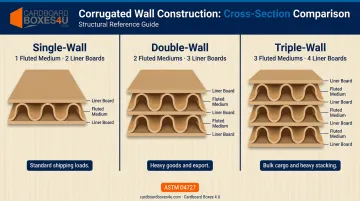
Wall construction adds another dimension of strength. Per ASTM D4727, the three main configurations are:
- Single-wall (one medium, two liners) — standard shipping loads
- Double-wall (two mediums, three liners) — heavier goods and export shipments
- Triple-wall (three mediums, four liners) — bulk cargo and heavy stacking applications
Key Benefits of On-Demand Corrugated Packaging
Shipping Cost Reduction Through Right-Sizing
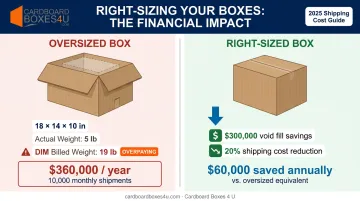
Carriers don't always charge by actual weight. UPS and FedEx calculate dimensional (DIM) weight by dividing package volume by a divisor—currently 139 for UPS Daily Rates—then billing whichever is higher, actual or DIM weight.
The math compounds fast. An 18 x 14 x 10 box weighing 5 lb bills as 19 lb under DIM pricing at that divisor. For a shipper moving 10,000 packages per month, a $3 DIM overcharge per package equals $360,000 per year in unnecessary carrier fees, according to Shipware's 2026 analysis.
Pitney Bowes estimates that optimizing package dimensions can reduce shipping costs by up to 20%. Right-sizing the box is the most direct fix.
Void Fill Elimination
When a box matches product dimensions, void fill requirements drop sharply. Crutchfield's case documented approximately $300,000 in first-year void fill savings after switching to right-sized corrugated cases—and cut overall box dimensions in half compared to prior manual selection. Beyond material cost, labor time spent stuffing air pillows and packing paper disappears too.
Warehouse Space Efficiency
Pre-assembled boxes in 15 sizes eat floor space and complicate inventory management. Flat-shipped corrugated—available across RSC, telescoping, double-wall, and government-spec configurations at Cardboard Boxes 4 U—stores in significantly less floor space than pre-assembled stock. Fanfold corrugated takes this further: Smurfit Westrock states a single fanfold bale can replace up to 1,300 individual packages or SKUs in storage.
Improved Product Protection
A box that fits reduces internal product movement—the primary cause of transit damage. Specialty configurations take protection further for high-value or fragile items (see the Korrvu section below). Fewer damaged shipments translate directly to fewer returns, lower replacement costs, and fewer customer support escalations.
Supply Chain Flexibility
On-demand sourcing handles new SKUs, seasonal shifts, and urgent shipment needs without waiting on minimum order quantities or long lead times from a single-size supplier. Key advantages for procurement teams include:
- Accommodates new SKUs and seasonal volume spikes without pre-ordering large stock
- Supports urgent shipment needs without single-supplier lead time constraints
- Minimums starting at 100 pieces make short runs and pilot product launches practical
- Reduces dependency on fixed-size inventory that may not match actual shipping needs
Types of On-Demand Corrugated Packaging Configurations
Standard RSC Boxes
Regular Slotted Containers are the workhorse of the shipping world—four flaps on top and bottom, available in hundreds of sizes. Access to a broad catalog matters here. Cardboard Boxes 4 U stocks over 1,000 RSC sizes for immediate fulfillment, enabling right-sizing without custom manufacturing lead times.
Specialty and Hard-to-Find Configurations
Fanfold Corrugated
Fanfold is continuous corrugated board folded accordion-style and delivered in bale form. It's designed to feed directly into box-making machines, cutting to exact dimensions at the packing station—no finished box inventory required. Two bale units fit side-by-side in a standard trailer, making transportation nearly twice as efficient as finished boxes.
Cardboard Boxes 4 U stocks fanfold across a wide range of configurations:
- Widths from 6 to 86 inches
- Single-wall (32 ECT Kraft) and double-wall (275# BC Flute) in stock
- Specialty grades available: V3C, W5C, V11C, fire retardant, and water-vapor resistant
- All grades meet ASTM D4727 standards
Government and Military Specification Corrugated
Standard commercial boxes don't qualify for government procurement. Military and federal applications require corrugated meeting specific grade constructions that control material grade, wall construction, and weatherization class:
| Grade | Wall Type | Burst Strength | Standards |
|---|---|---|---|
| V3C | Single Wall | 400 PSI | ASTM D5118 / ASTM D4727 |
| W5C | Single Wall | 275 PSI | ASTM D5118 / ASTM D4727 |
| V11C | Double Wall | 600 PSI | ASTM D4727 |
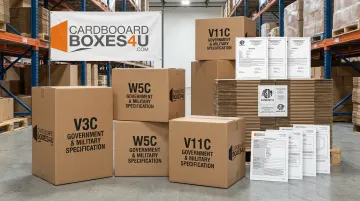
V3C and W5C grades carry WRA (Water Resistant Adhesive) and weather-resistant designations, making them suitable for outdoor or field logistics environments. Cardboard Boxes 4 U maintains 191 V3C SKUs in stock, with W5C available in both finished box and trimmed sheet formats.
Conductive Black Corrugated Boxes
Standard corrugated generates static electricity that can damage sensitive electronic assemblies during packaging, storage, and transit. Conductive black corrugated boxes are engineered to dissipate static buildup, protecting components where standard boxes create ESD risk. According to ESDA, ESD damage ranges from a few cents for simple diodes to thousands of dollars for complex integrated circuits—so the right packaging directly affects both yield rates and per-unit cost.
Cardboard Boxes 4 U offers conductive black corrugated for electronics manufacturers and assembly operations, with compliance documentation available upon request.
Korrvu Retention and Suspension Packaging
Korrvu suspends products in airspace within the outer box using elastomeric film—keeping fragile items away from container walls and absorbing shock from multiple drop angles without foam or heavy void fill. Three variants serve different needs:
- Suspension packaging: product floats between two film layers, ideal for high-value items shipped repeatedly
- Retention packaging: film holds product in a frame and doubles as a product display
- Compression packaging: simple blocking and bracing for a wide range of applications
Korrvu is particularly valuable for irregularly shaped, fragile, or high-value products where standard box-and-filler approaches result in unacceptable damage rates.
Industries That Benefit Most
E-Commerce and Retail Fulfillment
Variable SKU dimensions make a single box size economically unsustainable. DIM weight charges accumulate fast across oversized shipments, and fulfillment centers that right-size packaging across their catalog recover those costs directly.
Key considerations for this segment:
- Wide size range (1,300+ options) to match box to product, not the other way around
- Custom printed and promotional cartons available at 100-piece minimums for DTC brand presentation
- On-demand sourcing eliminates large inventory commitments on slow-moving sizes
Government, Military, and Aerospace/Defense
These sectors require documented compliance—ASTM certifications, government-spec corrugated, and weatherized configurations for field environments. Sourcing from a pre-certified supplier removes the qualification burden from the procurement team.
Cardboard Boxes 4 U's MIL-SPEC lines cover:
- V3C, W5C, and V11C government-spec corrugated
- ASTM D5118 and ASTM D4727 conformance
- WRA/MPA water-resistance standards for field and outdoor use
Electronics and Electronic Assembly Manufacturers
ESD damage during packaging and transit creates measurable quality and cost exposure. Conductive corrugated boxes and suspension packaging address both the electrostatic hazard and physical shock risk for boards, assemblies, and sensitive components.
Compliance documentation supports ISO and quality system requirements (confirm specific certifications with Cardboard Boxes 4 U directly).
Industrial Manufacturing and Distribution
Heavy or irregularly shaped parts demand double-wall or triple-wall corrugated with appropriate ECT ratings. Defaulting to one oversized box inflates costs and damage rates — sourcing the right board grade for each application eliminates both problems.
Cardboard Boxes 4 U's heavy-duty and pallet-shipping lines include 147+ products with ECT ratings from 32 to 71.
How to Source the Right On-Demand Corrugated Packaging
Start with a SKU Audit
Before selecting configurations, map your products:
- Dimensions (L x W x H for each SKU)
- Actual weights
- Fragility ratings
- Any regulatory or specification requirements (government, ESD, food-adjacent)
This data determines size range, wall construction, and whether specialty configurations are needed.
Match Specifications to Application
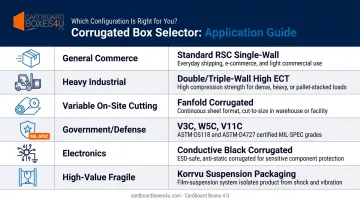
| Application | Recommended Configuration |
|---|---|
| General commerce | Standard RSC, single-wall |
| Heavy industrial parts | Double-wall or triple-wall, high ECT |
| Variable-dimension on-site cutting | Fanfold corrugated |
| Government/defense procurement | V3C, W5C, V11C (ASTM D5118/D4727) |
| Electronics assemblies | Conductive black corrugated |
| High-value fragile goods | Korrvu suspension or retention packaging |
Evaluate Suppliers Beyond Price
Commodity distributors stock a handful of standard sizes. A specialty supplier brings distinct capabilities:
- Ships in 1,000+ stock sizes — far beyond the few dozen a typical distributor carries
- Stocks hard-to-find configurations: government-spec, conductive black, fanfold, and suspension packaging
- Fulfills in flat-ship bundles that cut your storage footprint compared to pre-erected inventory
- Provides certification and compliance documentation for regulated industries
- Offers accessible minimums — Cardboard Boxes 4 U starts at 100 pieces, with custom sizes in 7–14 business days
Sustainability and Compliance Considerations
Corrugated Recyclability
According to AF&PA's 2025 report, 69–74% of cardboard available for recovery was recycled in the United States in 2024. US mills consumed over 46 million tons of recovered paper that year. Corrugated is consistently among the most recycled packaging materials in the country.
Right-sizing compounds this advantage: smaller boxes use less material per shipment, cutting total corrugated consumption before recycling is even a factor.
State-level regulations are also tightening. California's SB 54 requires 100% recyclable or compostable single-use packaging by 2032, and Colorado's Producer Responsibility Program begins producer dues in January 2026. Using recyclable-grade corrugated now aligns procurement with both current requirements and what's coming.
Certification and Compliance Documentation
For regulated industries, packaging certifications are mandatory:
- ASTM D5118 — required for government and military corrugated containers; governs fabrication standards for fiberboard shipping boxes
- ASTM D4727 — applies to corrugated and solid fiberboard sheet stock, covering domestic, weather-resistant, and water-vapor-resistant classifications
- WRA (Water Resistant Adhesive) — governs moisture resistance in corrugated adhesives; critical for outdoor storage or high-humidity environments
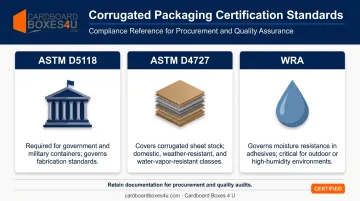
Buyers in government, defense, and electronics sectors should request and retain compliance documentation from their supplier for procurement and quality audit purposes. Cardboard Boxes 4 U's V3C and W5C product lines conform to ASTM D5118 and ASTM D4727 with WRA/MPA water resistance ratings—documentation packages are available upon request for procurement and audit use.
Frequently Asked Questions
What exactly is on-demand corrugated packaging?
On-demand corrugated packaging means sourcing or producing boxes in the exact size and specification each product requires—without maintaining large inventories of pre-made standard sizes. It reduces waste, lowers DIM weight shipping charges, and lets businesses respond quickly to new SKUs or changing product dimensions.
How is fanfold corrugated different from standard pre-cut boxes?
Fanfold is continuous corrugated board folded accordion-style, shipped flat in bale form, and cut to exact dimensions at the point of packing. It stores more efficiently than finished boxes and feeds directly into box-making machines—making it ideal for operations with highly variable product dimensions.
What are government spec corrugated boxes and who needs them?
Government spec corrugated (V3C, W5C, V11C) meets military and federal procurement standards for material grade, wall construction, and weatherization class under ASTM D5118 and ASTM D4727. Government agencies, defense contractors, and aerospace suppliers are required to use these grades and maintain documentation of packaging compliance.
Why do electronics manufacturers need conductive corrugated boxes?
Standard corrugated generates electrostatic discharge that damages sensitive components. Conductive black corrugated boxes dissipate static buildup, protecting assemblies during packaging, storage, and transit. ESD damage ranges from invisible latent defects to immediate component failure.
How do I choose between single-wall, double-wall, and triple-wall corrugated?
Single-wall suits lighter consumer goods and general e-commerce shipments. Double-wall handles heavier industrial parts and provides added crush resistance. Triple-wall is for very heavy loads or applications requiring maximum stack strength—typically industrial bulk containers and heavy manufacturing components.
Are corrugated boxes recyclable and do they meet sustainability goals?
Yes. Corrugated is one of the most recycled packaging materials in the US, with 69–74% of available cardboard recycled in 2024 per AF&PA. Right-sizing through on-demand sourcing reduces total material use per shipment, supporting both corporate sustainability commitments and compliance with emerging state-level packaging regulations.