Many buyers treat 32 ECT as a simple weight capacity label. It isn't. Others assume it's interchangeable with a 200 lb burst rating. That's also wrong. And choosing between B, C, or E flute at 32 ECT changes how the box actually performs in the field, even though the ECT number stays the same.
This guide covers what 32 ECT technically means, how it behaves across different flute grades, what the freight classification rules actually say about load limits, and the common misinterpretations that lead to costly packaging failures.
Key Takeaways
- 32 ECT = 32 lbs of edge compression resistance per linear inch of board width, not a box weight capacity
- A standard single-wall 32 ECT box carries a maximum suggested load of ~65 lbs under UFC Rule 41
- C, B, and E flute all reach 32 ECT differently, with real tradeoffs in thickness, cushioning, and printability
- 32 ECT ≠ 200 lb burst test: the two ratings measure entirely different failure modes
- At 90% relative humidity, effective board strength can drop to 48% of rated ECT
What 32 ECT Means in Corrugated Packaging
ECT stands for Edge Crush Test. Per TAPPI T 811, it measures the edgewise compressive strength of corrugated fiberboard — specifically, how much force a sample can withstand when loaded perpendicular to the flute axis before it buckles. The "32" means 32 pounds per linear inch of board width, not 32 lbs of total box capacity.
In palletized logistics, stacked boxes transfer cumulative weight through their vertical edges. Edge crush resistance is what keeps that stack from collapsing.
ECT vs. Burst (Mullen) Test
These two specs are frequently confused — and UFC Rule 41 lists them as separate qualification columns for a reason:
| Test | What It Measures | Failure Mode |
|---|---|---|
| ECT (Edge Crush Test) | Vertical compression resistance | Board buckles under stacking load |
| Burst (Mullen Test) | Puncture/rupture resistance | Board tears from internal or lateral pressure |
A box can score well on one and poorly on the other. Boards made with higher recycled fiber content may carry a strong ECT rating but lower burst strength. Neither test replaces the other.
Where 32 ECT Sits in the Freight Classification System
UFC Rule 41 organizes single-wall corrugated into clear strength tiers. 32 ECT occupies the standard middle tier:
| ECT Rating | Max Gross Weight | Max Outside Dimensions | Min Burst |
|---|---|---|---|
| 23 ECT | 20 lbs | 40 in | 125 psi |
| 26 ECT | 35 lbs | 50 in | 150 psi |
| 32 ECT | 65 lbs | 75 in | 200 psi |
| 40 ECT | 80 lbs | 85 in | 250 psi |
| 44 ECT | 95 lbs | 95 in | 275 psi |
| 55 ECT | 120 lbs | 105 in | 350 psi |
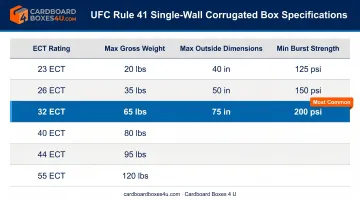
The 65 lb figure is a freight classification category limit, not a direct read from the ECT number. The actual box compression strength depends on additional variables — primarily box perimeter and board caliper — calculated through the McKee formula.
Those variables ultimately get codified in a compliance stamp every regulated box must carry. The Box Maker's Certificate (BMC) stamped on the box bottom declares these specifications, giving shippers and carriers a verifiable compliance reference. Per NMFTA's Item 222 requirements, the BMC is mandatory for fiberboard boxes in regulated freight applications.
32 ECT Across Flute Grades: B, C, and E
Two boxes can carry identical 32 ECT ratings while performing very differently. The ECT number describes compression strength; the flute grade determines physical thickness, cushioning depth, fold behavior, and print surface quality.
Per the Fibre Box Association, larger flute profiles provide better cushioning while smaller flutes deliver better graphics surfaces. Here's how that plays out across the three most common 32 ECT configurations.
B Flute (32 ECT B)
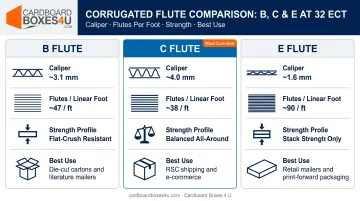
B flute runs approximately 47 flutes per linear foot with a caliper of roughly 3.1 mm (about 1/8"). The tighter, denser corrugation pattern makes it resistant to flat crushing — which matters when boards are scored, folded, or die-cut into complex shapes.
Common applications include:
- Mailer-style and literature boxes (tab-lock, side-loading)
- Folding cartons and presentation boxes
- Products in the 15–25 lb range where a compact profile matters more than cushioning depth
Cardboard Boxes 4 U stocks kraft literature mailers in 200#/ECT-32-B construction — B flute at 32 ECT in a specialty format.
C Flute (32 ECT C)
C flute has approximately 38 flutes per linear foot and a caliper of about 4.0 mm (roughly 11/64"). It's the industry's most widely used flute type, balancing compression strength, cushioning, and reasonable printability in a single configuration.
Typical uses:
- Standard RSC (regular slotted container) shipping boxes
- E-commerce fulfillment and palletized B2B shipments
- General merchandise where both stacking performance and product cushioning are needed
32 ECT C is the default construction across most of Cardboard Boxes 4 U's 1,300+ stock box sizes, including corrugated sheets (e.g., 32ECT C Single Wall Sheets 72" × 72") and corrugated partitions.
E Flute (32 ECT E)
E flute runs approximately 90 flutes per linear foot with a caliper of about 1.6 mm — the thinnest shipping-grade flute available. The near-flat surface enables high-resolution printing while maintaining the same 32 ECT stacking strength as B or C configurations.
Works well for:
- Branded retail mailers and direct-to-consumer presentation boxes
- Lightweight product packaging where print quality and slim profile are priorities
E flute does carry real trade-offs: it's more susceptible to bowing, and it absorbs less shock than B or C at the same ECT rating. For fragile or heavy products, plan on interior cushioning — the thinner flute profile alone won't compensate.
Quick Comparison: B, C, and E at 32 ECT
| Flute | Caliper | Flutes/Linear Ft | Strength | Best Use Case |
|---|---|---|---|---|
| B | ~3.1 mm (1/8") | ~47 | Flat-crush resistant | Die-cut cartons, literature mailers |
| C | ~4.0 mm (11/64") | ~38 | Balanced all-around | RSC shipping boxes, e-commerce |
| E | ~1.6 mm (1/16") | ~90 | Stack strength only | Retail mailers, print-forward packaging |
Key Performance Properties of 32 ECT Board
Stacking Strength and Box Compression
The 65 lb maximum suggested load for a standard 32 ECT single-wall box comes from UFC Rule 41's freight classification table, but actual box compression strength is calculated using the McKee formula:
BCT = k × ECT × √(h × Z)
Where h = board caliper and Z = 2(L + W) (box perimeter). This means a larger box with more perimeter can carry more weight than a smaller box at the same ECT rating, and vice versa. The raw ECT number alone doesn't determine capacity.
Moisture Sensitivity
This is the variable most buyers underestimate. Research documented by Esko/CAPE quantifies the degradation clearly:
- Standard testing: 50% RH at 73°F (baseline = 100% strength)
- At 80% relative humidity: Compression strength drops to ~68% of rated value
- At 90% relative humidity: Compression strength drops to ~48% of rated value
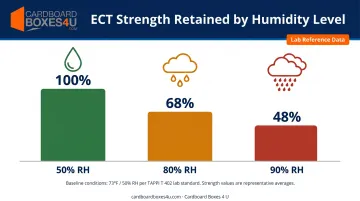
A 32 ECT box rated for 65 lbs may effectively carry under 32 lbs in a humid warehouse or refrigerated supply chain. Buyers in those environments should apply a safety margin or specify moisture-resistant board treatments. Cardboard Boxes 4 U carries fanfold corrugated with MRA (Moisture Resistance Adhesive) and Coating X300™ treatments for these applications.
Recyclability
Beyond moisture performance, 32 ECT has a favorable sustainability profile. Single-wall board uses less fiber per unit of compression strength than heavier-duty alternatives, making it one of the most resource-efficient options for standard shipping.
Key figures for procurement teams with sustainability reporting requirements:
- AF&PA recycling rate: Corrugated consistently recycles at 69–74%
- EPA container data: Corrugated ranks among the highest-recycled packaging materials
- Structural tradeoff: None — 32 ECT single-wall meets standard shipping demands without sacrificing performance
How 32 ECT Is Specified, Tested, and Validated
The Test Procedure
TAPPI T 811 is the current standard for ECT measurement. The test stands a corrugated board sample on its cut edge between two parallel plates and applies compressive force at a controlled rate until the sample buckles. The peak load before collapse, divided by the sample length, gives the ECT value in pounds per linear inch.
Note: ASTM D2808 (the former ECT standard) was withdrawn in 1991 and is no longer the active reference. ASTM D1761 is unrelated — it covers mechanical fasteners in wood. The applicable ASTM standards for corrugated fiberboard products are ASTM D4727 (corrugated and solid fiberboard sheet stock) and ASTM D5118 (fabrication of fiberboard shipping boxes).
Specification Documentation
The Box Maker's Certificate (BMC) printed on the box bottom is the primary compliance document. Per NMFTA's Item 222, carriers and shippers rely on BMC markings to verify that boxes meet freight classification requirements. UPS explicitly states that gross weight must not exceed the limit printed on the BMC.
Specialty corrugated products — including V3C and W5C configurations — carry compliance documentation tied to ASTM D5118 and ASTM D4727, with V3C board also meeting WRA and MPA water resistance standards. When sourcing these products, confirm that the supplier provides the corresponding certification documentation alongside the shipment.
Rated vs. Field Performance
Manufacturer-declared ECT values reflect production averages from tested board stock under controlled laboratory conditions. In the field, actual box performance depends on:
- Construction quality and closure method
- Box orientation during transit
- Cumulative handling impacts (drops, vibration, compression)
- Environmental humidity exposure
The declared ECT value is an upper reference limit under ideal laboratory conditions, not a guaranteed field performance number.
When to Use 32 ECT — And When to Upgrade or Downgrade
The 32 ECT Sweet Spot
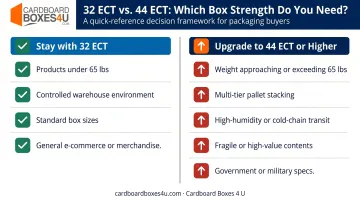
32 ECT is appropriate for:
- Products up to ~65 lbs shipped via parcel carriers or palletized LTL
- Controlled or semi-controlled warehouse environments
- General merchandise, e-commerce fulfillment, and light industrial shipping
- Standard box sizes without extreme aspect ratios
Cardboard Boxes 4 U stocks over 1,300 corrugated box sizes in 32 ECT construction across RSC and specialty configurations, with a 100-piece minimum order — accessible for both small businesses and high-volume operations.
When to Upgrade Beyond 32 ECT
Move to 44 ECT (95 lb capacity) or higher when:
- Product weight approaches or exceeds 65 lbs
- Multi-tier pallet stacking concentrates compressive load
- High-humidity transit or cold-chain storage degrades board strength
- Fragile or high-value contents justify additional structural margin
- Government or military procurement specifications apply
For government applications, the V3C and W5C product lines (ASTM D5118-compliant, 350# Test) from Cardboard Boxes 4 U are the appropriate alternative — engineered to higher burst and water-resistance standards than standard ECT-rated boxes. Double-wall (ECT-48) and 71 ECT bulk bin configurations are also available for industrial and pallet shipping upgrades.
When 32 ECT Is Over-Specified
Drop to 23–26 ECT when:
- Products weigh under 30 lbs and ship individually without pallet stacking
- Burst resistance (not stacking strength) is the primary protection concern
- Aesthetics and foldability outweigh structural requirements
- Cost reduction is a priority and lighter grades meet carrier minimums
Common Misinterpretations of 32 ECT in Practice
"32 ECT Means the Box Holds 32 Lbs"
This is the most common mistake buyers make. The 32 refers to pounds per linear inch of edge compression resistance on a board sample — a material property, not a box capacity. The ~65 lb load figure comes from a separate UFC Rule 41 freight classification category that pairs 32 ECT with specific box size and weight limits.
"32 ECT and 200 lb Burst Are the Same Thing"
Rule 41 lists them as separate columns for a reason — they measure different things. ECT measures vertical edge compression resistance. The Mullen burst test measures how much lateral pressure the board can withstand before rupturing. A box can carry a high ECT rating with a relatively low burst strength (common in boards with higher recycled fiber content), or the reverse. Specifying one doesn't substitute for the other.
"Lab-Rated ECT Holds Constant in the Field"
Lab testing occurs at controlled temperature and humidity. Real environments rarely cooperate. At 80% relative humidity, effective compression strength drops to roughly 68% of rated value. At 90% RH, it drops to 48%. Buyers specifying 32 ECT boxes for cold storage, outdoor staging, or coastal warehousing without a safety margin should expect failures at the box level.
Frequently Asked Questions
How much weight can a box made from 32 ECT corrugated board hold?
A standard single-wall 32 ECT box is rated for a maximum suggested load of approximately 65 lbs under UFC Rule 41. This is a box-level capacity figure, not a direct read from the ECT number — it's influenced by box size (perimeter), construction quality, and real-world handling conditions including humidity.
Is 32 ECT equivalent to a 200 lb test?
No. They measure fundamentally different things. ECT measures stacking and edge compression resistance; the 200 lb Mullen test measures puncture and rupture resistance. Rule 41 lists them as alternate qualification paths for the same freight category, but they are not interchangeable as specifications.
What is the difference between 32 ECT and 44 ECT corrugated board?
44 ECT offers higher edge crush resistance and is rated for loads up to roughly 95 lbs in single-wall configurations per Rule 41. It's appropriate for heavier products, demanding stacking environments, or applications where 32 ECT's structural margin is insufficient.
What are the core specifications for 32 ECT corrugated board?
- Edge crush resistance: 32 lbs per linear inch
- Construction: Single-wall B, C, or E flute
- Max suggested load: ~65 lbs (UFC Rule 41)
- Typical burst rating: 200 lb Mullen
- Verification: Box Maker's Certificate stamped on the box bottom
Which flute grade works best with 32 ECT corrugated?
C flute is the default for RSC shipping boxes where cushioning and stacking strength both matter. B flute works well for folded, die-cut, and presentation-style boxes, while E flute is the right pick when print quality and a slim profile take priority. All three deliver the same 32 ECT compression rating.
Does humidity affect 32 ECT corrugated strength?
Yes, significantly. Moisture absorption weakens corrugated fibers — at 90% relative humidity, compression strength can fall to roughly 48% of the rated value. Buyers in humid environments or cold-chain logistics should apply a strength safety margin or specify moisture-resistant board treatments.