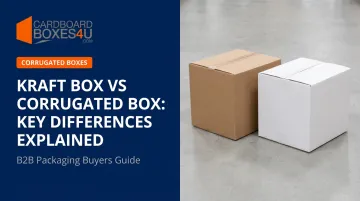
For buyers in shipping, manufacturing, distribution, or government procurement, this isn't a minor detail — it's an operational decision. Both box types are paper-based, both are widely available, and both can look the same from the outside. But their structure, strength, cost profiles, and ideal applications differ substantially.
Here's what you need to know before you order.
Key Takeaways
- Kraft boxes use a single paper layer — lightweight, affordable, and eco-friendly for retail and light goods
- Corrugated boxes add a fluted core between linerboards, delivering significantly greater strength and impact resistance
- Kraft suits retail, food, and gifting; corrugated handles shipping, industrial, electronics, and government applications
- Corrugated's higher upfront cost offsets damage losses on heavy or high-value shipments
- ASTM, ISTA, and military compliance requirements default to corrugated — not kraft
Kraft Box vs Corrugated Box: Quick Comparison
The differences between kraft and corrugated boxes come down to structure, strength, cost, and end use. Here's how they compare across each dimension.
Material and Structure
| Feature | Kraft Box | Corrugated Box |
|---|---|---|
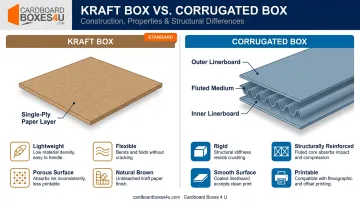
| Construction | Single layer of kraft paper | Outer linerboard + fluted medium + inner linerboard (minimum 3 layers) |
| Rigidity | Flexible, lightweight | Rigid, structurally reinforced |
| Surface | Slightly textured, porous | Smooth linerboard surface |
| Appearance | Natural brown (or bleached white) | Natural brown, printable outer face |
Strength and Load Capacity
Kraft boxes handle lightweight retail items well but aren't designed for compressive loads or repeated handling.
Corrugated boxes — per carrier rules that reproduce NMFC Item 222/Rail Rule 41 — are rated across wall configurations:
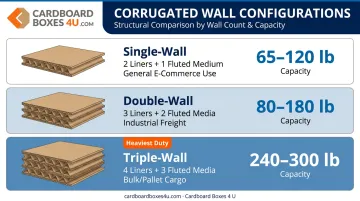
- Single-wall: 65–120 lb gross weight; 32–55 ECT ratings; 200–350 psi burst
- Double-wall: 80–180 lb gross weight; 42–82 ECT ratings; 200–600 psi burst
- Triple-wall: 240–300 lb gross weight; 67–112 ECT ratings; puncture-tested rather than Mullen burst
These aren't universal payload limits — they apply alongside specific board ratings and maximum dimension totals. But they illustrate the structural gap between kraft and corrugated. That structural advantage has a direct effect on cost.
Cost
- Kraft: Lower base material and production cost. Strong value for high-volume retail, food, or gift packaging where protection demands are minimal
- Corrugated: Higher upfront cost due to multi-layer manufacturing, but more economical at scale — especially when reduced product damage and fewer replacement shipments are factored in
Print requirements often drive the choice as much as cost does.
Customization and Print
| Kraft Box | Corrugated Box | |
|---|---|---|
| Surface | Porous; limits color accuracy | Smooth linerboard; accepts full-color printing |
| Best for | Minimalist designs, black ink, stamp printing | Flexographic and digital printing, branded graphics, handling instructions |
Sustainability
- Kraft: 100% biodegradable under appropriate conditions; minimal processing; strong eco-friendly credentials for green branding
- Corrugated: Highly recyclable — AF&PA reports a 69–74% cardboard recycling rate for 2024, and the Fibre Box Association notes corrugated boxes contain an average of 52% recycled content. Production is slightly more energy-intensive than single-layer kraft manufacturing
What Is a Kraft Box?
Kraft boxes are made from kraft paper, produced through a chemical pulping process that uses sodium hydroxide and sodium sulfide to strip cellulose fibers from lignin. The word "kraft" comes from German and Swedish for strength.
That process preserves a tight cellulose-fiber network, giving kraft paper solid tear resistance despite its single-layer structure.
Physical characteristics:
- Natural brown color (bleachable to white)
- Slightly textured, porous surface
- Lightweight and flexible
- Biodegradable in appropriate conditions
- Food-safe in approved grades
Kraft boxes come in non-corrugated form — flat sheet boxes or folding cartons — and fall within the folding carton category of paper-based packaging.
When Kraft Makes Sense
Kraft performs well in applications where structural protection is secondary to aesthetics, cost, or eco-friendly positioning:
- Retail point-of-sale packaging (cosmetics, soaps, candles)
- Bakery and food items with short distribution chains
- Artisanal and gift products
- Lightweight mailers for local or regional delivery
- Eco-focused consumer brands where unboxing experience matters
Where kraft falls short is structural durability. It isn't built for long-distance shipping, stacking under load, or environments where compressive forces, moisture, or repeated handling are factors — which is where corrugated construction becomes the better choice.
What Is a Corrugated Box?
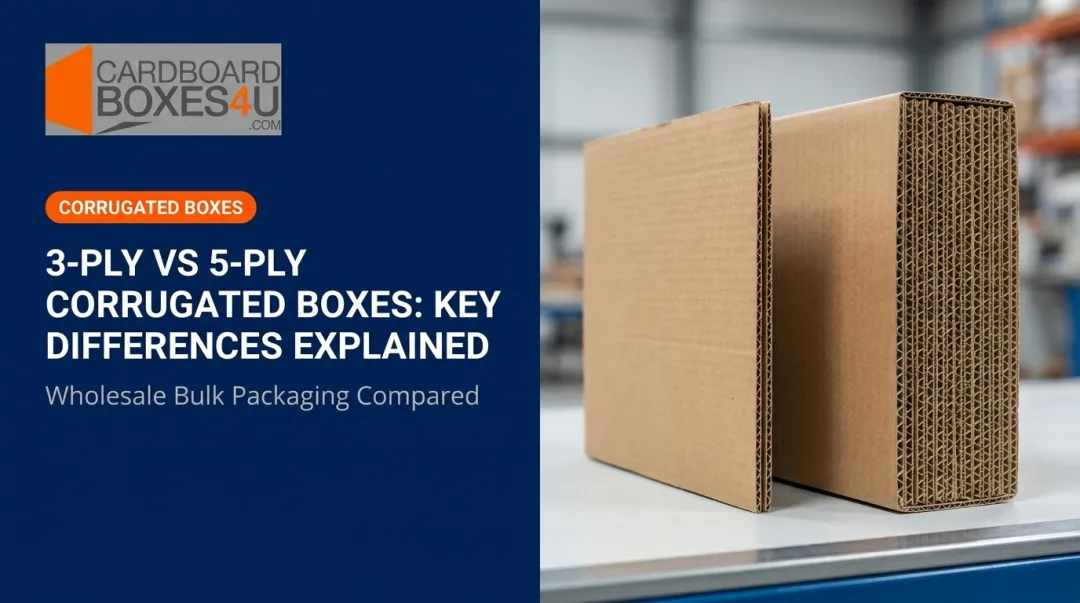
A corrugated box is made from corrugated fiberboard , a multi-layer material consisting of at least three components: an outer linerboard, a fluted (arched/wavy) medium, and an inner linerboard. The arch structure of the fluting distributes pressure and absorbs impact, which is why corrugated delivers a strong strength-to-weight advantage over flat-sheet alternatives.
Flute Grades and Wall Configurations
Flute type affects cushioning, stacking strength, and thickness. The Fibre Box Association identifies five common profiles:
| Flute | Approx. Flutes/Foot | Best For |
|---|---|---|
| A | 33 | Cushioning, stacking strength |
| B | 47 | Puncture/crush resistance, flat printing surface |
| C | 38 | General shipping — balance of A and B properties |
| E | 90 | Fine profile, high crush resistance, excellent print surface |
| F | 125 | Compact boards for high-quality retail packaging |
Wall configurations determine overall load-bearing capacity:
- Single-wall (2 liners + 1 medium): General e-commerce and retail shipping
- Double-wall (3 liners + 2 media): Heavier goods, industrial freight, bicycles
- Triple-wall (4 liners + 3 media): Bulk cargo, pallet shipping, industrial applications
Performance Properties
Corrugated boxes can be tested and specified across multiple performance dimensions: Edge Crush Test (ECT) for stacking strength, Mullen burst for face rupture resistance, ASTM D642 for container compression, and ASTM D5276 for drop performance.
They can also be manufactured with specialty treatments to address specific conditions:
- Weatherized coatings for moisture resistance
- Fire-retardant treatments for hazardous environments
- Conductive materials for static-sensitive electronics
Where Corrugated Is the Standard
Corrugated handles applications that kraft physically cannot:
- E-commerce fulfillment: Multi-point handling, carrier compliance requirements
- Electronics and appliances: Impact resistance, ESD protection options
- Industrial and manufacturing: Component transport, pallet stacking
- Food distribution: Long-haul transport of perishables
- Government and defense procurement: Specification compliance under ASTM D4727, ASTM D5118, and MIL-STD-2073-1E
Cardboard Boxes 4 U stocks over 1,300 corrugated box sizes built for this range of applications, including government spec V3C (single-wall, 400 PSI burst), W5C (weather-resistant, 275 PSI), and V11C (double-wall, 600 PSI) configurations compliant with ASTM D5118 and ASTM D4727. For electronic assembly manufacturers, Conductive Black Corrugated Boxes provide dedicated ESD protection.
Which Should You Choose?
The right choice depends on a few key considerations: product weight and fragility, shipping distance and handling complexity, compliance requirements, and sustainability goals.
Choose Kraft When:
- Product weight is under approximately 5 lbs
- Distribution is local or direct-to-retail with minimal transit handling
- The unboxing experience matters to the end customer (gift, food, artisan goods)
- Eco-friendly, minimalist branding is a priority
- No stacking, moisture exposure, or compliance standards apply
Choose Corrugated When:
- Products are heavier, fragile, or high-value
- Shipping involves multiple carrier handoffs, pallet stacking, or long distances
- The product category includes electronics, industrial equipment, or government/defense goods
- Packaging must meet test standards such as ISTA 3A, ASTM D642, or military specifications
When the Wrong Box Becomes the Expensive Choice
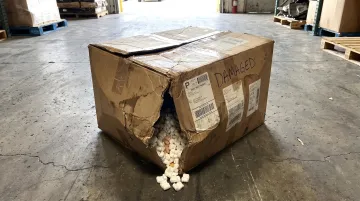
An electronics manufacturer shipping circuit board assemblies in single-layer kraft cartons pays less per box upfront. The problem: kraft provides no meaningful compression resistance under pallet stacking or repeated drops.
Research from Packaging Digest found that as much as 11% of unit loads arriving at distribution centers showed some level of case damage. Switching to double-wall corrugated (ECT-48, rated to 80–180 lb gross weight under carrier rules) adds structural integrity at every handling point. The cost of even a handful of damaged shipments quickly exceeds the per-unit price difference.
For businesses shipping across complex supply chains — from e-commerce fulfillment to government procurement — corrugated offers the specification compliance and protective performance that kraft isn't designed to provide. Cardboard Boxes 4 U carries corrugated configurations built for these demands, including standard RSC boxes, MIL-SPEC government-spec options, and ESD-protective boxes for electronics manufacturers.
Conclusion
Kraft and corrugated aren't interchangeable — they solve different problems. Kraft is well-suited for lightweight retail packaging, food items, and eco-focused consumer products where handling is minimal. Corrugated is built for the demands of real shipping environments: compression loads, drop impacts, moisture exposure, automated warehouse handling, and regulatory compliance.
For businesses in distribution, manufacturing, or government contracting, the choice of box is an operational decision. The right corrugated specification — wall type, ECT rating, flute profile, and applicable standard — directly affects product damage rates, replacement costs, and compliance. Matching the spec to the application before you order is far less expensive than correcting a mismatch after product losses mount at the distribution center. If you're sourcing corrugated for industrial, government, or high-volume shipping applications, working with a supplier that stocks specialty configurations — including MIL-SPEC and weatherized options — can simplify that decision considerably.
Frequently Asked Questions
What is the difference between a kraft box and a corrugated box?
Kraft boxes consist of a single layer of kraft paper — lightweight, flexible, and well-suited for retail and light-duty packaging. Corrugated boxes use a multi-layer construction with a fluted medium sandwiched between linerboards, providing greater strength, impact resistance, and load-bearing capacity purpose-built for shipping.
What is the strongest type of cardboard box?
Triple-wall corrugated boxes are among the strongest available, rated for 240–300 lb gross weights under carrier rules and used for industrial and pallet-level shipping. For most commercial applications, double-wall corrugated (ECT-48 or higher) offers the best balance of strength and cost.
What are the three main types of boxes?
The most common categories are folding cartons (thin paperboard for retail), corrugated boxes (multi-layer combined board for shipping and storage), and rigid or set-up boxes (thick non-folding boards for premium packaging). Kraft boxes fall within the folding carton category.
Can kraft paper be used in corrugated boxes?
Yes. Kraft paper is a core component of most corrugated boxes — the linerboards and fluted medium are often made from kraft-process paper. The distinction lies in the multi-layer corrugated architecture, not the paper type itself.
Which box is better for shipping heavy or fragile items?
Corrugated is the clear choice. The fluted core absorbs impact, resists compressive loads, and maintains structural integrity through multiple handling points and long transit routes. A single-layer kraft box is not designed for those conditions.
Are corrugated boxes more expensive than kraft boxes?
Corrugated carries a higher base cost due to multi-layer manufacturing. For high-value or heavy shipments, though, reduced product damage and fewer freight claims typically offset the per-unit price difference.