Both wall types are built from the same core materials: linerboard and corrugated fluting. What separates them is how many layers are bonded together, and that structural difference determines everything from weight capacity to compliance eligibility for government shipments.
This guide breaks down the construction, strength ratings, weight capacities, and ideal applications for each — so you can match the right box to the actual job.
Key Takeaways
- Single wall (3-ply) suits lightweight shipments under ~30 lbs; double wall (5-ply) handles 80–140+ lbs
- ECT ratings for single wall run 23–55; double wall starts at 42 ECT and goes significantly higher
- Over-specifying with double wall adds unnecessary material and freight cost — match the spec to the actual load
- Government and military shipments often require double wall or specialty formats like V11C (600 PSI) per ASTM D5118
- Electronics assemblies require static-dissipative or conductive corrugated — standard double wall isn't sufficient
Quick Comparison: Single Wall vs. Double Wall
| Factor | Single Wall | Double Wall |
|---|---|---|
| Construction | 1 flute layer + 2 linerboards (3-ply) | 2 flute layers + 3 linerboards (5-ply) |
| Typical ECT Range | 23–55 ECT | 42–82 ECT |
| Max Gross Weight | 20–120 lbs (by ECT/size per Railinc UFC 6000-M) | 80–180 lbs (by ECT/size) |
| Cost (12×12×12 benchmark) | ~$1.09/unit (200 lb test) | ~$2.33/unit (275 lb DW) |
| Best For | E-commerce, lightweight goods, retail | Heavy parts, fragile/high-value items, industrial |
| Compliance | Standard carrier rules | ASTM D5118, MIL-STD-2073 capable |
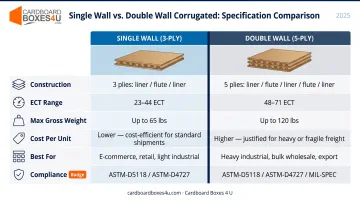
Cost benchmark from public Uline SKU pricing for same-size boxes; not an industry average.
What Is a Single Wall Box?
Single wall corrugated consists of one wavy corrugated medium (the fluting) bonded between two flat linerboards — a 3-ply board. The Fibre Box Association describes this as the foundational corrugated construction, with the linerboards and fluted medium joined using starch-based adhesive.
"Corrugated" specifically refers to that fluted internal structure — not simply thick cardboard.
Flute Types Matter
The two most common flute profiles for single wall boxes are B-flute and C-flute, each with distinct trade-offs:
- B-flute — ~47 flutes per foot, flute height ~0.09–0.11 in. Offers better stacking strength and a smoother print surface. Originally developed for self-supporting canned goods packaging.
- C-flute — ~38 flutes per foot, larger profile. Provides more cushioning and higher vertical compression strength. The standard all-purpose choice for most shipping applications.
Smaller flute profiles improve graphics quality; larger profiles improve cushioning. That distinction matters when deciding whether a single wall box will also serve as retail-facing packaging.
Strengths and Limitations
Single wall boxes are available in ECT-32 (200#) for standard shipments and ECT-44 (275#) for heavier single wall applications. Strengths include:
- Lower per-unit material cost
- Lighter shipping weight, which reduces freight charges
- Wide size availability and easy handling
- Good surface for custom printing and branding
Limitations are worth noting before spec'ing these for demanding routes:
- More susceptible to crushing under stacked loads
- Lower puncture resistance than double wall
- Degrades faster in humid or wet conditions
- Not suited for multi-leg or international routes where handling is unpredictable
Single Wall Use Cases
Single wall dominates wherever products are light, low-risk, and high-volume:
- E-commerce fulfillment of clothing, books, and small accessories
- Retail shelf-ready packaging where print quality matters
- Internal warehouse transfers of non-fragile items
Research cited by SupplyChainBrain found the average e-commerce package is 50% empty, and that right-sizing corrugated reduced material use by 12.5% per order. Using a correctly specified single wall box — rather than defaulting to double wall — directly cuts per-shipment cost at scale.
What Is a Double Wall Box?
Double wall corrugated adds a second fluted layer and a third linerboard, producing a 5-ply board. The result is a box that's thicker and structurally distinct from single wall construction.
The two flute layers work together to absorb and redistribute impact energy. Under vertical (stacking) load, both layers resist compression simultaneously. Under lateral force, the middle linerboard separating them prevents the localized collapse that can buckle a single wall box.
That's why double wall boxes maintain shape under sustained pallet weight during extended warehousing.
ECT Ratings: What the Numbers Mean
Edge Crush Test (ECT) measures how much force the edge of a corrugated board can withstand before buckling — and it's the primary measure of stacking strength. Per Railinc's Uniform Freight Classification tables:
- Single wall entries: 23, 26, 29, 32, 40, 44, and 55 ECT
- Double wall entries: 42, 48, 51, 61, 71, and 82 ECT
Cardboard Boxes 4 U's standard double wall boxes are rated at ECT-48 (275# DW) — roughly 9% higher edge crush resistance than ECT-44 heavy-duty single wall, plus the structural advantage of two corrugated medium layers. Their Octagon Bulk Bins reach 71 ECT, designed for extreme industrial bulk loads.
Specialty Double Wall Configurations
Standard double wall covers most industrial needs. But certain industries require more:
- V11C (Government-Spec Double Wall) — 600 PSI bursting strength, conforming to ASTM D4727 and ASTM D5118. Available through Cardboard Boxes 4 U for defense and government procurement applications where MIL-STD-2073-1E packaging requirements apply.
- Conductive Black Corrugated Boxes — Static-resistant construction for electronic assemblies. Under ANSI/ESD S541, ESD-sensitive items require appropriate packaging properties through production, transport, and storage — and conductive or dissipative corrugated is one compliant component.
Recyclability
Double wall uses more material, but it's fully recyclable through standard cardboard streams — and its durability often allows reuse for return shipments or internal transfers before it reaches the recycling bin.
Double Wall Use Cases
Double wall is the standard or required choice across:
- Industrial manufacturing — heavy machine parts, metal components, bulk industrial items
- Electronics assembly — especially where ESD-protective corrugated is needed alongside physical protection
- Aerospace and defense — where packaging specifications are documented and traceable
- Government and military procurement — requiring ASTM D5118-compliant containers
- Palletized warehouse storage — where boxes must withstand sustained compression under pallet weight without collapsing
Which Configuration Is Right for You?
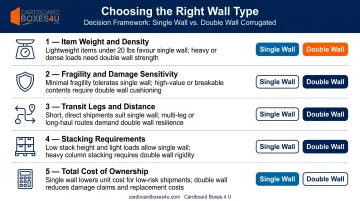
Neither wall type is universally better. The right choice depends on five factors:
- Item weight and density — Single wall handles up to ~65 lbs at 32 ECT/200 psi; double wall starts at 80 lbs minimum gross weight in standard tables
- Fragility and damage sensitivity — Fragile or high-value goods justify double wall's higher per-unit cost
- Transit legs and distance — More handling events mean more impact exposure; double wall absorbs that better
- Stacking requirements — Palletized storage with multiple box layers stacked demands higher ECT
- Total cost of ownership — Unit cost is only part of the equation. Packaging Digest reports that roughly 2% of unit loads arriving at distribution centers show case damage, with rates as high as 11% in some operations
Situational Recommendations
Choose single wall when:
- Shipping items under approximately 20–30 lbs
- Using direct or short-distance routes with minimal handling
- Prioritizing cost reduction on high-volume, low-value shipments
- Packaging retail-ready goods where print quality matters more than crush resistance
Choose double wall when:
- Shipping items above 30 lbs, especially above 65 lbs
- Sending products through multi-leg or international supply chains
- Stacking boxes during warehousing or palletizing
- Packaging fragile, high-value, or moisture-sensitive items
- Operating in regulated industries requiring ASTM D5118 or MIL-STD-2073 compliance
The Over-Specification Problem
Defaulting to double wall for everything is not automatically safer or smarter. Every double wall box adds material weight to the shipment — and freight carriers price by dimensional weight as well as actual weight. On high-volume operations shipping lightweight goods, that unnecessary mass compounds into meaningful additional freight cost. Match the specification to the actual product and transit requirement.
A Practical Scenario: Electronics Shipping
For electronics manufacturers shipping static-sensitive assemblies, the wall type question is secondary to the ESD question. Standard double wall provides physical protection, but circuit boards and electronic components need corrugated that also dissipates static charge. ANSI/ESD S541 defines the packaging properties required across production, transport, and storage for ESD-sensitive items.
Cardboard Boxes 4 U's Conductive Black Corrugated Boxes are built for this use case: static-resistant corrugated designed for electronics assembly manufacturers and distributors moving sensitive components through standard shipping environments.
Government and defense procurement introduces a separate set of documented requirements. The V11C double wall format (600 PSI, ASTM D4727/D5118 compliant) and the V3C/W5C single wall government-spec formats meet the performance standards procurement teams need on record. Cardboard Boxes 4 U's catalog of over 1,300 corrugated box sizes covers these specialty configurations alongside standard ECT-48 double wall and conductive formats.
Conclusion
Single wall delivers cost efficiency and practicality for everyday lightweight shipments. Double wall provides the strength, protection, and compliance capability needed for heavier, more demanding, or regulated applications. Neither is the universal answer.
The operational value comes from matching construction to actual need:
- ECT rating matched to the load weight and stacking requirements
- Wall type suited to the transit environment and handling conditions
- Specialty configuration when compliance documentation or environmental protection is required
Match those three variables correctly and you reduce damage rates, lower total packaging cost, and stop paying for material your shipment doesn't need.
Frequently Asked Questions
What is the difference between single wall and double wall boxes?
Single wall has one corrugated flute layer bonded between two linerboards (3-ply). Double wall has two flute layers and three linerboards (5-ply). That extra layer significantly increases crush resistance, stacking strength, and maximum weight capacity.
Is single wall or double wall better?
Neither is universally better. Single wall is the right choice for lightweight, low-risk shipments where cost and weight matter. Double wall is better for heavy, fragile, or high-value items and supply chains with more transit legs and handling events.
How do you tell if a box is double walled?
Look at the cut edge of the board. Single wall shows two flat linerboards surrounding one wavy fluted layer. Double wall shows three flat linerboards with two distinct wavy layers between them, giving you five total layers visible in cross-section.
What weight can a single wall box hold?
Weight capacity depends on ECT rating, box dimensions, and size — not wall type alone. Per Railinc's Uniform Freight Classification tables, single wall boxes range from 20 lbs at 23 ECT to 120 lbs at 55 ECT. The commonly cited 20–65 lb range reflects only the lower ECT ratings (23–32 ECT).
Can double wall corrugated boxes be recycled?
Yes. Double wall corrugated is fully recyclable through standard cardboard recycling streams. Their durability also makes them candidates for reuse — for return shipments or internal transfers — before they reach the recycling bin.
What is a triple wall box, and when is it needed?
Triple wall has three corrugated flute layers and four linerboards. It's used for extremely heavy industrial loads, bulk export, or applications requiring maximum compression strength: heavy machinery, bulk chemicals, and military freight where double wall falls short.