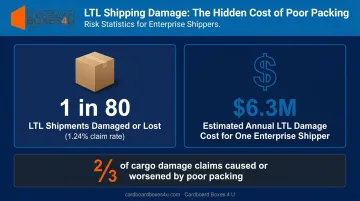
The reality is that packaging decisions touch every node in the supply chain. They determine how much damage occurs in transit, what freight costs look like at scale, whether shipments pass customs inspection, and how efficiently pallet space is used on every single truck that leaves a facility. According to TT Club's cargo claims data, two-thirds of cargo damage claims are caused or worsened by poor packing — a figure that puts packaging quality at the center of loss prevention, not at the margins of it.
This article breaks down how packaging functions as an operational variable across the supply chain — covering product protection, logistics cost management, and regulatory compliance — and what it costs when those functions are treated as afterthoughts.
Key Takeaways
- Two-thirds of cargo damage claims trace back to poor packing, making packaging a first line of defense against cargo loss
- Carrier DIM weight pricing (UPS and FedEx both use a 139 divisor) means oversized boxes are billed above their actual weight
- Fanfold corrugated fits nearly twice the usable material per trailer versus pre-formed boxes
- Non-compliance with 49 CFR government packaging standards carries civil penalties up to $238,809
- Format changes compound fast — efficiency gains from one packaging decision multiply with every order shipped
What Is Packaging in the Supply Chain?
Supply chain packaging is the system of materials, formats, and specifications used to contain, protect, identify, and move products from origin through manufacturing, warehousing, distribution, and final delivery.
This is a distinct function from retail or consumer-facing packaging. While retail packaging is optimized for shelf appeal and brand communication, supply chain packaging is optimized for:
- Physical protection against compression, vibration, drops, moisture, and electrostatic discharge
- Handling efficiency — how quickly and safely warehouse teams can pick, pack, and stage shipments
- Density and cube utilization — how many units fit on a pallet or in a trailer
- Compliance — meeting carrier, government, or safety standards for specific product categories
Every node in the supply chain is affected by packaging decisions. A box that's two inches too wide reduces pallet utilization across every load. A non-compliant container can hold up an entire shipment at customs.
A corrugated grade that's too light adds return and replacement costs that show up far removed from the original packaging purchase — making packaging decisions one of the most consequential variables in total logistics spend.
Key Advantages of Packaging in the Supply Chain
The advantages below are measured by operational outcomes — cost reduction, risk mitigation, and compliance performance — not abstract or theoretical benefits.
Product Protection and Damage Prevention
Protective packaging is the first line of defense against product loss. Depending on the industry, goods face compression, vibration, drops, moisture, and electrostatic discharge across multiple handling events before they reach their destination.
The right packaging format creates a physical buffer between transit stresses and the product itself. For standard goods, a properly specified corrugated box absorbs the majority of transit forces. For fragile, high-value, or sensitive items, the format matters considerably more.
Korrvu® suspension packaging suspends a product in airspace between two layers of elastomeric film, so it never makes direct contact with the corrugated structure during an impact. Korrvu® retention packaging uses a similar film mechanism to hold items securely within a retention frame, combining shock absorption with product visibility. Cardboard Boxes 4 U stocks all three Korrvu® formats (suspension, retention, and compression) as part of their specialty corrugated line, specifically for high-value, fragile, or return-eligible goods.
For electronics and electronic assemblies, Conductive Black Corrugated Boxes address a separate but equally serious risk. Electrostatic discharge from personnel, equipment, and work surfaces can silently damage components with no visible evidence of failure.
Why the damage numbers matter: Flock Freight's 2025 shipper research puts the LTL damage-and-loss claim rate at 1.24% — roughly 1 in 80 shipments. At enterprise scale, that same study estimates one shipper paid up to $6.3M annually on LTL damage in 2023. Beyond direct replacement cost, each damage event compounds through reverse logistics, customer service time, and brand damage.
KPIs affected: damage rate per shipment, return rate, cost of goods lost in transit, reverse logistics cost, customer satisfaction score
Primary use case: High-value, fragile, or compliance-sensitive goods: electronics, aerospace components, government/military equipment, where failure consequences extend well beyond the replacement cost of the item.
Logistics Cost Reduction and Space Efficiency
Packaging dimensions, weight, and format directly determine freight costs. This isn't a secondary effect . It's a primary cost mechanism that carriers have built into their pricing models.
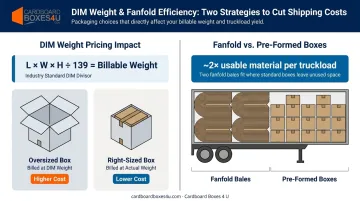
Both UPS and FedEx apply dimensional (DIM) weight pricing, where billable weight is the greater of actual scale weight and calculated DIM weight. UPS uses a divisor of 139 for Daily Rates and 166 for Retail Rates; FedEx's 2026 Service Guide applies a 139 divisor across US and international services. The practical effect: any box that's larger than it needs to be may be billed at a higher weight than the product actually weighs.
Right-sized packaging eliminates this exposure. Fewer cubic inches per unit means lower DIM weight, higher units per pallet, and more product per truck.
Fanfold corrugated takes this efficiency further. Because it ships as accordion-folded flat bales rather than pre-formed boxes, two fanfold bales fit side-by-side in a standard trailer , yielding nearly twice the usable packaging material per truckload compared to finished boxes. For high-volume operations, this directly cuts inbound shipping and storage costs. Cardboard Boxes 4 U offers fanfold corrugated in widths from approximately 6 to 86 inches, with each bale typically containing 750 to 1,500 linear feet of material.
Packaging standardization multiplies these savings. Working from a broad size inventory (Cardboard Boxes 4 U stocks over 1,300 corrugated box sizes) means operations can right-size across their entire product catalog without ordering custom boxes for every SKU, reducing procurement complexity and enabling higher-volume ordering.
KPIs affected: freight cost per unit, pallet utilization rate, warehouse cubic space usage, inbound shipping cost, packaging inventory carrying cost
Most critical for: High-volume shippers, distribution centers, and manufacturing operations where corrugated storage and inbound freight represent meaningful budget lines.
Regulatory Compliance and Supply Chain Traceability
In many industries, packaging isn't just a protection choice . It's a legal requirement. Specific materials, certifications, and labeling standards are mandated for shipping particular product categories, and failure to meet them carries real financial consequences.
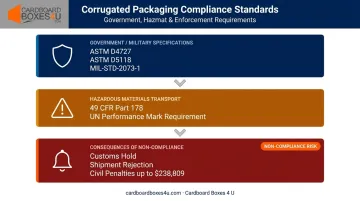
Government and military packaging must conform to documented specifications. Key active standards include:
- ASTM D4727: governs material-level properties of corrugated fiberboard
- ASTM D5118: governs fabrication of fiberboard shipping containers for government and military use
- MIL-STD-2073-1: covers the standard process for military packaging (active as of June 2024)
Both ASTM standards are active DoD standards adopted by the Defense Logistics Agency.
Cardboard Boxes 4 U's V3C and W5C configurations are manufactured to meet both ASTM D4727 and ASTM D5118 requirements. V3C boxes are fabricated from 350# Test corrugated with 400 PSI burst strength, meeting WRA (Water Resistant Adhesive) and MPA (Moisture-Proof Adhesive) standards. The company also stocks Fast Pack products carrying National Stock Numbers (NSNs), enabling direct procurement through DoD acquisition channels.
Hazardous material packaging operates under 49 CFR Part 178, which requires design-qualification testing for each packaging type before it can legally carry UN marks. Civil penalties for violations can reach $238,809 when a violation causes specified serious harm . Recent enforcement actions, including the $89,500 fine proposed against a shipper for improperly described and packaged air shipments, demonstrate that enforcement is active.
Traceability is the other compliance function packaging enables. Barcodes, RFID tags, and QR codes integrated into packaging labeling create trackable unit-level records that feed recall response, inventory accuracy, and audit readiness , particularly in aerospace, defense, and regulated industrial supply chains.
KPIs affected: compliance audit pass rate, customs clearance time, recall response time, inventory accuracy rate, regulatory fine exposure
Most critical for: Organizations shipping under government contracts, handling hazardous materials, or operating in aerospace, defense, and electronics supply chains.
What Happens When Packaging Is Overlooked
Packaging failures rarely announce themselves upfront. They compound quietly across shipments, inspections, and storage cycles — until one damage claim or compliance event reveals what the problem has been costing all along.
The operational consequences compound across every stage of the chain:
- Damage claims and returns increase when protective specifications are too light for actual transit conditions
- Freight overspend mounts on every shipment where oversized boxes trigger DIM weight billing above actual product weight
- Warehouse friction builds when non-standardized boxes create rework, repackaging bottlenecks, and inconsistent pallet configurations
- Compliance failures surface as customs holds, shipment rejection, contract penalties, or FAR-authorized cost recovery by the government — remedies that can include contractor-funded replacement, reinspection, and return transport
The reactive pattern is predictable: packaging issues go unaddressed until a significant damage claim, a failed inspection, or a compliance event forces a response. By then, the cost of the original packaging decision has been paid many times over. Specifying packaging proactively — before a failure event defines the standard — is consistently the lower-cost path.
How to Get the Most Value from Supply Chain Packaging
Getting value from packaging starts with matching specifications to actual product requirements — weight, fragility, environmental exposure, regulatory category — rather than defaulting to the cheapest or most familiar option.
Practical steps:
- Conduct a packaging audit — map each product category to its specific transit risks and compliance requirements before selecting formats
- Right-size across your SKU catalog — work from a broad size inventory to eliminate void space and reduce DIM weight exposure without custom orders for every product
- Standardize where possible — consistent box formats simplify warehouse procedures, reduce procurement complexity, and enable volume pricing
- Select specialty formats where they earn their cost — suspension packaging, ESD-protective corrugated, and government-spec containers carry higher per-unit costs that pay back through reduced damage claims and compliance exposure
- Revisit regularly — packaging choices should be reviewed as shipment volumes, carrier pricing, product mixes, or regulatory requirements change
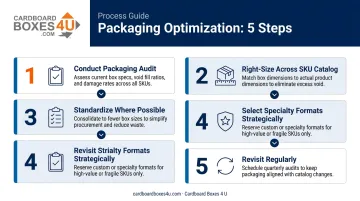
Executing steps 2 through 4 depends heavily on supplier range. Cardboard Boxes 4 U stocks over 1,300 corrugated box sizes, plus specialty formats — Korrvu® suspension systems, Conductive Black Corrugated for ESD-sensitive electronics, government-spec V3C and W5C containers, and Fanfold corrugated for inbound density — so operations can standardize on standard formats while sourcing compliant specialty formats from a single supplier.
Packaging optimization is an ongoing process. As carrier pricing, product mixes, and compliance requirements shift, so should your specifications — making periodic reviews as important as the initial selection.
Frequently Asked Questions
What is packaging in the supply chain?
Supply chain packaging refers to the materials and formats used to contain, protect, identify, and move products through each stage — from raw material sourcing through warehousing, distribution, and final delivery. The primary goals are transit damage prevention, handling efficiency, and regulatory compliance, not consumer-facing presentation.
What are the 4 C's of packaging?
The 4 C's of packaging are Containment, Convenience, Communication, and Cost-efficiency — covering secure product holding, ease of handling through the supply chain, product and compliance labeling, and economic optimization across procurement, freight, and storage.
How does packaging affect transportation costs?
Packaging dimensions determine freight costs through carrier DIM weight pricing — both UPS and FedEx bill at the greater of actual or dimensional weight. Right-sized packaging reduces DIM weight exposure, and high-density formats like Fanfold corrugated significantly lower inbound freight costs for high-volume operations by reducing volume per unit of material shipped.
What types of packaging are most commonly used in supply chain management?
Corrugated cardboard boxes are the dominant format due to their strength, stackability, and recyclability. Alongside standard RSC boxes, supply chain operations commonly use protective inserts, suspension and retention packaging for fragile goods, corrugated sheets for pallet layering, and specialty corrugated formats for regulated or high-sensitivity applications.
Why is packaging compliance important in logistics and distribution?
Many industries require packaging to meet specific government, carrier, or safety standards — such as ASTM D4727 and D5118 for government corrugated, or UN performance ratings under 49 CFR for hazardous materials. Non-compliant packaging can result in shipment rejection, customs delays, fines, or contract penalties, with civil penalties for hazmat violations reaching up to $238,809.
How does corrugated packaging support sustainability goals in the supply chain?
AF&PA estimates that 69%–74% of cardboard available for recovery was recycled in the US in 2024 — making corrugated one of the highest-recycled packaging materials in use. Right-sizing corrugated boxes further reduces material consumption and freight-related emissions per shipment, supporting measurable sustainability targets.