Introduction
Bulk packaging is straightforward in concept: industrial-grade containers designed to hold large quantities of product in a single unit, built for storage, transit, and handling — not for the end consumer's shelf. But choosing the wrong format creates real problems.
Poor bulk packaging decisions compound quickly:
- Oversized boxes inflate dimensional weight charges
- Standard corrugated fails in moisture-heavy environments, triggering damage claims
- Pre-assembled boxes shipped to warehouses waste trailer space and floor space
- Government and defense suppliers face bid disqualification if packaging doesn't meet spec grades
This guide covers what bulk packaging actually is, the formats businesses use most, and a practical framework for choosing the right option. That includes specialized scenarios: government contracts, electronics shipments, and high-volume distribution operations.
Key Takeaways
- Bulk packaging consolidates large quantities into fewer handling units, reducing per-unit shipping and labor costs
- Fanfold corrugated ships flat and delivers nearly twice the transportation cube efficiency of pre-assembled boxes
- Electronics, government, and fragile-goods applications each require specialized packaging formats that standard RSC boxes cannot satisfy
- ASTM D5118 governs finished corrugated containers; ASTM D4727 governs the fiberboard material itself — understand both before purchasing for compliance-sensitive applications
- Requesting certification documentation from suppliers is required for government and defense procurement
What Is Bulk Packaging?
Bulk packaging refers to industrial-grade containers used to consolidate large quantities of product into a single handling unit. It's the opposite of retail packaging — no branding, no single-unit presentation. The priorities are durability, load efficiency, and cost per unit shipped.
Two functions define it:
- Protection: Contents must survive repeated handling, stacking, and transit without damage
- Logistics optimization: Fewer handling units means lower labor, freight, and processing costs — provided the format matches your operation's volume and workflow
Where Bulk Packaging Fits in the Supply Chain
Understanding packaging levels helps clarify why material choice matters:
- Primary packaging directly contains the product (a bottle, a blister pack)
- Secondary packaging groups primary units (a cardboard tray, a shrink-wrapped multi-pack)
- Tertiary packaging consolidates goods for storage, handling, and transport — pallets, corrugated bulk containers, stretch-wrapped loads
Bulk packaging operates at the tertiary level. This is where structural integrity and material specification have the biggest impact on whether goods arrive intact and whether your logistics costs stay under control. A flute grade that's too light collapses under stack weight. An uncertified container gets rejected at a government receiving dock.
Regulatory definitions add another layer. For hazardous materials, PHMSA sets specific thresholds: more than 450 L capacity for liquids, more than 400 kg net mass for solids, or more than 454 kg water capacity for gases. Outside hazmat regulation, "bulk" is a functional description — large-format, multi-unit, transport-layer packaging.
Types of Bulk Packaging Solutions
Corrugated Bulk Boxes
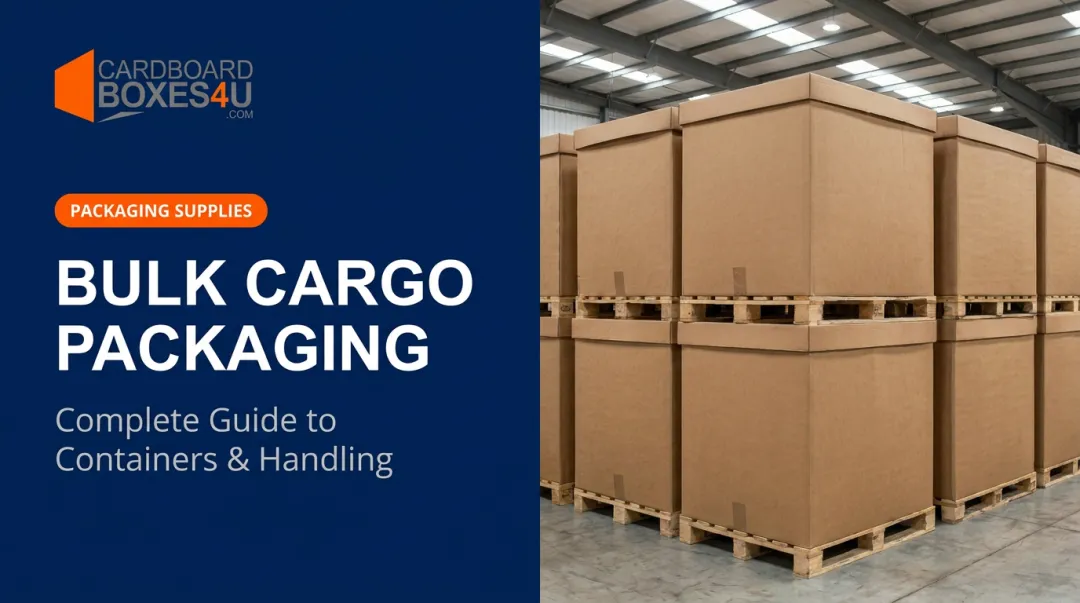
Corrugated boxes are the backbone of industrial shipping — stackable, recyclable, and adaptable across nearly every industry. Cardboard Boxes 4 U stocks over 1,300 corrugated box sizes, ranging from compact 4" × 4" × 4" units to heavy-duty Gaylord containers at 48" × 40" × 48", giving businesses the size precision needed to eliminate dimensional weight surcharges without custom manufacturing.
Standard stock boxes run 200#/ECT-32 kraft corrugated. Heavy-duty double-wall options (ECT-48) handle heavier industrial loads.
Specialty Corrugated Formats
Fanfold corrugated is a continuous accordion-folded board shipped as a compact bale, typically 1,000–1,500 linear feet per bale. Two bales fit side-by-side in a standard trailer, making the transportation cube nearly twice as efficient as pre-assembled finished boxes (which ship large volumes of air inside each unit). On the receiving end, fanfold stores flat and deploys quickly, cutting warehouse footprint without sacrificing material availability.
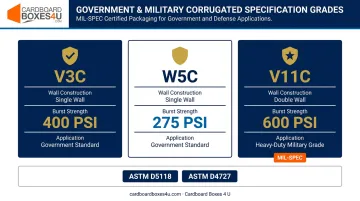
Government and military specification grades — V3C, W5C, and V11C — are required for federal and defense procurement:
| Grade | Wall Type | Burst Strength |
|---|---|---|
| V3C | Single Wall | 400 PSI |
| W5C | Single Wall | 275 PSI |
| V11C | Double Wall | 600 PSI |
These grades conform to ASTM D5118 (finished container performance) and ASTM D4727 (fiberboard material specifications), and meet WRA moisture-resistance standards. Standard RSC boxes do not satisfy these requirements.
ESD and Conductive Corrugated
According to ESDA, many electronic components can be damaged by static discharge below 100 volts — far below what ordinary materials generate through contact and separation. Conductive Black Corrugated Boxes dissipate electrostatic charges from personnel, equipment, and work surfaces before they reach the product. For electronics manufacturers and distributors handling circuit boards, assemblies, or sensitive components, standard corrugated creates an active risk. Conductive packaging removes that risk entirely.
Suspension and Retention Packaging
Korrvu-style packaging suspends products between layers of resilient film rather than resting them against box walls. When the outer container absorbs a drop, the product stays buffered — isolated from the impact. This sets it apart from common alternatives:
- Loose-fill peanuts shift during transit, leaving products exposed at impact
- Foam inserts compress permanently and lose effectiveness after one drop
- Korrvu film retains its protective properties after repeated drops and returns
The film also keeps the product visible through the packaging, which matters for high-value goods with display requirements.
Other Bulk Formats
| Format | Best For |
|---|---|
| FIBCs (bulk bags) | Dry flowables — sand, cement, seeds, powdered coatings |
| Drums and barrels | Liquids, hazardous materials |
| Palletized stretch-wrapped loads | Mixed case consolidation for LTL/FTL freight |
| Intermediate Bulk Containers (IBCs) | Regulated liquids and solids, up to 3.0 cubic meters per 49 CFR |
Key Benefits of Bulk Packaging for Businesses
Cost Reduction
Bulk packaging cuts costs in two ways: lower per-unit material cost when purchasing at volume, and fewer total shipments for the same product quantity. Cardboard Boxes 4 U offers volume tiers from 100-piece minimums up to 100,000-unit bulk runs with competitive PPV pricing, and the per-unit cost difference between those tiers is substantial.
Right-sizing matters here too. Carriers charge dimensional weight on oversized boxes. A business shipping product in a box that's two inches too large in each dimension pays for air, and at volume, that adds up fast.
Storage and Space Efficiency
Flat-packed corrugated formats store more packaging material per square foot of warehouse space than pre-assembled boxes. Fanfold bales, for instance, hold 1,100–1,500 linear feet of corrugated material in a compact footprint. The equivalent capacity in pre-made boxes would require significantly more racking space — and every unused pallet position in a warehouse has a real dollar cost.
Product Protection
Packaging Digest reports that an average of 2% of unit loads arrive at distribution centers with some case damage. At scale, that's a significant revenue loss. Purpose-built packaging addresses this directly:
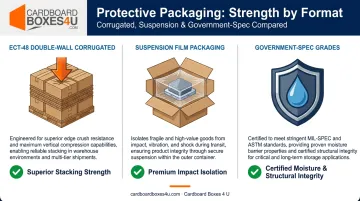
- Heavy-duty ECT-48 double-wall corrugated handles stacking pressure that standard corrugated can't
- Suspension packaging isolates fragile products from impact entirely
- Government-spec grades maintain structural integrity under moisture exposure
Compliance and Certification
Industries supplying government, military, or defense agencies must confirm packaging meets applicable specification grades. ASTM D5118 covers finished container construction and performance; ASTM D4727 covers the fiberboard material itself. Missing either exposes businesses to failed inspections, rejected shipments, and contract disqualification.
Cardboard Boxes 4 U carries products with National Stock Numbers (NSNs) and documented MIL-SPEC compliance. Request that documentation before assuming a supplier qualifies.
Sustainability
AF&PA reports that 69–74% of cardboard available for recovery was recycled in the US in 2024. Corrugated boxes are among the most recycled industrial materials available. Beyond recyclability, flat-shipping formats like fanfold reduce the number of inbound freight runs required to supply the same volume of packaging material — a direct operational efficiency with environmental benefit.
How to Choose the Right Bulk Packaging Solution
Start with Product Characteristics
The product dictates the format. Before evaluating any packaging option, answer these questions:
- Weight: Does the box need ECT-32, ECT-44, or double-wall ECT-48?
- Fragility: Does the product require suspension packaging or standard cushioning?
- Sensitivity: Is there moisture exposure, temperature variation, or ESD risk?
- Hazard classification: Are there regulatory requirements for containment or labeling?
A heavy industrial component and a static-sensitive circuit board have nothing in common from a packaging standpoint. Treating them the same way guarantees one of them ships wrong.
Assess Volume and Storage Efficiency
High-velocity shipping operations benefit from fanfold corrugated or flat-pack formats that maximize trailer and warehouse space utilization.
Businesses with varied SKU dimensions need supplier inventory depth. A supplier stocking 1,300+ box sizes makes it possible to find a near-exact fit at stock pricing, rather than paying custom manufacturing lead times and minimums for every non-standard dimension.
Evaluate Compliance Requirements
Government and defense buyers must verify:
- Grade designation matches contract requirements (V3C, W5C, V11C)
- Finished container compliance with ASTM D5118
- Fiberboard material compliance with ASTM D4727
- WRA moisture-resistance standards
Requesting compliance documentation — Certificates of Conformance, test reports, or NSN listings — is not optional in these segments. Confirm documentation availability before placing an order.
Consider Total Cost of Ownership
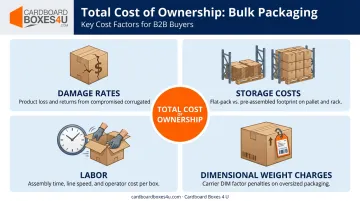
Unit price is not the full picture. Factor in:
- Damage rates: Cheap packaging that fails costs more than premium packaging that holds
- Storage costs: Pre-assembled boxes consume racking space; flat-pack formats don't
- Labor: Packaging that's awkward to assemble and fill adds handling time across thousands of units
- Dimensional weight charges: Over-sized boxes inflate freight costs on every shipment
Match Supplier Capability to Operational Needs
The right supplier should cover standard stock, specialty formats, and custom manufacturing without requiring you to split procurement across multiple vendors. Cardboard Boxes 4 U stocks over 1,300 box sizes alongside government-spec formats (V3C, W5C, V11C), conductive ESD boxes, and Korrvu suspension packaging. Custom manufacturing starts at 100 pieces, making it practical to source both standard fulfillment needs and compliance-sensitive applications from one supplier.
Frequently Asked Questions
What is an example of bulk packaging?
A common example is a large corrugated box used to ship dozens of units to a distribution center, or a fanfold corrugated bale delivered to a manufacturing plant and converted into custom box sizes on demand. What makes it bulk packaging is the consolidation — multiple units or a large continuous material supply in a single handling unit, designed for logistics efficiency rather than consumer presentation.
What are the 5 P's of packaging?
Common versions include Product, Protection, Preservation, Presentation, and Price/Performance — though no single industry-standard definition exists across organizations like PMMI or TAPPI. For bulk packaging decisions, Protection and Price/Performance carry the most weight, since durability and cost per unit drive most procurement choices.
What are the main types of bulk packaging solutions for businesses?
The most common formats are corrugated bulk boxes (including specialty grades like government-spec and ESD), FIBCs for dry flowable materials, drums and barrels for liquids and hazardous goods, and palletized stretch-wrapped loads for mixed freight. The right choice depends on product type, volume, regulatory requirements, and industry.
How does bulk packaging reduce shipping costs?
Consolidation reduces the number of shipments for the same volume. Flat-pack formats like fanfold reduce inbound freight costs by shipping nearly twice the packaging capacity per trailer compared to pre-assembled boxes. Right-sized packaging eliminates dimensional weight surcharges and reduces damage claims by improving load stability.
What certifications should I look for in bulk packaging?
For US businesses, ASTM D5118 (corrugated container performance) and ASTM D4727 (fiberboard material specifications) are the primary standards for government and defense applications; WRA standards cover moisture resistance. Government and defense buyers should request documented compliance from suppliers before procurement.
What is the difference between bulk packaging and retail packaging?
Retail packaging targets the end consumer — branding, single-unit presentation, shelf appeal. Bulk packaging targets logistics — durability, handling efficiency, and cost per unit at volume. The priorities are opposite: retail packaging maximizes presentation; bulk packaging maximizes protection and transport efficiency.