Introduction
A rejected government contract. A shipment of damaged components. A compliance audit that reveals your fiberboard boxes don't meet spec. These aren't hypothetical scenarios — they're the real consequences of misunderstanding two ASTM standards that govern a significant portion of commercial and defense packaging in the United States.
ASTM D3951 and ASTM D5118 work as a pair. One defines what your packaging must accomplish; the other defines how the box must be built to accomplish it. Together, they form the foundation of compliant packaging for government contractors, defense suppliers, electronics manufacturers, and industrial shippers alike.
This article covers:
- What each standard requires and how they work together
- Which shipment types fall under each standard
- How to determine when DoD shipments must follow D3951 versus the stricter MIL-STD-2073
- Key differences that affect government contractors and defense suppliers
Key Takeaways
- ASTM D3951 sets performance requirements: packages must survive multi-modal transit, store for at least one year without degradation, and support redistribution without repackaging.
- ASTM D5118 sets fabrication requirements: how fiberboard boxes must be constructed, including adhesive/fastener controls and material specifications.
- D3951 defines what a package must do; D5118 defines how the box is built. The two standards are complementary, not interchangeable.
- DoD shipments use D3951 only when five specific conditions are met; all others default to MIL-STD-2073.
- V3C is the heavier-duty grade (~400 PSI burst strength); W5C is the medium-duty grade (~275 PSI) — selecting the right one matters for compliance and product safety.
What Is ASTM D3951? Understanding the Standard Practice for Commercial Packaging
ASTM D3951-18(2023) — officially titled "Standard Practice for Commercial Packaging" — establishes minimum requirements for the preservation, packaging, packing, unitization, and marking of supplies and equipment. One clear boundary: it explicitly excludes ammunition, explosives, and hazardous materials covered under Title 49 of the Code of Federal Regulations.
Scope and Core Requirements
According to ASTM and confirmed by the Defense Logistics Agency, D3951 rests on three non-negotiable performance requirements:
- Multi-modal transit handling — packages must withstand handling and shipment by multiple parties across any mode of transportation
- Minimum one-year enclosed storage — the package must protect its contents without degradation or damage for at least one year in enclosed facilities
- Redistribution readiness — package quantities must be suitable for redistribution without additional repackaging or remarking
The standard's appendix provides guidance on cushioning and dunnage materials — the materials that control shock and limit product movement during transit. Confirmed dunnage categories include blocking, bracing, cushioning wraps, void fill, and plastic wrap. Loose-fill materials (peanuts, shredded paper) are prohibited for DoD, GSA, and aerospace facility shipments under DLA policy — though this prohibition is a DLA overlay, not a universal D3951 requirement.
When ASTM D3951 Applies to Military and DoD Shipments
Material selection is only part of the equation. D3951 isn't limited to purely commercial use — The DoD Packaging and Marking Guide confirms that D3951 applies instead of MIL-STD-2073 when a shipment meets all five of the following conditions:
- The item is intended for immediate use (not stock)
- The item fulfills a Not-Mission Capable Supply requirement (non-mission-critical)
- The item is intended for depot operational consumption
- The shipment goes small parcel within CONUS (not for stock)
- The delivery is a direct vendor delivery (CONUS only)
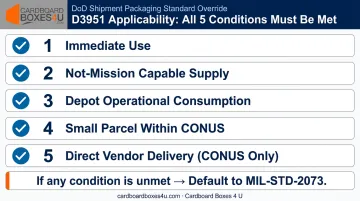
If even one condition isn't met, the shipment defaults to MIL-STD-2073, the stricter military packaging standard. Misclassifying a shipment in either direction carries real consequences: over-engineering wastes budget, while under-engineering risks rejected deliveries and compliance violations.
What Is ASTM D5118? The Standard for Fiberboard Box Fabrication
ASTM D5118/D5118M-25 — updated January 24, 2025 — is the "Standard Practice for Fabrication of Fiberboard Shipping Boxes." It replaced the former federal specification PPP-B-636, and it governs both corrugated and solid fiberboard box constructions. Where D3951 tells you what the package must do, D5118 tells you how the box must be built.
The standard controls manufacturing consistency by specifying requirements at the manufacturer's joint — the seam where box panels meet. Joints on grades like V3C and W5C may be secured with either adhesive or metal fasteners, depending on the grade requirements.
Key Material and Construction Specifications
D5118 references ASTM D4727 for fiberboard sheet stock material properties, covering:
- Fiberboard type and grade
- Paperboard thickness (facings and corrugated medium dimensions)
- Liner durability and weather-resistance classifications
Testing methods cited include TAPPI T 810 for burst strength and TAPPI T 811 for edge crush resistance (ECT). These tests verify real-world logistics performance, including performance under varying humidity and temperature conditions.
V3C and W5C Fiberboard Grades Under ASTM D5118
Both grades are weather-resistant corrugated fiberboard defined under ASTM D4727 and fabricated into finished boxes per ASTM D5118. Understanding which grade to use requires knowing your product's weight, fragility, and shipping environment.
| Attribute | V3C | W5C |
|---|---|---|
| Wall Type | Single-wall | Single-wall |
| Duty Rating | Heavy-duty | Medium-duty |
| Burst Strength | ~400 PSI | ~275 PSI |
| Facing Thickness | 0.23 inches | 0.16 inches |
| Weather Class | Severe (V) | Less severe (W) |
| Typical Use | Instruments, gauges, sensitive meters | Electronic modules, circuit boards |
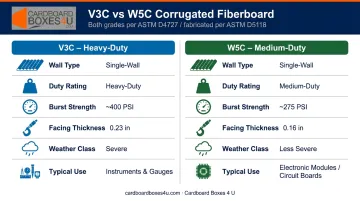
The "V" prefix in V3C indicates weather resistance for severe conditions; "W" in W5C indicates water resistance for less severe overseas use. V3C is the higher-strength grade — a point that matters when selecting boxes for heavier or more rugged applications.
For buyers sourcing to spec, Cardboard Boxes 4 U stocks ASTM D5118-certified V3C and W5C corrugated boxes in 191+ V3C configurations and multiple W5C sizes. Weatherized coated variants that also meet ASTM D4727 are available in bundle and pallet quantities for government, defense, and industrial procurement.
How ASTM D3951 and ASTM D5118 Work Together
These two standards address different dimensions of packaging compliance — but they're designed to operate as a system.
| Standard | Role | What It Covers |
|---|---|---|
| ASTM D3951 | Performance | What the complete packaging system must achieve — transit survival, storage, redistribution. Doesn't specify box construction. |
| ASTM D5118 | Fabrication | How a fiberboard shipping box must be built — joint methods, adhesive types, material grades, testing benchmarks. Doesn't define system-level requirements. |
| ASTM D4727 | Material | Defines the grades (V3C, W5C, V11C) used to manufacture D5118-compliant boxes. |
Why You Need Both
Relying on one standard without the other creates real compliance gaps:
- A box built to D5118 spec can still fail if the overall packaging system — cushioning, blocking, markings, unitization — doesn't meet D3951 requirements
- A D3951-compliant packaging plan is weakened if the fiberboard box used doesn't meet D5118 construction standards
For government and military procurement, both standards frequently appear simultaneously in contract language. A DLA solicitation referencing ASTM D3951-18 and MIL-STD-2073-1 is common; so is a Navy solicitation citing D5118 alongside other packaging specs. Buyers and suppliers should always verify which standards are cited and whether additional standards like ASTM D4727 (for weatherized corrugated) also apply.
The Four Levels of Packaging: Where These Standards Fit
Commercial and military packaging systems recognize four levels of packaging. Knowing which level a standard governs prevents a costly compliance mistake: applying requirements at the wrong tier.
| Level | DoD Term | Description | Primary Governing Standard |
|---|---|---|---|
| I | Unit Pack | Innermost package directly protecting the item | ASTM D3951 (preservation); MIL-STD-2073 (military) |
| II | Intermediate Pack | Grouping of unit packs for handling efficiency | MIL-STD-2073 (when applicable) |
| III | Exterior/Shipping Container | Outer container providing safe delivery | ASTM D5118 (fabrication); ASTM D3951 (performance) |
| IV | Unitization | Palletized or unit loads | MIL-STD-147; ASTM D3951 |
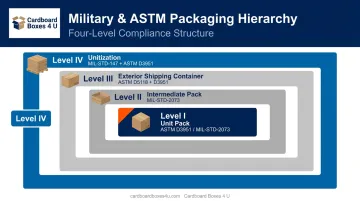
ASTM D3951 primarily governs Levels I, III, and IV — it sets performance requirements for the unit pack, exterior container, and palletized loads. ASTM D5118 most directly governs Level III: the physical fabrication of the exterior fiberboard shipping container.
With the tier structure clear, the next step is understanding what each standard actually requires — starting with ASTM D3951's performance criteria for unit packs and exterior containers.
Which Industries Need to Follow These Standards?
Government and Defense Contractors
The most frequent users of both standards. D3951 is explicitly required for certain DoD commercial shipments, and D5118's V3C and W5C grades are widely specified in government procurement contracts for corrugated containers. Raytheon's vendor packaging instructions require D3951 compliance directly, specifying void-fill, blocking, and cushioning requirements. Lockheed Martin Aeronautics (PM-5010J) requires sellers to mark all shipping containers per ASTM D3951-10.
Electronics and Electronic Assembly Manufacturers
MIL-DTL-75K (September 2022) explicitly requires fiberboard boxes to conform to ASTM D5118/D5118M for packaging electron tubes. Electronics manufacturers working under this specification need corrugated that meets:
- D5118 construction standards for consistent structural quality
- Appropriate grade selection (V3C, W5C) based on weight and hazard class
- ESD-rated corrugated for electrostatic discharge protection throughout the supply chain
Aerospace, Industrial, and Commercial Operations
Aerospace firms, industrial manufacturers, and e-commerce operations benefit from understanding these standards when shipping products that require documented proof of packaging compliance. FedEx, UPS, and insurance carriers do not publicly mandate ASTM D3951 or D5118 compliance.
In commercial contexts outside defense, these standards are contract-driven: prime contractors like Raytheon and Lockheed Martin flow requirements down to their suppliers, extending military packaging standards into civilian supply chains.
Frequently Asked Questions
What is ASTM D3951-18 standard practice for commercial packaging?
ASTM D3951-18(2023) sets minimum requirements for commercial packaging to withstand multi-modal transit, store for at least one year without degradation, and support redistribution without additional repackaging or marking. It covers preservation, packing, unitization, and marking for supplies and equipment, excluding ammunition, explosives, and hazardous materials.
What does ASTM D5118 mean?
ASTM D5118/D5118M-25 is the standard practice for fabricating fiberboard shipping boxes, specifying construction methods, material requirements, adhesive and fastener controls, and testing criteria. It ensures corrugated and solid fiberboard boxes meet consistent strength and durability benchmarks, replacing the former federal specification PPP-B-636.
What are the 4 levels of packaging?
The four levels are Unit Pack (innermost protection), Intermediate Pack (grouping of unit packs), Exterior/Shipping Container (outer fiberboard box), and Unitization (palletized loads). ASTM D3951 governs the overall packaging system performance; ASTM D5118 most directly applies at the exterior container level.
What is the difference between ASTM D3951 and ASTM D5118?
D3951 is a performance standard that defines what a commercial package must accomplish: transit survival, one-year storage, and redistribution readiness. D5118 is a fabrication standard that defines how a fiberboard box must be constructed. They are complementary standards that work together, not interchangeable alternatives.
When does ASTM D3951 apply to DoD or military shipments?
D3951 applies to DoD shipments when the item is for immediate use, non-mission-critical, intended for depot consumption, or ships via small parcel or direct vendor delivery within CONUS. Shipments that don't meet these conditions default to MIL-STD-2073.
What are V3C and W5C fiberboard grades?
V3C and W5C are weather-resistant corrugated grades defined under ASTM D4727 and fabricated into boxes per ASTM D5118. V3C is the heavier-duty grade (~400 PSI burst strength) suited for instruments and sensitive equipment; W5C is the medium-duty grade (~275 PSI) used for electronic modules and circuit boards.