This guide breaks down exactly how Gaylord box dimensions work: how they're expressed, which sizes are standard in North America, how wall count interacts with size to define weight capacity, and how to pick the right configuration for your application.
Key Takeaways
- Dimensions are always expressed as Length × Width × Height in inches
- The dominant North American footprint is 48" × 40", matching the standard GMA pallet per ISO 6780
- Inside dimensions govern product fit; outside dimensions govern pallet and trailer planning
- Wall count determines weight capacity, not box size alone
- The 48" × 40" × 36" and 48" × 40" × 40" are the most commonly stocked configurations
What Gaylord Box Dimensions Mean in Corrugated Packaging
Defining the Container
A Gaylord box — also called a bulk bin, skid box, or pallet box — is a large corrugated bulk container designed to sit on a standard pallet for storage and transport of loose, granular, or packaged goods.
The name traces to the Gaylord Container Company (trademark filed 1962, registered 1964) and is now used generically across the US and Canada for triple-wall corrugated pallet boxes.
How Dimensions Are Measured
Dimensions are always listed in Length × Width × Height order, in inches:
- Length — the longest base dimension
- Width — the shorter base side
- Height — vertical measurement from bottom to top of the assembled box
ASTM D2658 ("Standard Test Method for Determining Dimensions of Fiberboard Boxes") governs how interior and exterior dimensions are determined. The practical implication for buyers:
- Inside dimensions → use for product fit calculations
- Outside dimensions → use for pallet footprint matching and trailer cube planning
Wall thickness, liner type, corner geometry, and flap style all reduce usable interior volume from the outside measurement. For a real-world example, PCA Tharco's 425# double-wall bulk container has outside dimensions of 48" × 40" × 42.5" but inside dimensions of only 46" × 37.75" × 36.75" — a meaningful reduction that matters when you're planning fill volume.
Rectangular vs. Octagonal
Gaylord boxes come in two primary shapes:
- Rectangular — full interior corner space, preferred for stacked or boxed goods
- Octagonal (octabins) — angled corner panels that distribute internal pressure and reduce sidewall bulge, preferred for loose, flowable, or produce-type loads
Both shapes typically share the same nominal outside footprint (such as 48" × 40"). According to International Paper, octagonal double-wall and triple-wall totes provide more resistance to bulging than rectangular totes — making shape selection a functional decision, not just a preference.
Dimensions as a System
Footprint, height, and wall count must be selected together:
- Footprint — driven by pallet size (typically 48" × 40" for GMA standard pallets)
- Height — driven by load volume and facility clearances
- Wall count — driven by load weight and required stacking strength
Getting one of these wrong — oversizing height for a light load, or undersizing wall count for a dense material — leads to wasted cube, structural failure, or both.
Standard Gaylord Box Sizes and Specifications
No single regulated standard mandates Gaylord dimensions. Industry practice has converged on common footprints and heights driven by North American pallet standards (ISO 6780) and trailer constraints.
Common Footprints
The 48" × 40" footprint accounts for most Gaylord boxes in use. According to NWPCA, the 48" × 40" pallet is the most popular dimensional pallet at 35% of pallets in North America — and CHEP confirms this as the standard US pallet size.
Other footprints serve specific needs:
- 45" × 45" — used in produce and square-load applications
- 48" × 45" — broader loads in specific industries
- 40" × 40" and 36" × 36" — denser loads, smaller facilities, tighter trailer configurations (smaller footprint = more units per trailer but less per-box volume)
Height Options and Size Reference
Height selection is driven by load density and facility constraints:
- 24"–30" — dense or heavy loads filled by hand (shallower reach-in depth)
- 36"–40" — most common general-purpose warehouse configurations
- 48"–60" — light, bulky goods where volume fill, not weight, is the limiting factor
The table below shows common configurations with calculated cubic footage from outside dimensions. Note that usable inside volume is smaller per ASTM D2658 — verify exact inside dimensions with your supplier before specifying.
| Nominal Outside Dimensions | Approx. Cubic Feet | Typical Use Case |
|---|---|---|
| 48" × 40" × 24" | 26.7 cu ft | Dense/heavy goods, hand-loaded |
| 48" × 40" × 30" | 33.3 cu ft | Medium-density loads |
| 48" × 40" × 36" | 40.0 cu ft | General warehouse (most common) |
| 48" × 40" × 40" | 44.4 cu ft | General warehouse, higher volume |
| 48" × 40" × 48" | 53.3 cu ft | Lighter/bulky goods |
| 48" × 40" × 60" | 66.7 cu ft | Very light, high-volume loads |
| 45" × 45" × 40" | 46.9 cu ft | Square-base produce/specialty loads |
| 48" × 45" × 40" | 50.0 cu ft | Broader industrial loads |
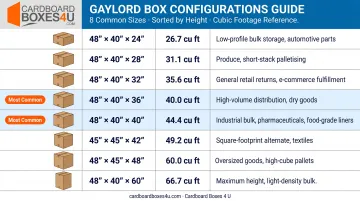
Cubic footage calculated arithmetically from outside dimensions. Confirm actual specifications with supplier.
If you're sourcing to spec, Cardboard Boxes 4 U stocks over 300 Gaylord-specific sizes, including confirmed configurations at 48" × 40" × 24", 48" × 40" × 36", 48" × 40" × 48", and 45" × 45" × 42". Certification and compliance documentation is available for government and industrial buyers. For non-standard footprints, contact us to confirm exact in-stock dimensions and volume pricing.
How Wall Count Affects Weight Capacity
Wall Count and Load Rating
Size and wall count are co-dependent. A box with the right footprint and height still fails if the wall configuration is undersized for the load ; over-specifying wall count adds unnecessary cost and tare weight.
Wall count configurations and typical strength ratings (product-specific data from major corrugated suppliers):
| Wall Configuration | Typical Strength Rating | Product-Specific Capacity Note |
|---|---|---|
| Single-wall | 200#/ECT-32 or 275#/ECT-44 | Example: 65 lb capacity at ECT-32 |
| Double-wall | 275#/ECT-48 or 51 ECT | Example: 100 lb max at 51 ECT (Uline) |
| Triple-wall | 90 ECT+ | Laminated designs can reach 3,000 lb |
| Quadruple/Five-wall | Varies by configuration | Require tested load rating — no universal range |
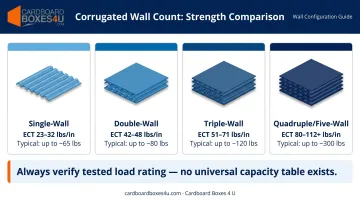
Important caveat: No universal weight-capacity table by wall count exists in industry standards. Actual ratings depend on the specific ECT rating, board grade, box compression test, and load configuration. Always verify the tested load rating for the exact box you're ordering — not a generic wall-count range.
What Wall Count Also Affects
Beyond capacity, wall count influences:
- Adds tare weight, reducing effective payload capacity
- Reduces usable interior volume as wall thickness increases
- Raises material cost; only specify what the load actually requires
Calculate your load weight per box first, then select the minimum wall count that meets that requirement with an appropriate safety margin.
Named Container Types
Once you've confirmed the right wall count, matching that spec to a named container type simplifies ordering. Five types are recognized by name in industry:
| Type | Approximate Dimensions | Typical Application |
|---|---|---|
| Standard | 48" × 40" × 36" | General palletized bulk storage |
| D | 58" × 42" × 45" | Large industrial bulk shipments |
| Mini D | 48" × 40" × 40" | Standard warehouse, slightly taller |
| E | 42" × 29" × 26" | Smaller dense shipments |
| EH | 36" × 22" × 22" | Compact specialty containers |
Note that dimensions vary by supplier and whether inside or outside measurements are cited — confirm the basis with your vendor. Cardboard Boxes 4 U stocks the Standard (48" × 40" × 36") in double-wall, triple-wall, and fire-retardant triple-wall configurations; contact their team to confirm availability of D, Mini D, E, and EH types.
How to Choose the Right Gaylord Box Size
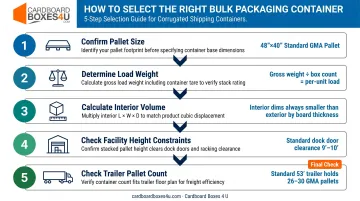
Follow this selection sequence to avoid mismatches:
- Confirm your pallet size — this fixes your footprint. For most North American operations, that means 48" × 40".
- Determine load weight: select the minimum wall count that covers it with a safety margin. Require a tested ECT or Mullen rating, not a generic range.
- Calculate required interior volume — add a 10–15% buffer, then match to the smallest box height that covers it using inside dimensions per ASTM D2658.
- Check facility height constraints: account for dock door clearances, rack heights, and trailer ceilings, then work backward from those limits. A standard 53-foot dry van has a typical interior height around 110 inches. A 36" box on a standard 5.6" CHEP pallet stacks to ~41.6" loaded; a 48" box reaches ~53.6" — both clear single-layer without issue. Double-stacking requires a separate clearance check.
- Check trailer pallet count: a 53-foot dry van holds 26–30 pallet positions for 48" × 40" footprints on a single layer. Double-stacking works for shorter boxes only — confirm load stability and trailer height before building it into your plan.
Once you've locked in dimensions, choose your box shape based on what you're filling.
Shape Selection
- Rectangular: best for stacked, boxed, or uniform goods that use the full interior corner space
- Octagonal: better for loose, flowable, or produce-type loads where corner panels distribute internal pressure and reduce sidewall bulge
Common Mistakes When Specifying Gaylord Box Dimensions
Using Outside Dimensions for Product Fit
Outside measurements overstate usable interior space — wall thickness and corner geometry both reduce the volume your load actually has to work with. A box that looks adequate on paper may not physically fit the intended product.
Per ASTM D2658, inside dimensions govern product fit. Always confirm which dimension basis your supplier's catalog uses — inside or outside — before running any volume calculations.
Mismatching Box Footprint to Pallet Size
Ordering a 45″ × 45″ footprint box when your operation runs 48″ × 40″ pallets — or vice versa — creates overhang, instability, or wasted pallet deck space. Confirm your pallet dimensions before finalizing the box order.
Treating Height as Flexible After the Fact
Buyers sometimes order a standard height and then discover the loaded box doesn't clear a rack, dock door, or truck ceiling. Height selection must account for the loaded box height: box dimension + pallet height (typically 5.5–6″) + any load extending above the box top. Run the clearance check against that total before committing to a height.
Before placing any Gaylord order, run through these three checks:
- Interior dimensions confirmed with supplier (not outside measurements)
- Pallet footprint matched to your operation's standard pallet size
- Loaded height calculated including pallet + any load above the box top
Frequently Asked Questions
What are standard Gaylord box dimensions?
No single regulated standard governs Gaylord dimensions, but the most widely used configurations are 48" × 40" × 36" and 48" × 40" × 40", both matching the GMA pallet footprint per ISO 6780. Heights range from 24" to 60" depending on load type and facility constraints.
What defines a Gaylord box?
A Gaylord box is a large corrugated bulk container — typically double-wall to triple-wall construction — designed to sit on a standard pallet for bulk storage and shipping. The term is used generically in the US and Canada across industrial, distribution, and manufacturing applications.
Are Gaylord box dimensions measured inside or outside?
Published dimensions typically refer to outside measurements, but this varies by supplier. Per ASTM D2658, inside dimensions are smaller due to wall thickness — use inside dimensions for product fit and outside dimensions for pallet and trailer planning. Always confirm the basis with your supplier.
How much weight can a Gaylord box hold?
Capacity depends on the specific ECT or Mullen rating — not wall count alone. Double-wall boxes at 51 ECT may be rated to 100 lbs, while triple-wall configurations can handle significantly more. Always require the tested load rating for your exact box configuration rather than relying on a generic wall-count estimate.
What is the difference between a rectangular and octagonal Gaylord box?
Rectangular boxes offer full interior corner space for stacked or uniform goods. Octagonal boxes (octabins) have angled corner panels that distribute internal pressure and reduce sidewall bulge — they're preferred for loose, flowable, or produce-type loads where the contents push outward on the walls.
Can Gaylord boxes be ordered in custom dimensions?
Yes. Buyers with non-standard pallet footprints, specific height constraints, or unusual load profiles can work with specialized corrugated suppliers. Cardboard Boxes 4 U offers custom Gaylord manufacturing across a range of configurations — reach out directly to discuss your exact dimensional and load requirements.