Corrugated cardboard has dominated pizza box manufacturing for decades — and that's not inertia. It's the result of a three-layer engineered structure that simultaneously handles heat retention, structural load, moisture management, and food safety in a single lightweight material.
This article breaks down exactly why corrugated cardboard works for pizza boxes, what happens when operators use the wrong packaging, and how to match box specifications to your actual delivery operation.
TL;DR
- Corrugated cardboard's three-layer construction (outer liner, fluted medium, inner liner) gives it properties no single-layer paperboard can match
- The fluted air layer acts as passive insulation, slowing heat loss during transit
- The arch geometry of the flutes resists stacking loads without adding significant weight
- The Fibre Box Association reported a 93.6% OCC recycling rate for corrugated in 2022, making it one of the most-recycled packaging materials in the US
- Flute type, box sizing, and food-safe liner specifications all affect real-world performance, so not all corrugated pizza boxes deliver equally
What Is Corrugated Cardboard?
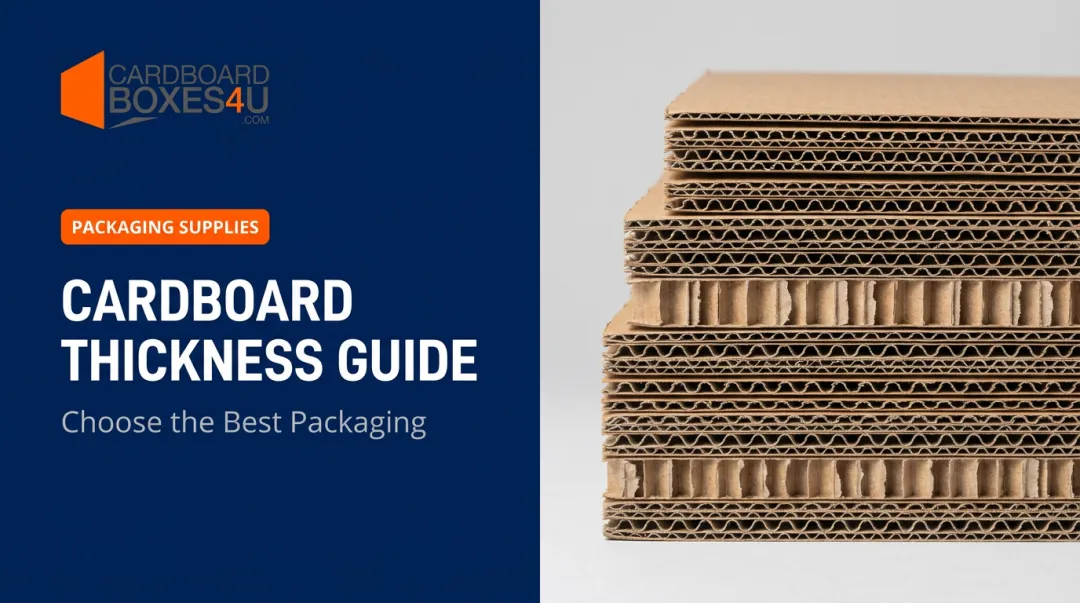
Corrugated cardboard is not the same material as the flat paperboard used in cereal boxes or folding cartons. It's a three-layer engineered composite: two flat liner sheets bonded to a wavy "fluted" medium sandwiched between them.
That fluted middle layer is what makes corrugated structurally distinct. According to the Fibre Box Association, the medium is formed into arches and glued between the linerboard facings — those arches distribute load across the panel rather than concentrating stress at any single point. The result is a lightweight material that delivers disproportionate rigidity and insulation relative to its mass.
B-Flute vs. E-Flute for Pizza Boxes
Two flute profiles dominate pizza box manufacturing:
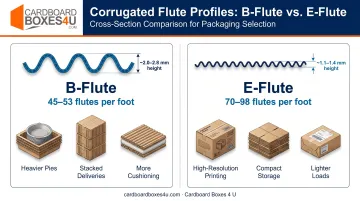
| Flute | Flutes per foot | Height | Best for |
|---|---|---|---|
| B-flute | 45–53 | ~2.0–2.8 mm | Heavier pies, stacked deliveries, cushioning |
| E-flute | 70–98 | ~1.1–1.4 mm | Branding-forward boxes, compact storage, lighter loads |
B-flute offers more cushioning and structural depth. E-flute's finer wave pattern creates a flatter outer surface — better for high-resolution printing when brand presentation matters. The choice affects not just performance but how many flat-packed blanks fit in a storage shelf.
Single-layer paperboard has none of this internal architecture. Without the fluted core, it has no mechanism to resist the steam and load a pizza generates. Under those conditions, it flexes, softens, and loses shape — the exact failure mode pizza delivery cannot afford.
Key Advantages of Corrugated Cardboard for Pizza Boxes
Each advantage below connects to a measurable outcome: product integrity on arrival, customer satisfaction, and packaging cost per unit. These properties explain why corrugated has held its position in food service packaging for decades.
Structural Strength and Stackability
The fluted medium inside corrugated board functions as a series of connected arches. Arches are one of the most load-efficient structural forms — they redirect compressive force along the curve rather than bearing it at a single point. This is why a corrugated pizza box maintains its shape under a stack of three or four additional boxes in a delivery bag, while a single-layer board box bows and buckles.
In real delivery operations, that difference is tangible. A driver carrying four boxes in an insulated bag applies downward pressure on every box in the stack. If the lid of a lower box deflects inward, cheese contacts the lid surface, toppings compress, and the product arrives damaged.
Research confirms the material's vulnerability to moisture. A 2024 study published in MDPI Applied Sciences found that corrugated board ECT values can fall to as low as 22% of reference values under high humidity conditions — which is why proper liner specifications and grease-resistant coatings matter, not just flute selection.
Structural integrity matters most for:
- Deep-dish and heavily topped pies (higher base weight)
- Deliveries over 15 minutes with multiple handling events
- Operations stacking 3–5 boxes per bag or transport bin
KPIs affected: delivery damage rate, customer complaint volume, product waste per shift
Thermal Insulation and Humidity Regulation
The trapped air within the fluted layer provides passive insulation. Heat from the pizza must travel through the inner liner, cross the air pockets in the fluted medium, and then exit through the outer liner. Each layer transition slows heat transfer — a property confirmed in structural panel research measuring corrugated cardboard's thermal conductivity at approximately 0.05 W/mK, attributed directly to the still air within the fluted structure.
But insulation alone isn't the full story. Pizza generates steam. Trap too much of that moisture and the crust goes soggy — which is a quality failure regardless of temperature. Corrugated boards, when combined with ventilation slots or perforations, allow controlled moisture diffusion while still slowing heat loss. Single-layer paperboard provides neither the insulation depth nor the structural room for that kind of controlled venting.
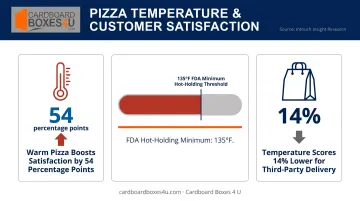
The FDA's minimum hot-holding threshold for food safety sits at 135°F (57°C). Packaging that allows pizza to drop below that threshold before delivery doesn't just hurt quality — it creates a food safety concern.
Temperature at delivery has a direct impact on perceived quality. Intouch Insight research found that warm pizza boosted customer satisfaction ratings by nearly 54 percentage points, and that food temperature scores were 14% lower for brands relying on third-party delivery drivers.
Thermal performance matters most for:
- Deliveries exceeding 15–20 minutes
- Cold weather conditions
- High-moisture pizzas (extra sauce, fresh mozzarella, vegetable toppings)
KPIs affected: pizza temperature at delivery, crust quality consistency, negative review rates
Cost-Effectiveness and Lightweight Design
Corrugated pizza boxes ship flat as die-cut blanks and are assembled at the point of use. That flat-pack format keeps storage requirements manageable for high-volume operations and reduces freight costs compared to pre-formed boxes. Cardboard Boxes 4 U's fanfold corrugated, for instance, fits two bale units side-by-side in a trailer — a transportation cube efficiency that's nearly twice that of finished pre-formed boxes.
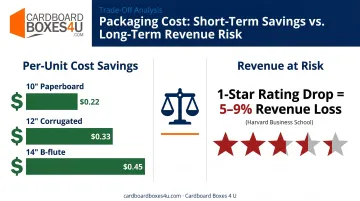
On a per-unit basis, corrugated pizza boxes run higher than single-layer paperboard alternatives. Current catalog pricing shows:
- 12" corrugated pizza box: ~$0.33 per unit
- 14" B-flute corrugated: ~$0.45 per unit
- 10" clay-coated paperboard box: ~$0.22 per unit
The cost gap is real, but it's not the right comparison in isolation. A single delivery complaint that results in a remake order or a refund erases the per-box savings from cheaper packaging many times over — and that calculation doesn't include the downstream effect on reviews.
Harvard Business School research found that a one-star increase in Yelp rating correlates with a 5–9% revenue increase for independent restaurants. Packaging failures that generate consistent negative reviews compound over time in ways that per-box cost comparisons don't capture.
KPIs affected: packaging cost per unit, storage space utilized, remake rate tied to packaging failure
Sustainability and Recyclability
Corrugated is one of the most actively recycled materials in US packaging. The Fibre Box Association reported a 93.6% recycling rate for old corrugated containers in 2022, with a three-year average of 91.3%. AF&PA data shows that in 2024, more than 80% of US paper mills use some recovered fiber, with more than half running predominantly on recycled furnish.
The grease question comes up often. The EPA's current guidance confirms that pizza boxes with grease can be recycled — remove food scraps and flatten the box. AF&PA draws the line at boxes that are completely saturated or soaked through: those should be composted or trashed, as heavy grease contamination interferes with the pulping process. Clean and lightly stained boxes re-enter the recycling stream without issue.
For operators with sustainability commitments, FSC-certified corrugated is available through select suppliers. FSC's own consumer research found that 62% of consumers aware of FSC certification would choose an FSC-certified product over a non-certified alternative — a relevant data point for brands where environmental positioning is part of the customer proposition.
What Happens When Pizza Boxes Aren't Made Right
What Happens When Pizza Boxes Aren't Made Right
Single-layer paperboard degrades quickly under pizza delivery conditions. Steam from a hot pizza softens the board within minutes, the base loses rigidity, and lid sag follows. The result: cheese contacts the lid, toppings compress or shift, and the customer receives a product that looks nothing like what was ordered.
That failure has a direct operational cost:
- Remake orders consume ingredients, labor, and delivery capacity
- Refunds reduce margin on already-thin delivery economics
- Negative reviews compound over time — research from Harvard Business School found that a one-star drop in rating can reduce revenue by 5–9%
Not all corrugated boxes avoid this outcome. Corrugated only outperforms if the specification is right:
- Wrong flute for the load: E-flute under a 20-ounce deep-dish pie will underperform B-flute in the same situation
- Incorrect box sizing: A box too large for the pizza allows it to slide and tip, regardless of how strong the board is
- Missing food-safe liner: An inner liner not rated for food contact creates a compliance exposure in regulated foodservice environments
Corrugated gives you the structural foundation — but only the right spec translates that into a box that holds up through the full delivery run.
How to Choose the Right Corrugated Pizza Box
Match your box selection to three operational variables:
1. Pizza weight and size Larger, heavier pies — deep-dish, stuffed crust, heavily topped — need B-flute construction. The added depth and cushioning capacity of B-flute handles compressive loads that E-flute wasn't designed for.
2. Delivery distance and conditions Longer routes benefit from better insulation. If your average delivery window exceeds 20 minutes, or if you operate in cold climates, prioritize boxes with adequate flute depth and consider ventilation perforations to manage steam without sacrificing heat retention.
3. Brand presentation requirements If custom printing is part of your packaging strategy, E-flute's finer surface provides better print resolution. Confirm with your supplier that inks used near food-contact zones comply with applicable food-contact standards under 21 CFR Part 176.
Beyond these three variables, verify that any inner liner contacting the pizza directly meets FDA food-contact requirements under 21 CFR Part 176. Request compliance documentation from your supplier before placing high-volume orders.
For operators who need non-standard corrugated configurations — unusual dimensions, specific flute profiles, or custom printing — Cardboard Boxes 4 U offers over 1,300 box sizes and custom manufacturing with lead times of 10–14 business days and minimums starting at 100 pieces. Contact their team at (888) 333-9513 or Sales@cardboardboxes4u.com to confirm available specifications.
Conclusion
Corrugated cardboard earns its position in pizza packaging through engineering, not convention. Its three-layer fluted structure handles structural load, thermal retention, humidity management, and food safety at onceIts three-layer fluted structure handles structural load, thermal retention, moisture management, and food safety in a single lightweight material — one that ships flat and assembles at the point of use.
The material is only as effective as the specification behind it. Flute type, box sizing, and inner liner ratings all affect how well corrugated performs under actual delivery conditions. Operators who treat packaging as a quality variable rather than a fixed overhead category protect both their product and the experience it delivers.
Frequently Asked Questions
Why is corrugated cardboard used for pizza boxes?
Corrugated cardboard's three-layer fluted structure provides structural strength, passive thermal insulation, and controlled moisture diffusion — properties that single-layer paperboard cannot replicate. That combination makes it the most reliable material for maintaining pizza quality from oven to door.
What is the best material for pizza boxes?
Corrugated cardboard is the industry standard for delivery and takeaway. Single-layer paperboard is acceptable only for very short-distance dine-in service where transit time is under a few minutes and stacking isn't a factor.
How does corrugated cardboard keep pizza warm?
The trapped air within the fluted middle layer slows heat transfer from the warm interior to the cooler exterior environment. Heat must cross multiple material boundaries before escaping, giving the pizza more time to arrive above acceptable temperature.
Can corrugated pizza boxes be recycled?
Clean or lightly greased corrugated pizza boxes are recyclable through standard curbside programs, as confirmed by the EPA. Boxes completely soaked through with grease should be composted or discarded, as heavy oil contamination disrupts the pulping process.
Is corrugated cardboard food-safe for direct pizza contact?
Food-grade corrugated pizza boxes use inner liners that comply with FDA food-contact standards under 21 CFR Part 176. Operators should request compliance documentation from their supplier, especially for custom-printed boxes where ink placement near food-contact zones needs verification.
What is the difference between E-flute and B-flute pizza boxes?
E-flute is thinner with a finer wave pattern, making it better for high-quality printing and compact storage with lighter standard pies. B-flute is thicker with greater cushioning depth, better for heavier pies or operations that stack multiple boxes under significant load during delivery.