Introduction
A shipment of electronic assemblies travels across three climate zones. It arrives with moisture damage — warped boards, corroded contacts, failed components. The culprit isn't always a flood or a burst pipe. Often, it's a packaging decision made without fully understanding what "waterproof" and "water-resistant" actually mean in practice.
These two terms get used interchangeably in procurement conversations, but they describe different levels of moisture protection. Choosing the wrong one doesn't just risk product damage — it can trigger failed compliance audits, inflated replacement costs, and unnecessary packaging spend.
According to TT Club's cargo damage analysis, maritime transit accounts for 65% of wet-damage claims, with road and storage making up another 27%. That exposure spans every stage of the supply chain — and the right protection level depends on knowing exactly what each term covers.
This guide breaks down the difference between waterproof and water-resistant packaging, the materials behind each, and how to choose the right protection level for your application.
Key Takeaways
- Waterproof packaging blocks water penetration under sustained or heavy exposure; water-resistant packaging repels light moisture like splashes and humidity
- No paper-based material achieves true waterproofing — materials like PE lamination and aluminum foil come closest
- V3C and W5C corrugated meeting ASTM D4727 and D5118 handles the vast majority of industrial and government shipping scenarios
- Water-resistant corrugated is recyclable; plastic laminates and foil barriers complicate end-of-life disposal
- Match your choice to moisture exposure intensity, not a "more is better" assumption
Waterproof vs. Water-Resistant Packaging: Quick Comparison
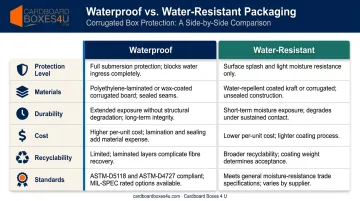
The table below breaks down the key differences across six decision factors — use it to quickly identify which protection level fits your application.
| Factor | Waterproof | Water-Resistant |
|---|---|---|
| Protection Level | Full barrier; resists sustained immersion or heavy moisture | Partial barrier; repels splashes, condensation, brief humidity |
| Materials | PE laminates, aluminum foil, silicone coatings, heavy plastic films | Hydrophobic coatings, wax treatments, weatherized corrugated (V3C, W5C) |
| Durability | Maintains integrity under extended water contact | Degrades under prolonged or sustained moisture exposure |
| Cost | Higher — advanced materials and manufacturing complexity | More cost-effective for most commercial applications |
| Recyclability | Often non-recyclable or requires specialized processing | Many options (especially ASTM-compliant corrugated) are recyclable |
| Standards | MIL-PRF-131, ASTM F1249 (WVTR testing) | ASTM D4727, ASTM D5118, ASTM D951 spray test |
What Is Waterproof Packaging?
Waterproof packaging creates a complete moisture barrier that prevents water penetration regardless of exposure duration or contact pressure. The key distinction from water-resistant packaging is full impermeability, not just resistance.
Materials That Achieve Waterproofing
The most common constructions include:
- Polyethylene (PE) lamination: applied to corrugated outer facings to block liquid water penetration; PPP-F-00320E requires at least 6 lb of PE per 1,000 sq ft for its Waterproof and Water Vapor-Resistant (WWVR) corrugated class
- Aluminum foil laminates: near-impermeable vapor and liquid barriers, governed by MIL-PRF-131 for military heat-sealable barrier materials
- Silicone coatings: used in specialty flexible packaging for water and vapor resistance
- Multi-layer polymer films: tested under ASTM F1249 for water vapor transmission rate (WVTR)
That said, none of these materials are universally certified "waterproof" by a single standard. ASTM D951, for example, is a spray test for finished shipping containers, not an immersion certification. Performance claims must reference a specific test, exposure condition, and pass criterion.
Trade-Offs Worth Knowing
Waterproof packaging comes with real costs beyond the purchase price:
- Raises unit cost due to lamination and manufacturing complexity
- Increases freight cost per shipment from added material weight
- Limits recyclability: PE and foil laminates are incompatible with standard corrugated recycling streams
- Creates compliance friction with eco-mandates in government and retail procurement
When Waterproof Packaging Is Appropriate
- Maritime shipping with sustained seawater exposure risk
- Military field deployments requiring MIL-PRF-131 or MIL-STD-2073-1 preservation methods
- Pharmaceutical distribution where moisture-sensitive drugs require validated low water-vapor permeation (per FDA container-closure guidance)
- Electronic components rated under IPC/JEDEC J-STD-033D, where moisture barrier bags provide a minimum 12-month shelf life from seal date
- Any application where even trace moisture contact carries catastrophic consequences
What Is Water-Resistant Packaging?
Water-resistant packaging is a partial moisture barrier designed to repel light moisture exposure: condensation, rain splashes, surface humidity, and brief transit contact. It does not claim full impermeability, and its performance is defined by standardized testing rather than a blanket label.
Standards That Define It
Three ASTM standards govern water-resistant corrugated, each covering a different scope:
- ASTM D4727 — specifies corrugated and solid fiberboard sheet stock; governs material composition and performance characteristics
- ASTM D5118 — governs fabrication practices for corrugated and solid fiberboard shipping containers
- ASTM D951 — spray test method for a finished container's resistance to water deterioration or penetration
WRA and MPA designations within the ASTM D4727/D5118 framework indicate specific levels of water resistance and moisture protection built into the board itself, not separate external certification bodies.
How It Performs Under Humidity
A 2019 Clemson University study of 3,000 corrugated boxes found that compression strength declined approximately 7% for each 1 percentage-point increase in board moisture content, with board moisture rising from 6.7% at 30% RH to 13.7% at 90% RH. Water-resistant treatments delay moisture uptake, preserving compression strength in transit and reducing product damage claims.
Government Spec Grades: V3C and W5C
Cardboard Boxes 4 U's V3C and W5C corrugated are the most documented water-resistant configurations for demanding supply chain environments:
| Grade | Wall Type | Bursting Strength | Facings | Standard |
|---|---|---|---|---|
| V3C | Single Wall | 400 PSI | 0.23" | ASTM D4727 / D5118 |
| W5C | Single Wall | 275 PSI | 0.16" | ASTM D4727 / D5118 |
| V11C | Double Wall | 600 PSI | 0.23" | ASTM D4727 |
Both V3C and W5C meet WRA and MPA standards for water resistance, making them suitable for government and military procurement where specification compliance is required but full waterproofing is not mandated.
Recyclability Advantage
Spec compliance isn't the only advantage over fully waterproof alternatives — end-of-life disposal matters too. AF&PA's 2025 voluntary standard for coated or treated corrugated requires at least 60% fiber yield and no more than 20% rejects to confirm repulpability.
Water-resistant corrugated with hydrophobic coatings can meet this threshold — unlike PE laminates or foil barriers. Standard corrugated overall achieved a 69–74% recycling rate in the US in 2024 per AF&PA. Choosing ASTM-compliant water-resistant corrugated over fully waterproof formats preserves that end-of-life pathway.
Which Is Right for Your Needs?
The most common packaging mistake isn't under-protecting a shipment — it's over-engineering protection for an exposure scenario that doesn't require it.
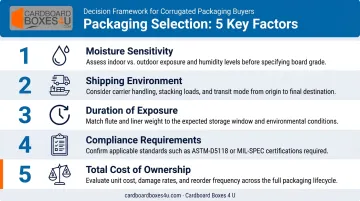
Key Decision Factors
- Moisture sensitivity: Will any moisture contact cause irreversible product failure, or is the risk measured in degradation over time?
- Shipping environment: Indoor warehouse vs. outdoor storage vs. maritime transit represent fundamentally different exposure profiles
- Duration of exposure: Brief transit humidity differs from prolonged rain or submersion risk
- Compliance requirements: Government and military specs may mandate specific grades (V3C, W5C) regardless of your own risk assessment
- Total cost of ownership: Factor in damage claims, returns, packaging weight, and recyclability costs — not just unit price
Clear Recommendations
Choose waterproof if:
- Your shipment faces submersion risk or prolonged outdoor exposure in high-rainfall conditions
- You're shipping to maritime or extreme-humidity environments
- Product failure from any moisture contact carries catastrophic consequences (certain medical devices, military-grade electronics under MIL-STD-2073-1)
Choose water-resistant corrugated if:
- Your shipments face typical transit moisture: humidity, rain splashes, condensation during refrigerated transport
- You need to balance protection with cost-efficiency and recyclability
- Your procurement requires ASTM D4727/D5118 compliance documentation
- You're shipping electronics where the moisture barrier bag (per J-STD-033D) handles primary protection and the outer corrugated handles structural and incidental moisture protection
For most industrial, retail, and government buyers, water-resistant corrugated meets spec requirements, reduces packaging costs, and keeps materials recyclable — without sacrificing protection for the exposure conditions those shipments actually face.
Real-World Application: Matching Moisture Protection to Industry
Defense and Government Electronics
A defense contractor shipping electronic assemblies across multiple climate zones — from humid coastal warehouses to arid field depots — needs moisture protection that holds up in transit without adding weight or creating recycling compliance issues.
V3C corrugated meeting ASTM D4727 and D5118 is the standard-compliant answer. It delivers:
- Consistent box compression strength across humidity ranges
- Compliance with government procurement specifications
- No recyclability or weight penalties from PE or foil lamination
The moisture barrier for electronic components is handled by the inner dry pack system (per J-STD-033D); the corrugated outer manages structural integrity and incidental environmental exposure.
Cardboard Boxes 4 U offers 191 V3C products in standard and custom sizes, with lead times of 10–14 days for custom work. Compliance documentation and certificates of conformance are available on request.
E-Commerce and Last-Mile Delivery
A consumer goods brand shipping clothing or home goods faces a simpler but still real moisture risk: doorstep exposure, rain during delivery, and condensation in refrigerated last-mile vehicles. Full waterproofing adds cost and conflicts with the sustainability commitments most retail brands carry publicly — water-resistant corrugated is the better fit. It handles incidental weather exposure, supports unboxing presentation, and stays compatible with standard corrugated recycling, which matters for brands with active eco-label commitments.
Choosing the Right Protection Level
Most buyers across industrial, retail, government, and electronics sectors will find that certified water-resistant corrugated meets their protection needs. The exceptions — submersion risk, extreme outdoor exposure, pharmaceutical or military zero-tolerance applications — genuinely require waterproof solutions.
If you're evaluating corrugated options for moisture-sensitive shipments, explore Cardboard Boxes 4 U's range of ASTM D4727/D5118-compliant V3C and W5C configurations to find the right protection level without paying for more protection than your application needs.
Conclusion
Waterproof and water-resistant packaging are not interchangeable — and treating them as such drives both unnecessary cost and real damage risk. The right choice comes from evaluating moisture exposure intensity, product sensitivity, and compliance requirements honestly, rather than assuming heavier protection automatically means better outcomes.
For the majority of B2B shippers — electronics manufacturers, government contractors, e-commerce distributors, and industrial suppliers — water-resistant corrugated meeting ASTM D4727 and D5118 standards delivers the right balance of protection, cost efficiency, and recyclability. If your current spec hasn't been reviewed against actual exposure conditions, that's the right place to start — before a damage claim or a failed audit makes the decision for you.
Frequently Asked Questions
What is waterproof packaging?
Waterproof packaging creates a complete moisture barrier that prevents water penetration even under sustained exposure or immersion, using materials like PE laminates, aluminum foil, or silicone coatings. It differs from water-resistant packaging, which repels only light or brief moisture contact without achieving full impermeability.
What material is 100% waterproof?
No paper-based material is truly 100% waterproof under all conditions. Polyethylene lamination, aluminum foil laminates, and silicone coatings come closest by creating near-impermeable barriers, while ASTM-certified corrugated with hydrophobic treatments resists water penetration but does not fully block it.
What type of cardboard is waterproof?
No standard cardboard is fully waterproof, but corrugated board with heavy PE or foil lamination can approach waterproof performance. Most "waterproof cardboard" claims actually describe water-resistant corrugated with hydrophobic coatings, such as V3C and W5C configurations meeting ASTM D4727 and D5118.
Can corrugated boxes be made water-resistant without losing recyclability?
Yes — ASTM-compliant hydrophobic coatings and weatherized corrugated configurations can deliver effective water resistance while remaining compatible with standard recycling streams. The 2025 AF&PA/FBA voluntary standard requires at least 60% fiber yield in repulpability testing — a threshold well-designed coated corrugated can meet.
What is the difference between water-resistant and weatherproof packaging?
"Weatherproof" covers a broader range of environmental stresses — temperature swings, UV, wind, and moisture — while "water-resistant" refers specifically to moisture protection. Weatherized government-spec corrugated (V3C, W5C) addresses both under ASTM D4727 and D5118.
When should I use waterproof vs. water-resistant corrugated packaging?
Waterproof is necessary for submersion risk, extreme outdoor exposure, or zero-tolerance applications in medical or military contexts. For most industrial, retail, e-commerce, and government transit scenarios, water-resistant corrugated is the better choice — more cost-effective, sustainable, and fully compliant when moisture exposure is incidental.