The concept sounds straightforward. The calculation isn't. Accurate results for 5-ply construction require specific test conditions, correct sample preparation, and an understanding of the variables that swing your readings. This article walks through all of it.
Key Takeaways
- 5-ply (double-wall) corrugated boxes consist of three liners and two fluted mediums, giving them significantly higher stacking and burst resistance than single-wall boards
- Bursting strength is measured via the Mullen hydraulic diaphragm test (TAPPI/ANSI T 810); double-wall boards typically fall in the 200–600 psi range
- Samples must be conditioned at 23°C ± 1°C and 50% ± 2% RH per ISO 187:2022 until mass equilibrium is confirmed — not just a fixed time window
- Liner grade, flute type, moisture content, and adhesive bond quality all directly affect your burst reading
- Mullen burst data paired with ECT values gives procurement teams the most complete performance picture
What Is Bursting Strength and Why It Matters for 5-Ply Boxes
Bursting strength is the maximum hydraulic pressure a corrugated board can withstand before it ruptures — expressed in psi or kPa. It's a face-rupture measurement: force applied perpendicular to the board wall until the material fails. This makes it distinct from stacking or compression resistance, which measure top-to-bottom load bearing.
For applications where boxes experience drops, impacts, or dense contents pushing outward against the walls, bursting strength is the relevant metric. Compression strength tells you how many pallets you can stack — burst strength tells you whether the wall holds when a forklift clip or an awkward drop applies sudden lateral force.
The 5-Ply Construction Advantage
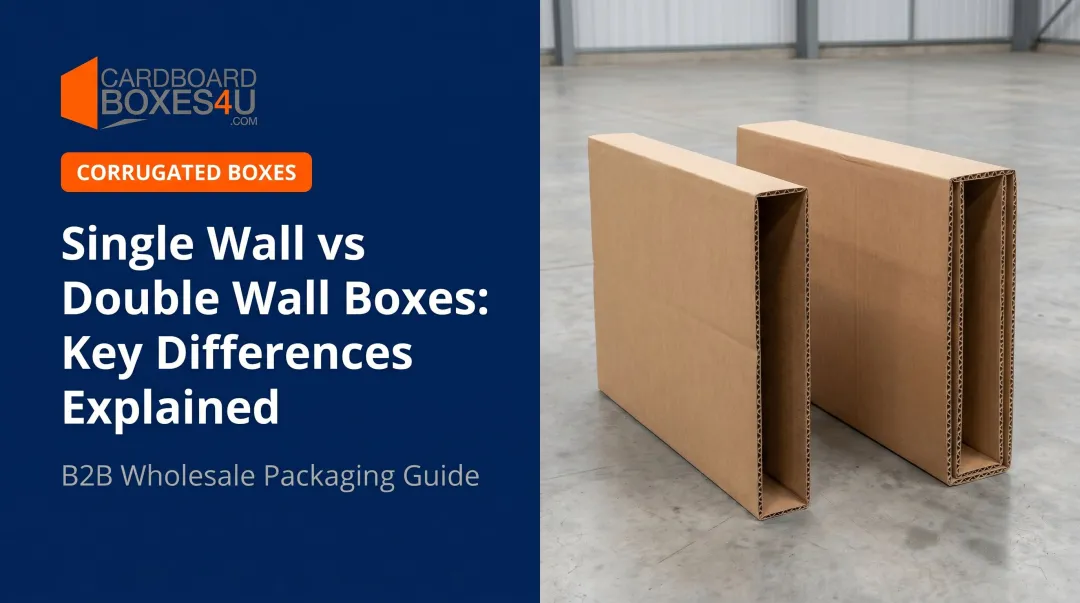
According to the Fibre Box Association, double-wall (5-ply) corrugated board consists of three sheets of linerboard with two fluted mediums between them. That layered structure — outer liner, fluted medium, center liner, fluted medium, inner liner — gives 5-ply boxes measurably more burst resistance than single-wall (3-ply) boxes, which use only two liners and one medium.
That said, "5-ply" is a construction description, not a guaranteed performance level. Actual bursting strength varies based on liner grade, flute type, and adhesive quality. Two boxes with identical ply counts can test at very different values.
| Construction | Liner Count | Fluted Mediums | Typical Burst Range |
|---|---|---|---|
| 3-ply (single-wall) | 2 | 1 | 125–200 psi |
| 5-ply (double-wall) | 3 | 2 | 200–350+ psi |
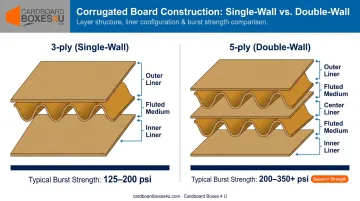
Ranges vary by liner grade and flute combination. Verify against your BMC stamp or tested samples.
Finding the Declared Rating: The BMC Stamp
Most corrugated boxes carry a Box Manufacturer's Certificate (BMC) — a circular stamp printed on the bottom flap. Per the NMFTA's guidance on NMFC Item 222, this stamp governs freight compliance for motor-carrier shipments and typically lists:
- Minimum burst rating (psi) or ECT value
- Combined facings weight (lb per 1,000 sq ft)
- Maximum box size (outside L + W + D in inches)
- Maximum gross weight (box plus contents)
- Box manufacturer identification
For quality-critical applications, treat the BMC value as the starting point — not the final answer. Verify it against tested samples from your actual batch.
How to Calculate Bursting Strength for a 5-Ply Corrugated Box
Calculating bursting strength involves two components: running the physical Mullen burst test to get the raw pressure reading, then applying a formula to derive the bursting index for material comparison. Both are covered below.
Step 1: Prepare and Condition the Sample
Cut your specimen from the 5-ply board in an area free of creases, fold lines, printing, or moisture damage. The sample must be large enough to cover the tester's full clamping area without reusing any previously clamped zone.
Conditioning is non-negotiable. Per ISO 187:2022, the standard atmosphere is:
- Temperature: 23°C ± 1°C
- Relative humidity: 50% ± 2% RH
- Equilibrium criterion: two weighings at least 1 hour apart must differ by no more than 0.25% of specimen mass
ISO 187 notes that high-grammage boards can require 48 hours or longer to reach equilibrium. Condition until the mass stabilizes — never apply an arbitrary fixed duration.
Testing an unconditioned sample introduces moisture variability that makes results unreliable and non-comparable across batches.
Step 2: Mount the Sample and Run the Mullen Burst Test
The governing U.S. method for double-wall corrugated board is TAPPI/ANSI T 810 om-22, which covers burst values from 690 to 4,825 kPa (100 to 700 psi). The international equivalent is ISO 2759:2014.
Follow this sequence:
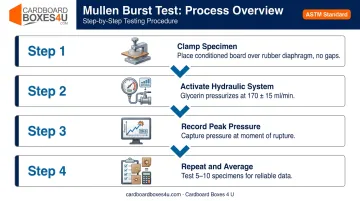
- Clamp the conditioned specimen firmly over the rubber diaphragm of the bursting strength tester — no slippage, no air gaps. Inadequate clamping pressure directly compromises accuracy.
- Activate the hydraulic system. Under ISO 2759, the glycerin pressurizes the diaphragm at a controlled rate of 170 ± 15 ml/min until the specimen ruptures.
- Record the peak pressure at the moment of rupture. Modern digital testers capture this automatically.
- Repeat on 5–10 specimens from different areas of the same board batch. ISO 2759 specifies 20 valid tests for full reporting; at minimum, average across multiple specimens for statistically reliable quality control data.
5-ply boards specifically: The multi-layer construction can produce non-simultaneous bursts across the facing layers. Record whether results came from crushed or uncrushed board and keep those data sets separate — mixing them produces meaningless averages.
Step 3: Calculate the Bursting Index
With peak pressure values recorded, the next step is converting them into a normalized metric. ISO 2759:2014 defines the bursting index as:
Bursting Index (kPa·m²/g) = Mean Bursting Strength (kPa) ÷ Grammage (g/m²)
Grammage is measured per ISO 536 — you'll need a GSM cutter and precision scale. This normalizes the burst reading against material weight, allowing fair comparison between boards of different construction.
Example: If a 5-ply board tests at a mean of 2,000 kPa and its measured grammage is 800 g/m², the bursting index is 2.50 kPa·m²/g. A different board testing at 1,800 kPa but weighing only 650 g/m² yields a bursting index of 2.77 — stronger relative to its weight, despite the lower absolute reading.
For procurement teams qualifying new suppliers or validating spec changes, the bursting index is the right number to put in your acceptance criteria — it holds consistent regardless of whether liner weights shift between production runs.
Key Variables That Affect Bursting Strength Results
Two 5-ply boxes with identical dimensions can test at significantly different burst values. These are the variables that drive that gap.
Liner Paper Grade and GSM
The outer and inner liners are the primary contributors to burst resistance. Research published in Packaging Technology and Science found that adding 40% virgin pine fiber to a recycled fiber furnish increased the burst index of liner paper by approximately 63%. That's a meaningful difference at the finished box level.
Recycled-fiber liners are cost-effective and widely used, but shorter, less-structured fibers distribute burst pressure less effectively than virgin kraft. For applications where you need the upper end of the 200–600 psi double-wall range, liner grade selection matters.
Flute Type and Medium Quality
The corrugated medium distributes force across a wider area, reducing stress concentration at any single point. Heavier flute profiles — B or C flute, or BC combination flute in double-wall construction — generally contribute more to burst resistance than finer profiles like E flute.
The adhesive bond between liner and medium is just as important. Delamination or weak glue lines create stress concentration points where the board fails prematurely during testing, producing artificially low readings that don't reflect the material's true capability.
Moisture Content and Ambient Conditions
Corrugated board is hygroscopic — it absorbs moisture from the air. High humidity softens fiber bonds and reduces burst strength. The ISO 187 conditioning protocol exists for this reason.
A sample stored in a humid warehouse before testing will produce a lower burst reading than one properly conditioned. Neither result accurately represents in-service performance without controlling for ambient conditions.
Testing Parameters: Pressure Rate and Equipment Condition
ISO 2759 specifies a hydraulic rate of 170 ± 15 ml/min. Out-of-tolerance testing — whether faster or slower — produces results that are not comparable to standard-method values. Report any deviation explicitly rather than treating non-standard results as equivalent.
Two equipment checks to run before each test session:
- Pressure rate: Confirm the hydraulic rate falls within the 170 ± 15 ml/min spec before testing begins
- Diaphragm condition: Inspect for wear, cracking, or calibration drift — any of these produce inconsistent readings that undermine your sample average
Mullen Burst Test vs. Edge Crush Test for 5-Ply Boxes
Procurement teams regularly encounter both the Mullen burst rating and the Edge Crush Test (ECT) value without a clear sense of when each applies. They measure different things and answer different questions.
| Mullen Burst Test (T 810) | Edge Crush Test (T 811) | |
|---|---|---|
| What it measures | Resistance to face rupture under hydraulic pressure | Edgewise compressive stacking strength |
| Output | psi or kPa | lb/in or kN/m |
| Best for | Rough individual handling, drops, impact resistance | Palletized storage, bottom-of-stack loading |
| Example rating | 275# Mullen (275 psi minimum) | 48 ECT (48 lb/in) |
| Governing standard | TAPPI/ANSI T 810 om-22 | TAPPI/ANSI T 811 om-23 |
For double-wall 5-ply applications, published commercial specifications pair Mullen and ECT ratings across load capacities. The Fibre Box Association references the following performance thresholds as a baseline:
| Max Weight (lb) | Min Burst (psi) | Min ECT (lb/in) |
|---|---|---|
| 80 | 200 | 42 |
| 100 | 275 | 48 |
| 140 | 400 | 61 |
| 180 | 600 | 82 |
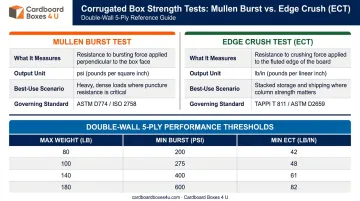
A box optimized for ECT may use lighter liners arranged differently than one built for Mullen performance. For heavy-duty 5-ply applications, specifying both values gives procurement teams a complete, verifiable strength profile.
Cardboard Boxes 4 U carries products rated across both metrics — ECT values of 32, 44, 48, and 71 lb/in, and burst ratings of 275, 400, and 600 psi — so buyers can match specifications to actual load requirements before ordering.
Common Mistakes When Testing or Specifying Bursting Strength
Even well-equipped labs produce unreliable data when testing protocols or specifications are flawed. These are the most common errors to avoid:
- Condition samples to mass equilibrium per ISO 187 — not for a fixed number of hours. Field-stored or unconditioned board introduces moisture variability that makes results non-comparable across batches.
- Average across at least 5–10 specimens from different areas of the board batch. One burst reading is statistically insufficient, and ISO 2759 requires 20 valid tests for full reporting.
- Use ECT, not Mullen rating, when specifying boxes for palletized stacking. Burst strength tells you nothing about how a box performs under a pallet load — that's compression performance, and ECT measures it directly.
- Inspect and replace the rubber diaphragm before each test session. A worn or cracked diaphragm produces inconsistent pressure distribution and skews results.
- For 5-ply boards that produce non-simultaneous bursts, record preparation method consistently and never average results from different test conditions.
Conclusion
Calculating bursting strength for a 5-ply corrugated box comes down to three essentials: proper sample conditioning to mass equilibrium, a correctly executed Mullen test per TAPPI T 810 or ISO 2759, and applying the bursting index formula to interpret results relative to material weight.
Burst strength gives you a reliable measure of puncture resistance, but it's only part of the picture. Pair it with ECT data — using the combined specification table as a guide — and source from suppliers who publish documented strength ratings tied to recognized standards. Together, those two data points tell you how a box performs under both impact and stacking load: the conditions your shipments face in real transit.
Frequently Asked Questions
How much weight can a corrugated box hold?
Weight capacity depends on box construction (ply count, flute type), ECT or Mullen rating, and how the contents are distributed inside. The Box Manufacturer's Certificate (BMC) on each box lists the maximum gross weight — box plus contents — that the specific construction is rated to carry within a defined size limit.
What is the difference between 5-ply and 7-ply corrugated boxes?
5-ply (double-wall) has two fluted medium layers for heavy-duty applications. 7-ply (triple-wall) adds a third fluted layer, increasing both burst and compression ratings for extreme loads or industrial export packaging, at greater material cost and box weight.
What is a good bursting strength for a 5-ply corrugated box?
One published commercial specification lists double-wall grades from 200 to 600 psi, paired with load limits from 80 to 180 lb. The right value depends on product weight, handling conditions, and whether carrier-specified minimums apply — there's no single "correct" number without knowing the application.
What is the difference between the Mullen Burst Test and the Edge Crush Test?
The Mullen test measures resistance to puncture and rupture from force applied perpendicular to the box wall; ECT measures top-to-bottom compressive stacking strength. ECT better predicts performance in palletized storage, while Mullen is more relevant for rough handling and impact resistance.
What is bursting factor, and how is it different from bursting strength?
Bursting strength is the raw pressure reading from the Mullen test (in psi or kPa). Bursting index normalizes that value against the board's grammage (g/m²), allowing fair comparison between materials of different weights. A higher bursting index indicates stronger material relative to its own weight.
How do I find the bursting strength rating on a corrugated box?
Look for the Box Manufacturer's Certificate (BMC), a circular stamp on the bottom flap. It lists the burst test value or ECT rating, combined facings weight, outside dimensions (L + W + D), and maximum gross weight. On a Mullen certificate, the top line shows the minimum burst rating in psi.