Gaylord boxes are workhorses of bulk storage and distribution. Stack them correctly and they perform reliably for their rated lifecycle. Stack them wrong — on damaged pallets, in humid conditions, beyond their compression limits — and you're creating a collapse hazard that can injure workers, destroy inventory, and trigger regulatory scrutiny.
This guide covers what you need to know: how to assess boxes before they enter a stack, what OSHA actually requires, and how environmental conditions silently undermine stacking performance over time.
Key Takeaways
- Always stack Gaylords on pallets — never directly on concrete floors
- Inspect every box for moisture damage, soft walls, and torn corners before stacking
- OSHA 29 CFR 1910.176(b) mandates stable, secure stacks — no fixed tier limit, but collapse prevention is required
- Always use forklifts or pallet jacks for loaded Gaylords — manual handling of bulk containers risks injury
- At 90% humidity, corrugated compression strength can fall to 57% of its rated value — moisture control is critical
Safety Guidelines for Stacking Gaylord Boxes
Safe stacking depends on the right box, correct technique, and an appropriate storage environment. Weakness in any one area creates compounding risk across the others.
The primary hazards are mechanical and ergonomic. Mechanical risks include stack collapse and tip-over, both of which can occur with little warning when a damaged or overloaded box is mid-stack. Ergonomic risks accumulate through repeated manual handling of heavy bulk containers across a shift.
Safety is also not a one-time setup check. Corrugated degrades with use, moisture cycling, and load duration. Stacks that were stable on Monday may not be on Friday.
General Safety Precautions
Workspace and PPE basics:
- Wear protective footwear where falling or rolling objects are a hazard (OSHA 1910.136); assess your stacking area and match foot protection to documented risks
- Use cut-resistant gloves when handling corrugated edges that present laceration or abrasion hazards (OSHA 1910.138)
- Wear high-visibility garments where forklift traffic is present; OSHA 1910.132 requires a site-specific hazard assessment to determine when PPE is needed
- Mark dedicated stacking zones away from main forklift lanes; OSHA 1910.176(a) requires safe clearances for mechanical equipment with no hazardous obstructions
Basic handling rules — no exceptions:
- Never push, pull, or reposition a loaded stack by hand
- Never climb on or lean against stacked Gaylords
- Always approach from the face of a stack, not from the side
Safety Before Stacking: Load Assessment and Box Selection
Every box that enters a stack should be inspected before it goes in. A single compromised box placed mid-stack can trigger cascading failure under load, and it won't always give visible warning before it buckles.
What to look for during pre-stack inspection:
- Moisture saturation or soft, spongy walls
- Buckled or bowed wall panels
- Torn or missing corner posts
- Signs of prior overloading (permanent deformation, crushed flutes)
- Any compromise to the base of the box
Understanding wall construction and stacking capacity:
Wall construction directly determines how much compression load a box can carry. Single-wall corrugated suits lighter, short-duration stacks. Double-wall and triple-wall constructions provide substantially more compression resistance — the right choice for taller stacks or heavier contents.
Cardboard Boxes 4 U carries Gaylord options from 2-ply single-wall up to 8-ply configurations, including a 71 ECT-rated Octagon Bin Double Wall and triple-wall bulk bin formats designed for heavy industrial use.
Reading strength ratings correctly:
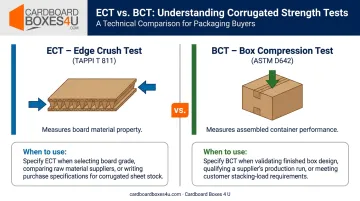
Two tests matter here, and they measure different things:
- ECT (Edge Crush Test) per TAPPI T 811 measures the compressive strength of a corrugated board specimen — it's a material property, not a finished-box load rating
- BCT (Box Compression Test) per ASTM D642 measures the actual compression resistance of the assembled container — this is the number that tells you what the box can support in a real stack
Use ECT to compare board grades. Use BCT — or the manufacturer's tested stack limit — to determine whether a specific Gaylord is appropriate for a given stack height and load weight. If a supplier can't provide BCT data, ask for it before committing to a stacking application.
Weight distribution within each box:
- Place the heaviest items at the bottom of the box
- Center the load — no single side should carry a disproportionate weight
- Lateral lean in a loaded box transfers uneven force to adjacent tiers
Pallet inspection before stacking:
A compromised pallet undermines everything above it. Check for:
- Broken or cracked deck boards
- Missing or damaged stringers
- Warped or uneven surfaces
- Protruding fasteners that could damage the box base
Any of these conditions should disqualify the pallet.
Safety While Stacking and Operating with Gaylords
OSHA 29 CFR 1910.176(b) states: "Storage of material shall not create a hazard. Bags, containers, bundles, etc., stored in tiers shall be stacked, blocked, interlocked and limited in height so that they are stable and secure against sliding or collapse."
In practical terms, this means:
- Gaylords must always be on pallets, not stacked on bare floor
- Stacks must be plumb and vertically aligned — not leaning
- Height must be limited to what the lowest box's compression rating can safely support under actual load conditions
Stack height guidance:
OSHA sets no universal tier count. Allowable height depends on box design, wall construction, load weight, box condition, and environmental factors. Some manufacturer-specified double- and triple-wall Gaylord designs are rated for three tiers; some heavy-duty engineered designs support four.
Neither number applies automatically to a different box. Always use the tested limit for your exact container and conditions, and verify stability at each tier before adding the next.
As a conservative baseline: most loaded corrugated Gaylords should not exceed two to three tiers. Reduce that further for aged boxes, heavy contents, or elevated humidity.
Interlocking technique:
Where box geometry allows, stagger each tier slightly — similar to brick-laying — to improve lateral stability and reduce the risk of the stack shifting as a single column.
Mechanical handling equipment:
NIOSH's Revised Lifting Equation starts at a 51-lb load constant under ideal conditions and drops as task factors worsen. BLS data shows musculoskeletal disorders accounted for 30% of private-industry days-away-from-work cases, the category most directly tied to repeated manual handling. Move loaded Gaylords with forklifts or pallet jacks. Manual handling of bulk containers is not a workaround.
Environmental and Storage Safety Considerations
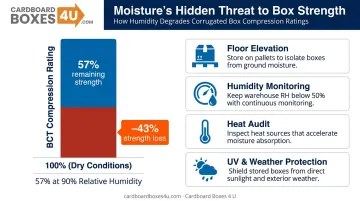
Moisture is the most significant environmental threat to corrugated stacking performance. A 2024 ASTM Journal study found that at 90% RH, corrugated compression strength drops to 0.57 of its rated value — meaning a box loses more than 40% of its dry-condition BCT rating in a high-humidity environment.
Environmental factors to control:
- Never store Gaylords directly on concrete — the floor wicks moisture from below and degrades the box base; pallet or rack elevation is required
- Control or monitor relative humidity in storage zones; at elevated humidity, reduce stack height or switch to moisture-resistant corrugated
- Audit storage areas for high heat before designating them for stacked Gaylords — excessive temperature weakens corrugated adhesives
- Avoid long-term outdoor or skylight-exposed storage without weatherized packaging; prolonged UV exposure degrades board fibers over time
For operations storing Gaylords in variable or humid environments, Cardboard Boxes 4 U offers MIL-SPEC weather-resistant corrugated options — including V3C and W5C configurations that meet ASTM D5118 and comply with WRA and MPA water resistance standards. These are available in bulk and Gaylord-compatible formats for applications where standard corrugated would face moisture-related strength loss.
Long-term storage consideration:
Standard corrugated Gaylords handle short-to-medium-term use well. Extended storage in variable conditions accelerates degradation. If the storage duration or environment is uncertain, evaluate weatherized treatment or heavier wall constructions before assuming standard boxes will hold up.
Common Safety Mistakes to Avoid
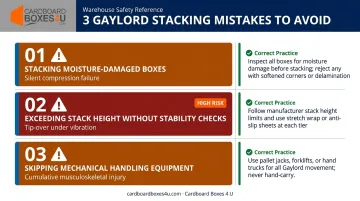
Three mistakes account for a disproportionate share of Gaylord stacking incidents:
1. Stacking boxes with moisture damage or structural wear
A softened wall doesn't look dangerous — but it has lost much of its load-bearing capacity. The damaged box gradually buckles under load rather than giving obvious warning before collapse — that's compression failure without visible signs. Inspect before every use, not just before the first use.
2. Exceeding recommended stack height or skipping tier-by-tier stability checks
The tendency is to keep adding tiers without re-evaluating the stack. Top-heavy configurations tip under minor vibration from nearby forklift traffic or operating machinery. Check plumb and lateral stability before each additional tier goes on.
3. Bypassing mechanical handling equipment because it feels slower
A worker may handle a partially-loaded Gaylord once without incident. Repeated manual handling across a full shift, or week after week, accumulates the ergonomic stress that leads to musculoskeletal injury. Those few saved minutes per load rarely show up on any incident report — until they do.
Conclusion
Safe Gaylord box stacking depends on getting the box specification right for the load, applying correct technique at every tier, and keeping storage conditions within the range that corrugated is rated to handle. These aren't independent checkboxes — cut one corner and the risk compounds across the entire stack.
Treat these guidelines as part of standard operating procedure and worker onboarding — not as a reference document pulled out after an incident. When the process is built into daily routine and covered during onboarding, failures from improper stacking — collapsed loads, damaged inventory, worker injuries — stop being surprises and start being preventable.
Frequently Asked Questions
Can you stack Gaylord boxes?
Yes. Gaylord boxes are designed for stacking. Safe stacking requires a pallet base, load weight within the stacking strength rating of the lowest box, and appropriate environmental conditions. Never stack directly on the floor or exceed the tested compression limit of the box.
How high can you stack Gaylord boxes?
Maximum height depends on wall construction, load weight, box condition, and humidity. As a general guideline, most loaded corrugated Gaylords should not exceed two to three tiers; that number drops with heavy contents, older boxes, or elevated moisture. Always follow the manufacturer's tested limit for your specific container.
How much weight can a Gaylord box hold when stacked?
Weight capacity varies by wall construction and board grade. Single-wall, double-wall, and triple-wall designs carry progressively higher compression loads. The stacking weight capacity of the lowest box in the stack is the binding constraint. BCT ratings, not just ECT values, reflect actual assembled-box performance.
What does OSHA say about stacking boxes in a warehouse?
OSHA 29 CFR 1910.176(b) requires that materials stored in tiers be stacked, blocked, interlocked, and height-limited so they remain stable against sliding or collapse. OSHA sets no fixed tier count. The requirement is stability, and every stack must be assessed against that standard.
How do you prevent Gaylord box stacks from collapsing?
Inspect every box before stacking, use pallets, stay within the manufacturer's tier limit, ensure even weight distribution inside each box, and position stacks away from forklift lanes and vibration sources. Conduct stability checks between tiers.
Does moisture affect how well corrugated Gaylord boxes stack?
Significantly. At 90% relative humidity, corrugated compression strength can fall to roughly 57% of its standard-condition rating, meaning a stack that appears safe at capacity can become unstable as humidity rises. Moisture-resistant corrugated options with WRA/MPA-compliant constructions are available for high-humidity storage environments.