Choosing the wrong wall construction doesn't just risk product damage. It affects stacking integrity in the warehouse, compression strength under pallet loads, and the cost of every damage claim that follows. For buyers sourcing at volume — distributors, manufacturers, government procurement teams — those downstream costs far outpace any savings on a cheaper box.
This article breaks down how 3-ply and 5-ply corrugated boxes are built, where each performs reliably, and how to match wall construction to your actual shipping conditions.
Key Takeaways
- 3-ply (single wall) = 2 liners + 1 fluted medium; designed for lightweight goods on short-haul routes
- 5-ply (double wall) = 3 liners + 2 fluted mediums; built for heavier loads, stacking, and multi-point freight
- Weight, stacking height, and transit complexity are the three factors that drive ply selection
- Mismatching ply to load costs more than upgrading — the wrong box fails in transit or wastes budget on unnecessary strength
- Both formats are available in specialty configurations — including MIL-SPEC and weatherized options for government and industrial procurement
3-Ply vs 5-Ply Corrugated Boxes: Quick Comparison
| Factor | 3-Ply (Single Wall) | 5-Ply (Double Wall) |
|---|---|---|
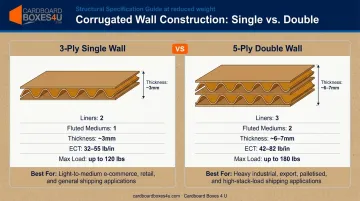
| Construction | 2 liners + 1 fluted medium | 3 liners + 2 fluted mediums |
| Approximate Thickness | ~3mm | ~6–7mm |
| Typical Weight Range | Up to ~65–120 lbs (grade-dependent) | Up to ~80–180 lbs (grade-dependent) |
| ECT Range | 32–55 lb/in | 42–82 lb/in |
| Stacking Strength | Adequate for light warehouse loads | Handles multi-high stacking without deformation |
| Cost | Lower per-unit | Higher upfront, offset by fewer damage claims |
| Best For | Retail, light e-commerce, FMCG | Industrial, electronics, government, palletized freight |
A note on weight capacity: Corrugated board specifications from the Fibre Box Association show grade-dependent overlap: a high-grade single wall can reach 120 lbs maximum gross weight, while lighter double wall grades start at 80 lbs. Wall count alone doesn't determine capacity. Paper grade (GSM/basis weight), box dimensions, and ECT rating all contribute.
What Is a 3-Ply Corrugated Box?
A 3-ply corrugated box — called single wall corrugated in most industry and procurement contexts — consists of two flat linerboard sheets (outer and inner liner) bonded to a single fluted paper medium. The flute itself functions as a series of small arches running the length of the board, absorbing impact shock and distributing pressure across the wall.
Performance Characteristics
Single wall board is lightweight, folds cleanly, and prints well. It ships flat efficiently, which matters for high-volume storage and inbound freight costs. For surface protection and minor impact resistance, it performs adequately.
What it doesn't do well is carry sustained compression loads. Under warehouse stacking or repeated freight handling, the single wall can deform — particularly without an interior support structure.
How Flute Profile Changes the Game
Within 3-ply construction, flute choice has a significant effect on performance. According to the Fibre Box Association:
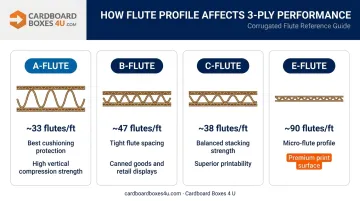
- A-flute (~33 flutes/ft): larger profile, more cushioning, higher vertical compression
- B-flute (~47 flutes/ft): tighter spacing, good for canned goods and point-of-sale displays
- C-flute (~38 flutes/ft): best balance of stacking strength and printability
- E-flute (~90 flutes/ft): very small profile, excellent print surface for retail packaging
A C-flute 3-ply box stacks better than E-flute. E-flute prints better. Bottom line: specifying flute type on your purchase order is as important as specifying wall count.
Where 3-Ply Works Best
- Lightweight retail goods: clothing, accessories, books, small consumer items
- Light e-commerce orders shipped direct-to-consumer via courier
- Light industrial components and manufactured parts with low weight requirements
- High-volume FMCG and CPG applications where cost efficiency drives format
Where 3-Ply Falls Short
Single wall is the wrong choice when:
- Products exceed ~15 lbs
- Boxes will be stacked more than two or three high
- Shipments travel multi-transfer freight routes
- High burst or compression strength is a specification requirement
Adding foam or bubble wrap inside doesn't fix a wall that can't handle the load. When compression strength is the requirement, the answer is a heavier wall construction — not more interior fill.
What Is a 5-Ply Corrugated Box?
Double wall corrugated — the industry standard term for what's commonly called 5-ply — adds a second fluted medium and a third linerboard to the wall structure. That second fluted layer doubles the arch structure running through the board, which is where the strength increase actually comes from.
Performance Characteristics
The difference in measurable performance is significant. Where single wall ECT grades run from 32 to 55 lb/in, double wall grades run from 42 to 82 lb/in per the same FBA-derived benchmark table. At the upper end, that's more than double the edgewise compression resistance.
Box compression test (BCT) values — which measure the completed box, not just the board — depend on dimensions, creasing, humidity, and load conditions, so there's no single number that applies universally.
What holds across applications: double wall construction maintains structural integrity under warehouse stacking loads and resists puncture and deformation during multi-point freight handling in ways single wall cannot.
Specialty Configurations for Government and Defense
5-ply isn't just one product. Double wall corrugated can be produced in government and military specification formats. Under MIL-STD-2073, the relevant packaging codes include:
- E8: ASTM D5118, Type CF, domestic, double-wall corrugated
- NO: ASTM D5118, Type CF, weather-resistant, double-wall corrugated
For buyers in defense or institutional procurement, the contract's packaging code determines the required construction — not a general assumption that "double wall" covers the requirement. Always verify the specific ASTM edition and code before sourcing.
Cardboard Boxes 4 U stocks V11C double wall corrugated — a 600 PSI burst strength configuration meeting ASTM D4727 — alongside V3C and W5C single wall government-spec formats. Their catalog also includes weatherized coated configurations meeting both ASTM D4727 and ASTM D5118 standards, which cover moisture resistance requirements for outdoor storage and humid transit conditions.
Where 5-Ply Works Best
- Electronics and electronic assemblies requiring ESD protection or puncture resistance
- Industrial components, auto parts, and manufacturing hardware
- Aerospace and defense hardware shipments
- Government and military procurement (per contract packaging codes)
- Any product being palletized, warehouse-stacked, or routed through multiple freight handlers
- Heavy retail goods: appliances, power tools, equipment
The Weight and Cost Tradeoff
Double wall adds material weight per box, which can marginally increase freight cost per unit. For most applications, lower damage claim rates and reduced return processing costs absorb that difference. Total landed cost — not box unit price — is the right number to compare.
3-Ply vs 5-Ply: Which Should You Choose?
The decision comes down to four variables:
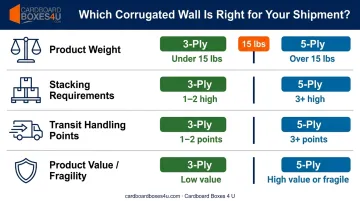
- Product weight — Under ~15 lbs, 3-ply is typically sufficient. Over 15 lbs, evaluate double wall grades based on the specific ECT and box dimensions required.
- Stacking requirements — Any multi-high warehouse stacking favors 5-ply. Single wall construction deforms under sustained compression loads.
- Transit distance and handling points — Longer routes with more transfers mean more cumulative stress. Double wall is the appropriate choice when a shipment touches more than two or three handling points.
- Product fragility and value — A single damage claim on a high-value shipment typically costs far more than upgrading the entire run to a stronger wall spec.
Situational Guidance
Choose 3-ply when:
- Packaging lightweight consumer goods for short courier delivery
- Cost efficiency is the primary driver and stacking loads are minimal
- Volume is high and product weight stays consistently under 15 lbs
Choose 5-ply when:
- Shipping industrial components, electronics, or goods routed through palletized freight
- Products will be warehouse-stacked more than two or three high
- Compliance requirements specify ASTM D5118 or equivalent double wall construction
- Recurring transit damage suggests the current box wall isn't handling the load
Compliance and Certification
Certain procurement categories — government contracts, military specifications, aerospace supply chains — require corrugated boxes to meet specific ASTM standards. In these cases, a certified 5-ply configuration such as ASTM D5118 E8 or NO code is the appropriate specification. A commercial double wall box without certification doesn't satisfy a contract requirement that calls for a specific code.
Cardboard Boxes 4 U offers certification and compliance documentation for MIL-SPEC orders. For defense or government sourcing, confirm documentation requirements with their team before placing an order.
Real-World Scenarios: 3-Ply vs 5-Ply in Practice
Scenario 1: E-Commerce Operation Experiencing Recurring Damage
An e-commerce fulfillment operation ships mid-weight goods — averaging 12–18 lbs per order — using standard single wall corrugated. Products travel through two or three carrier transfers before reaching the customer. Damage claims are running consistently, and the internal assumption is that void fill needs improvement.
The actual issue is that the box wall isn't holding compression under stacking in carrier sort facilities. Adding more bubble wrap doesn't change what happens to the box exterior under a 40 lb stack. Upgrading to a double wall configuration — matching the ECT grade to the box dimensions and gross weight — is the structural fix. Interior cushioning handles impact. Wall construction handles compression.
Crushed corners and bulging sidewalls are diagnostic signals that the ply selection doesn't match the actual transit load. These aren't cushioning problems. They're structural ones.
Scenario 2: Electronics Manufacturer with Government Contract Requirements
An electronics distributor receives a defense procurement contract requiring corrugated packaging that conforms to ASTM D5118. The contract packaging code specifies weather-resistant double wall construction. A standard commercial double wall box without certification doesn't meet the requirement.
This is where specialty 5-ply configurations become the practical answer. Cardboard Boxes 4 U's V11C double wall format (600 PSI burst strength, ASTM D4727 compliant) and their weatherized coated configurations — which meet both ASTM D4727 and ASTM D5118 — are built for exactly these applications. For ESD-sensitive assemblies, they also carry conductive black corrugated boxes engineered to resist static discharge.
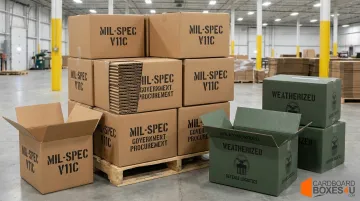
For buyers navigating government or defense procurement, working with a supplier that has certification documentation ready eliminates compliance risk. Sourcing a generic commercial double wall and hoping it qualifies is not a viable path when a contract is on the line.
Cardboard Boxes 4 U carries over 1,300 corrugated box sizes, including specialty government-spec formats (V3C, W5C, V11C), hard-to-find configurations, and custom manufacturing with 7–14 day lead times. Minimum orders start at 100 pieces. Contact their team at 888-333-9513 or Sales@cardboardboxes4u.com to match the right wall construction to your application.
Conclusion
3-ply and 5-ply corrugated aren't ranked against each other — they're matched to different jobs.
- 3-ply (single wall) suits lightweight, cost-sensitive, short-haul shipments where stacking loads are minimal and courier delivery is the primary channel.
- 5-ply (double wall) is the better fit when product weight, transit complexity, stacking requirements, or compliance specifications exceed what single wall board can reliably handle.
Getting this decision right reduces transit damage, lowers return and replacement costs, supports warehouse stacking efficiency, and ensures the packaging meets the specification standards that industrial, government, and defense procurement actually requires.
Frequently Asked Questions
What is the difference between 3-ply and 5-ply corrugated boxes?
3-ply (single wall) consists of 2 linerboards bonded to 1 fluted medium. 5-ply (double wall) adds a second fluted medium and third liner, making it approximately twice as thick with significantly higher compression and burst strength ratings.
What is a 5-ply corrugated box?
A 5-ply box uses double wall corrugated construction: three flat linerboards with two inner fluted layers. It's the standard specification for heavier loads, warehouse stacking, and industrial or long-distance shipping where single wall board would deform under compression.
How thick is a 3-ply corrugated box?
3-ply single wall board typically measures approximately 3mm, though the exact caliper varies by flute profile. A-flute is thicker; E-flute is thinner. Always specify the flute type when exact thickness matters for your packaging line or machinery.
Which is stronger — 3-ply or 5-ply corrugated?
5-ply is substantially stronger. Double wall construction delivers ECT values ranging from 42 to 82 lb/in, compared to 32 to 55 lb/in for single wall grades, and its compression resistance makes it suitable for stacking applications where single wall board would deform or collapse.
When should I upgrade from 3-ply to 5-ply corrugated boxes?
Upgrade when products exceed approximately 15 lbs, boxes will be stacked more than two or three high, shipments travel through multiple freight handling points, or recurring transit damage (crushed corners, bulging walls) signals the current wall construction isn't handling the actual load.
Are corrugated boxes recyclable?
Both 3-ply and 5-ply corrugated boxes are recyclable. AF&PA reported that 69%–74% of cardboard available for recovery was recycled in the US in 2024. Note that wax-treated or coated boards require recyclability certification; standard kraft corrugated in both wall counts processes through normal corrugated recycling streams.