
Confusing MIL-SPEC with the loosely used "military grade" marketing label can cause real procurement problems: compliance failures, rejected shipments, and contract violations that carry financial penalties.
This article cuts through the confusion. You'll learn exactly what MIL-SPEC means, how it differs from MIL-STD and "military grade" marketing claims, and what compliance actually requires — including documentation.
Key Takeaways
- MIL-SPEC is a numbered DoD document, not a general quality label — compliance requires documentation, not just a claim
- MIL-STD governs processes and methods; MIL-SPEC governs product characteristics — both are distinct document types
- "Military grade" has no official definition and requires no testing or verification to use
- Canceled MIL-SPECs are often replaced by ASTM, SAE, or IEEE standards — always verify status before specifying
- Government packaging contracts require documented compliance — standard commercial boxes are not acceptable substitutes
What Does MIL-SPEC Stand For?
MIL-SPEC stands for Military Specification — a formal acquisition document issued by the U.S. Department of Defense that states essential technical requirements for purchased materials or products, along with the criteria for determining whether those requirements are met.
DoDM 4120.24 defines a defense specification as applying to military-unique materiel or substantially modified commercial items. This is a precise, enforceable definition — not a general quality claim.
How to Read a MIL-SPEC Document Number
MIL-SPEC documents follow a structured naming convention:
- Current performance specifications use MIL-PRF-[number]
- Current detail specifications use MIL-DTL-[number]
- Older unrevised specifications may retain subject-letter prefixes like MIL-C (cables) or MIL-W (wire)
- First-issue documents carry no revision letter; later revisions add capital letters (A, B, C...)
- Amendments and notices are numbered consecutively
So a number like MIL-DTL-117 tells you it's a detail specification, and you can track its revision history directly in the DoD's ASSIST database.
What MIL-SPEC Compliance Actually Requires
Meeting a MIL-SPEC does not automatically mean a product is superior to commercial alternatives. It means the product satisfies a defined set of requirements. That's it. Some specifications were written decades ago and have since been surpassed by commercial standards.
What compliance does require:
- A specific, named document number and revision
- Test reports, certification sheets, or official compliance documentation
- Verification that the specification is still active (not canceled or superseded)
Labeling a product "MIL-SPEC" without a cited document number and supporting evidence carries no weight in procurement. Any legitimate claim requires traceable documentation.
MIL-SPEC vs. MIL-STD: Key Differences Explained
These two document types are related but serve distinct functions. Mixing them up is a common mistake — one that can create serious sourcing errors.
The Four Main DoD Document Types
| Document | Function |
|---|---|
| MIL-SPEC | Essential technical requirements for military-unique or modified commercial materiel |
| MIL-STD | Uniform engineering or technical criteria, methods, processes, and practices |
| MIL-PRF | Required results and verification criteria — without specifying how to achieve them |
| MIL-DTL | Prescribes specific design, materials, fabrication, or construction details |
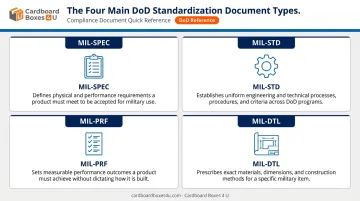
When sourcing components, the MIL-PRF vs. MIL-DTL distinction is critical: a performance spec lets manufacturers choose their own approach to meet requirements, while a detail spec locks in exactly which materials and methods to use.
The Five Categories of MIL-STD Documents
Each MIL-STD document belongs to one of five categories, which determines how it applies to design, production, and testing:
- Interface standards — compatibility between systems
- Design criteria standards — engineering requirements for design
- Manufacturing process standards — how to build something
- Standard practices — uniform procedural requirements
- Test method standards — how to verify performance
MIL-STD-130, for example, is an active test standard that defines identification marking requirements for U.S. military property (last updated August 26, 2019).
Checking Current Status
Knowing the category doesn't guarantee a document is still active. Some MIL-SPECs and MIL-STDs have been canceled and replaced by commercial standards — MIL-STD-498 (software development), for instance, was canceled in 1998 and superseded by IEEE/EIA 12207. Citing a canceled spec in a contract can create compliance gaps, so always verify current status using the DoD ASSIST QuickSearch database before referencing any document number.
"Military Grade" vs. MIL-SPEC: Cutting Through the Marketing
This distinction has direct consequences for procurement buyers.
"Military grade" is a marketing term. There is no official DoD definition for it, no document class called "military grade" in the Defense Standardization Program, and no independent body certifying products that carry the label. As Consumer Reports noted in 2022, manufacturers can select their own tests and parameters — which means the claim is essentially self-defined.
MIL-SPEC is a named document with verifiable, enforceable requirements — a designation backed by specific test protocols, not a manufacturer's own benchmarks.
You'll see "military grade" applied to industrial equipment, packaging materials, tool storage, and countless other products. Unless a specific MIL-SPEC number accompanies the claim, it provides no assurance of performance, durability, or safety. That gap matters most when contractual compliance is on the line.
Why This Matters for Government Contractors
Government contracts specify exact document numbers. A contract calling for MIL-DTL-117 heat-sealable bags cannot be fulfilled with a product that only claims to be "military grade." Non-compliant materials result in contract violations, product rejection, or financial penalties.
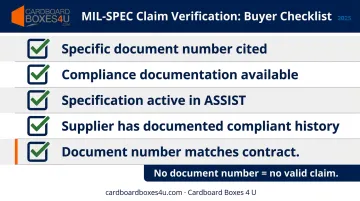
Buyer Checklist: MIL-SPEC Claim vs. Marketing Language
Before accepting any MIL-SPEC claim from a supplier, verify:
- A specific MIL-SPEC, MIL-STD, MIL-PRF, or MIL-DTL document number is cited
- Test reports or compliance documentation are available on request
- The cited specification is still active in ASSIST (not canceled)
- The supplier has a documented history of compliant deliveries
- The document number matches what your contract actually requires
A Brief History of Military Standards
Understanding why MIL-SPEC exists makes the system easier to navigate.
WWII and the Standardization Problem
The Army's official logistics history documents the procurement chaos of World War II: duplicated organizations, inconsistent equipment nomenclature, numerous models of similar items, and the resulting burden on maintenance and spare-parts supply. Standardization and cross-referencing emerged as the practical solution — parts needed to be interchangeable across manufacturers and supply chains.
The 1952 Unification and Later Reform
Public Law 82-436, passed in 1952, created a unified defense cataloging and standardization program specifically aimed at eliminating overlapping specifications and reducing unnecessary variety in parts and materials.
By the late 1980s and 1990s, the system had grown to encompass tens of thousands of documents. On June 29, 1994, Secretary of Defense William J. Perry directed DoD to prioritize performance specifications and non-government standards wherever practical, treating military specifications as a last resort requiring a formal waiver.
Many MIL-SPECs were subsequently canceled, with ASTM, SAE, and IEEE standards replacing them. That reform still shapes procurement today. Several industries continue referencing original MIL-SPEC frameworks, and many current commercial standards trace directly back to those canceled specifications:
- Aerospace and defense contracting — where original MIL-SPEC tolerances remain the benchmark
- Specialty packaging — including military-grade corrugated containers that reference ASTM D5118 and ASTM D4727
- Electronics manufacturing — where MIL-SPEC-derived standards govern materials and testing protocols
MIL-SPEC Packaging: What Procurement Buyers Need to Know
Packaging is one of the most commonly overlooked areas where MIL-SPEC requirements create sourcing headaches for procurement buyers. Government and military contracts frequently specify packaging performance , not just box dimensions.
The Standards That Govern Military Packaging
Four documents form the core of military packaging compliance:
| Document | What It Covers |
|---|---|
| MIL-STD-2073 | Standard practice for military packaging processes and documentation |
| MIL-DTL-117 | Heat-sealable preservation bags (Active; updated August 29, 2019) |
| ASTM D4727 | Corrugated and solid fiberboard sheet stock — material specification |
| ASTM D5118 | Fabrication of fiberboard shipping boxes — manufacturing practice |
These documents are complementary, not interchangeable. ASTM D4727 governs the fiberboard material itself; ASTM D5118 governs how that material is fabricated into a box. A contract may reference both, either, or neither, so reading the actual solicitation language is essential.
Government-Grade Corrugated: V3C, W5C, and V11C
Standard commercial corrugated boxes are not acceptable substitutes when a contract specifies government-grade packaging. The grades used in military and government applications have specific material requirements and bursting strength ratings that most commercial suppliers don't stock.
Here's how the three main MIL-SPEC corrugated grades compare:
| Grade | Wall Type | Bursting Strength | Key Feature |
|---|---|---|---|
| V3C | Single Wall | 400 PSI | High strength + WRA/MPA water resistance |
| W5C | Single Wall | 275 PSI | Weather-resistant (WR) construction |
| V11C | Double Wall | 600 PSI | Maximum strength for heavy-duty applications |
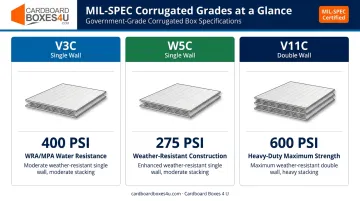
The V3C grade is fabricated from 350# Test corrugated material conforming to ASTM D4727, making it the highest-strength single-wall option for government applications. The W5C is engineered for weather and moisture resistance, critical for outdoor storage or field logistics.
The V11C's double-wall construction at 600 PSI suits heavy or high-value equipment that requires maximum crush resistance during long-term storage or transport.
Cardboard Boxes 4 U stocks all three grades, certified to ASTM D4727 and ASTM D5118. The V3C line includes over 191 stock sizes, with custom configurations available in 10–14 business days. W5C grades are also stocked as trimmed corrugated sheets (19" x 48") for operations that fabricate their own containers.
Documentation Is Non-Negotiable
For government contracts, the packaging documentation is as important as the packaging itself. DLA directs vendors to read solicitation or award language carefully and decode packaging requirements according to MIL-STD-2073 Appendix J. Having compliance records on file protects buyers in audits and contract disputes.
Procurement buyers should request from their packaging supplier:
- Compliance documentation referencing the specific ASTM or MIL-SPEC document
- Test reports or certificates of conformance
- Specification reference numbers and revision levels
- Records confirming weather resistance ratings (WRA/MPA compliance where applicable)
For buyers sourcing government-spec corrugated, contact Cardboard Boxes 4 U at 888-333-9513 or Sales@cardboardboxes4u.com to request compliance documentation for V3C, W5C, or V11C products.
Frequently Asked Questions
What does MIL-SPEC stand for?
MIL-SPEC stands for Military Specification — a formal DoD document defining the essential technical requirements a product must meet for military use. Compliance requires documented proof, including test reports and a specific named document number. A label alone means nothing.
What is the difference between military grade and MIL-SPEC?
"Military grade" is an unregulated marketing term with no official definition, no required testing, and no verification process. MIL-SPEC refers to a specific, numbered DoD document with measurable requirements. Compliance must be demonstrated through documentation — not claimed through marketing language.
Can civilians buy MIL-SPEC products?
Yes. Many MIL-SPEC components are widely used in commercial industries, including aerospace, automotive, and construction. The ASSIST database makes most specifications publicly accessible. Not every product marketed as "military grade" actually meets a specific MIL-SPEC standard, though. The two terms are not interchangeable.
Are all AR-15s MIL-SPEC?
No. The term is used by manufacturers to indicate that specific components — such as the buffer tube or trigger group dimensions — meet U.S. military dimensional specifications. The rifle as a whole may vary significantly. Buyers should confirm exactly which components are cited as MIL-SPEC and what document they reference.
What are the different types of MIL-SPEC documents?
The DoD standardization system uses five main document types:
- MIL-SPEC — product requirements
- MIL-STD — engineering and process standards
- MIL-PRF — performance specifications
- MIL-DTL — detail specifications
- MIL-HDBK — reference handbooks
Each serves a distinct function and applies to different stages of procurement.
Does MIL-SPEC apply to packaging materials?
Yes. Military packaging requirements cover compression strength, moisture resistance, and shock protection. For corrugated packaging, buyers should look for products certified to ASTM D4727 (material standard) and ASTM D5118 (fabrication standard), with government-grade designations like V3C, W5C, or V11C confirming the specific performance tier.